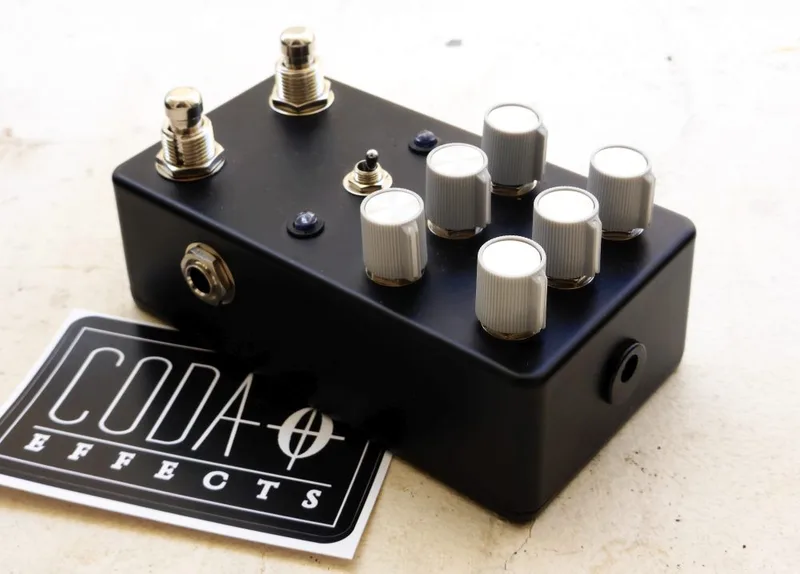


The Coda Effects Montagne Tremolo is a tremolo pedal made in France, built to reproduce one of the first guitar effects ever: the volume throb of tremolo. Coda Effects describes it as an analog tremolo with tap tempo, one that can provide vintage, smooth, tube-like tremolos but can also create choppy, extreme sounds1.
What makes it unusual is how it gets there. The audio signal path is fully analog, but the low-frequency oscillator (LFO) that drives the effect is a digital chip, the Electric Druid TAPLFO2D. That hybrid design is what allows tap tempo, something a purely analog LFO cannot easily do2.
What it does to your sound
Tremolo raises and lowers the volume of your signal in a repeating cycle, and the Montagne covers the full range of what that can mean. Coda Effects says it can provide vintage, smooth, tube-like tremolos, the kind of gentle throb associated with older amplifier circuits, but that it can also create choppy, crazy sounds when pushed1.
The Depth knob sets how far the volume swings: from a very subtle shimmer in the background to a huge, choppy tremolo that cuts the signal almost completely between pulses2. A Symmetry knob lets you modulate the waveform itself, which Coda Effects presents as adding versatility beyond a standard sine-shaped throb1. An external Volume control lets you adapt the effect level to your setup or even use the pedal as a boost1.
The controls
The finished pedal carries four controls to modulate the effect, plus two footswitches1. The original prototype design used six potentiometers, reflecting how many parameters the TAPLFO2D chip exposes2.
| Control | What it does |
|---|---|
| Depth | Sets the tremolo's deepness, from very subtle to huge and choppy2 |
| Symmetry | Modulates the waveform for more versatility1 |
| Volume | Adapts the effect to your setup, or boosts the signal1 |
| Temporary switch | Makes the effect active only while you hold it1 |
The two footswitches are the tap tempo switch on the right side and the bypass switch. The Temporary switch is a performance feature: hold it and the effect engages for as long as you want, then releases when you let go1.
The TAPLFO2D chip behind these controls offers more than the panel shows. Its pin functions include a tap tempo input, a PWM output that drives the LFO's LED, a tempo CV for division rate, a waveform selection input, a tempo multiplier with six possibilities, a level CV tied to the depth knob, and a wave distort CV tied to the symmetry knob2.
How the circuit works
The signal path is deliberately simple. Coda Effects used a double op amp, a TL072, with the guitar signal modulated by an LDR (a light-dependent resistor, in a vactrol package) that is driven by an LED. The TAPLFO2D generates the LFO and blinks that LED, and the vactrol's resistance changes with the light, smoothly attenuating the signal in time with the waveform2.
The TAPLFO2D itself is a digital LFO PIC microcontroller for audio circuits, sold by Electric Druid, the company of Tom Wilshire2. Because tap tempo requires digital circuitry, the chip is the reason the pedal can offer it at all2.
Bypass and switching
The Montagne uses a relay-based true bypass with an anti-pop system, which Coda Effects calls an absolutely silent true bypass switching system1. In the prototype documentation, the maker describes the relay bypass as completely silent and more reliable than a classic 3PDT true bypass switch2. For a player, that means no loud click when switching the effect on and off, and no mechanical footswitch wear over time.
Where it came from
The Montagne began as a DIY project. In May 2016, the author of Coda Effects documented a tap tempo tremolo he had been prototyping for nearly six months, and explained the name2:
"I called it \"Montagne\" which means \"mountain\" in french, like the shape of the waveforms"2
Coda Effects, 20162
The 2016 post describes a second prototype. The first version had no relay bypass, suffered from noise issues, and used a different PCB; at least five versions of the PCB were designed along the way2. The design also used a compact 1P6T Alpha rotary switch, adapted through a custom PCB with connectors, to keep the pedal small2.
The finished product packs all of this into a small, pedalboard-friendly 125B enclosure1.
The Montagne draws around 100mA at 9V DC, center negative1. That is higher than many simple analog tremolos, so make sure your pedalboard power supply has an output that can cover it.
Videos
Loïc Bronner
Benoit M
Questions
Is the Coda Effects Montagne Tremolo true bypass?
Yes. It uses a relay-based true bypass system with an anti-pop circuit, which Coda Effects describes as an absolutely silent switching system. The relay design is also presented as more reliable than a classic 3PDT true bypass switch, and it avoids the loud click those switches can make.
What power supply does the Montagne Tremolo need?
It runs on a standard 9V DC power supply with a center negative plug, the same arrangement as most modern pedals, so it fits a typical pedalboard power supply. It draws around 100mA, which is more than a simple analog tremolo, so it is worth checking that an isolated output can cover that.
Is the Montagne Tremolo analog or digital?
Both, in a hybrid arrangement. The audio signal path is fully analog, built around a TL072 op amp that modulates the signal through a vactrol. The control side is digital: an Electric Druid TAPLFO2D chip generates the LFO, which is what makes tap tempo possible.
Does the Coda Montagne have tap tempo?
Yes. Tap tempo is one of its two footswitches, on the right side of the pedal. Tapping sets the speed of the tremolo in real time, and the TAPLFO2D chip also offers tempo division and multiplication options, plus a choice of waveforms.
Where is the Coda Effects Montagne made?
It is made in France by Coda Effects. The project began as a DIY tap tempo tremolo design documented by the maker in 2016, and the finished pedal is built in a 125B enclosure sized for pedalboard use.
Sources (2)
- Coda Effects, Coda Effects, 2026
- Coda Effects, Coda Effects (www.coda-effects.com), 2016-05