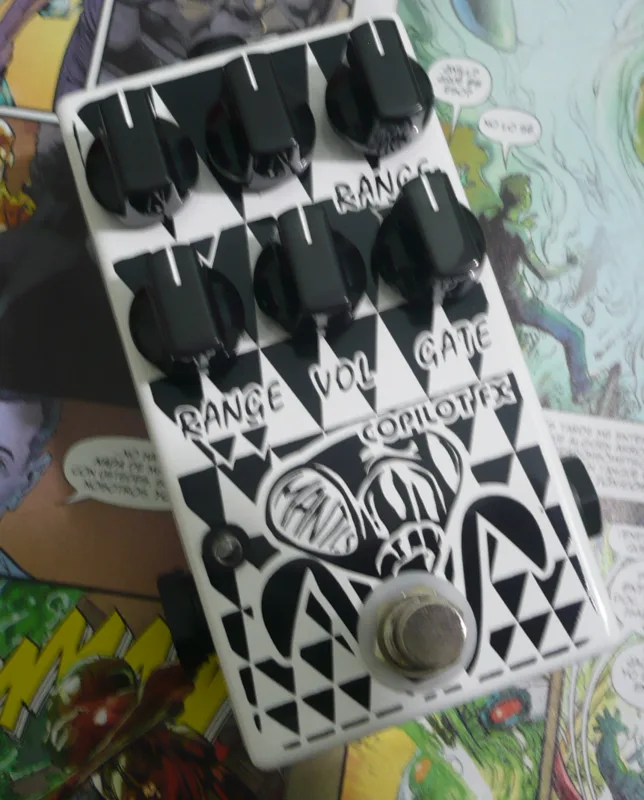


The Copilot Fx Mantis is, in the maker's words, "a multivoice octave down square wave fuzz": a fuzz pedal in the fuzz family that generates square wave octave-down voices alongside a straight fuzz voice. The revamped version offers three voices: straight fuzz, one octave down, and two octaves down1. Copilot FX describes it as an octave and fuzz pedal whose controls set "amount of octave fuzz to the overall balance of the output"2.
Controls
| Control | What it does |
|---|---|
| Vol | Unison fuzz volume1 |
| Range ▼ | Pulse width amount of the one octave down voice1 |
| Gate | Input sensibility1 |
| Exp / CV Jack | External control of the pulse widths of both octave down voices, via TRS expression pedal or 0-5V CV signal1 |
The manual also describes a RANGE control that sets the pulse width of an octave down voice and is disengaged when an expression pedal or CV source is plugged in. The two documents in the manual disagree on whether this knob governs the one octave down voice or the two octaves down voice, so both readings stand2.
Plugging an expression pedal or CV source into the Exp/CV jack takes over the pulse width control of the octave down voices, disengaging the front-panel knob for that function12.
Power and connections
The Mantis is powered only by a DC 9V power jack with center negative polarity, and there is no battery option1. The manual specifies a supply of 15mA or higher2. Connections are straightforward:
- Input jack: signal from your instrument or output from another pedal2
- Output jack: signal to your amplifier or input to another pedal2
- Exp/CV jack: TRS expression pedal or 0 to 5V CV signal1
Because there is no battery option, the pedal needs a 9V center negative supply rated for at least 15mA on your board's power supply2.
Expression and CV control
The Exp/CV jack gives external control of the pulse width of the octave down voices, accepting either a TRS expression pedal or a 0 to 5V CV signal1. The manual names the Copilot FX Broadcast, Broadband or Bandwidth as compatible external controllers for control and modulation of this function2. For players who want their octave voices to sweep and move under foot control rather than sitting at one fixed pulse width, this is the Mantis's main performance feature.
Tracking
The manual is direct about how the pedal behaves with chords and note changes: "Tracking: the pedal is monophonic, so it only tracks one note at a time." It advises muting strings and notes when starting the next note so previous harmonic content does not interfere, otherwise the pedal will glitch2. That gated, glitchy character is part of the design rather than a fault: Parasit Studio, whose related one-knob design the Thundering Mantis is described as "a glitchy and gated octave fuzz in a simple to use one-knob format," markets the same trait openly3.
The Mantis and the Thundering Mantis
The Mantis shares its family tree with the Parasit Studio Thundering Mantis, a DIY fuzz pedal PCB build document. Parasit Studio calls the Thundering Mantis "a simple one-knob octave fuzz"4, and its build document describes a gated octave fuzz with a mix of one octave down and one octave up, "perfect for playing synthy leads, without having to tweak so many kno[b]"3. The Copilot FX Mantis is the finished pedal take on the octave-down square wave fuzz idea, with more voices and external control.
How the new Mantis differs from the five-knob version
Copilot FX describes this Mantis as the revamped version, offering the straight fuzz voice, one octave down voice and two octaves down. On the earlier five-knob Mantis, the maker says: "This version can get into the territory of the previous 5 knob version but it performs with more stability"1. In other words, the newer pedal narrows the controls down but reaches similar ground with steadier tracking.
Support
Copilot FX publishes the Mantis manual at http://copilotfx.com/mantis.pdf, and the manual directs further questions to adam@copilotfx.com2.
Videos
Copilot Fx
Disarm D'arcy
OsearyDrakoulias
Questions
Is the Copilot FX Mantis monophonic?
Yes. According to the Copilot FX manual, the pedal is monophonic and only tracks one note at a time. The maker advises muting strings and notes when starting the next note so previous harmonic content does not interfere; if you do not, the pedal will glitch.
Can the Mantis run on a battery?
No. Copilot FX states the Mantis is powered only by a DC 9V power jack with center negative polarity, and there is no battery option. The manual specifies a supply of 15mA or higher.
What expression pedal or CV signal works with the Mantis?
The Exp/CV jack takes external control of the pulse widths of both octave down voices via a TRS expression pedal or a 0 to 5V CV signal. The manual names the Copilot FX Broadcast, Broadband or Bandwidth as compatible external controllers for control and modulation of this function.
How much current does the Copilot FX Mantis draw?
The manual specifies a 9V center negative supply delivering 15mA or higher.
How is the new Mantis different from the five-knob version?
Copilot FX describes the revamped Mantis as offering a straight fuzz voice, one octave down voice and two octaves down, and says this version can get into the territory of the previous five-knob version but performs with more stability.
Where can I find the Mantis manual?
Copilot FX publishes the Mantis manual as a PDF at copilotfx.com/mantis.pdf, and the manual lists adam@copilotfx.com as the contact for further questions.
Sources (4)
- Copilot Fx Mantis synth octave down Pedal, Copilot Fx, 2017
- mantis.pdf, Copilot FX, 2015
- Thundering-Mantis-doc.pdf, Parasit Studio, 2018-02
- Thundering Mantis, Parasit Studio