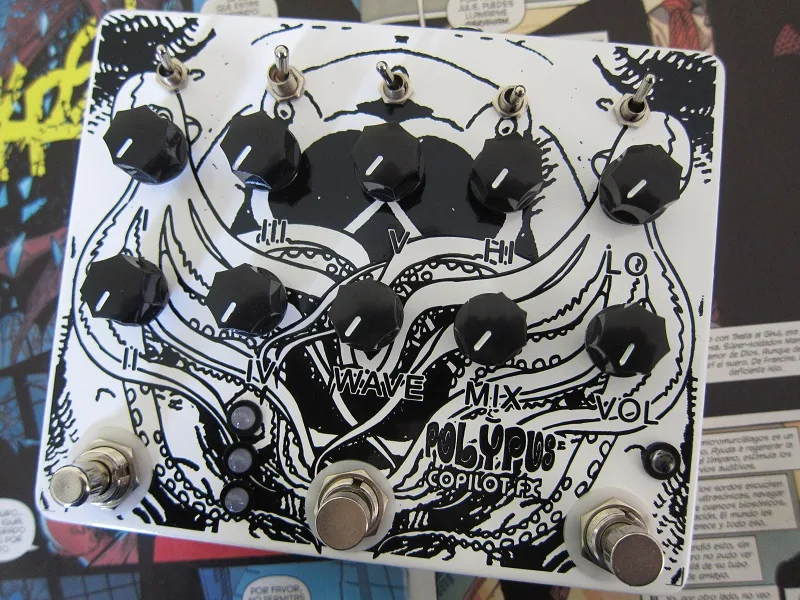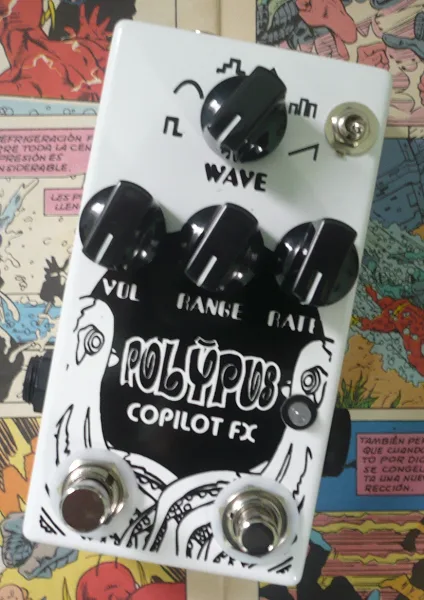


The Copilot Fx Polypus is a tremolo pedal: it raises and lowers your volume in a repeating cycle, the classic amplitude modulation effect heard on countless recordings. What sets it apart from a basic tremolo is how the cycling is shaped and controlled. The volume is modulated by an LFO (low frequency oscillator, the circuit that generates the repeating wave) with six different waveshapes to choose from, and the speed can be set by hand, by tap tempo, or from outside the pedal through an expression or CV input1.
Copilot FX builds the Polypus in a powder coated aluminum case with silk screened artwork applied in enamel ink1. The company also makes an expanded version, the Copilot Fx Polypus Supreme, which adds a five step sequencer and more control over the same core idea2.
Six waveshapes, one knob
A tremolo's character depends heavily on the shape of the wave that turns the volume up and down. A smooth wave gives a gentle, even pulse; sharper or stepped shapes give a choppier, more rhythmic chop. The Polypus gives you six of these waveshapes, selected with the Wave knob, so one pedal covers a wide range of tremolo feels without touching anything else in the signal chain1.
The audio path itself is kept simple: the Polypus is a tremolo, not a multi effect, and its job is volume modulation rather than tone shaping. The Vol knob sets the amount of volume, so you can use it to match your bypassed level or push a little harder1.
The controls
The front of the pedal is deliberately minimal. Four knobs and a toggle cover everything:
| Control | What it does |
|---|---|
| Range | Controls the amount of modulation (depth), from a subtle shimmer to a full on/off chop1 |
| Wave | Selects the waveshape of the LFO1 |
| Rate | Sets the rate of the LFO in manual mode, or the tap ratio multiplier in tap mode1 |
| Vol | Amount of volume1 |
| Speed/Rate/Ratio toggle | Up: the knob sets LFO speed like a traditional speed control. Down: the knob sets the tap multiplier3 |
The footswitch activates the tremolo effect3.
Tap tempo and ratio multipliers
The toggle is where the Polypus gets more flexible than a standard speed knob. With the toggle up, the Rate knob works like a traditional tremolo speed control. With the switch down, you are in tap tempo mode: tap twice on the switch to set the tempo, or speed, of the LFO3.
In tap mode the ratio knob selects multipliers of the tempo you tapped: x1, x2, x3, x4, x8, or x1/21. That means one tapped tempo gives you six related speeds. Tap in a tempo that matches your song, then flip the ratio to x2 for a double time pulse or x1/2 for a half time swell, all locked to the same underlying beat.
Power and connections
The Polypus runs on a 9V DC power jack with center negative polarity, and there is no battery option1. The manual specifies a supply rated at 10mA or higher3, a light enough draw that it is easy to run from a shared pedalboard supply.
Center negative only, and no battery. Check that your power supply has a center negative plug before plugging in; this is the standard polarity for most modern pedal supplies, but not all.
Connections are straightforward. The input jack takes the signal from your instrument or the output of another pedal, and the output jack feeds another pedal or your amplifier3.
External speed control
The TRS expression jack is the other feature that separates the Polypus from a basic tremolo. It provides external control of the rate and ratio via a TRS expression pedal, so you can sweep the speed with your foot while playing. The same jack also accepts a 0 to 5V CV signal for external rate control, which opens the door to controlling the pedal from other gear that outputs control voltage13.
The Polypus Supreme
For players who want more, the Polypus Supreme is an expanded version of the Polypus2. It keeps the same foundation, a tremolo pedal with an all analog audio signal path and an LFO with six waveshapes modulating volume2, but adds a five step sequencer: five step knobs (I to V) set either the rate of the LFO or the tap ratios depending on the Tap/Rate toggle position2. It also adds a MIX depth control, a LO control for the amount of bass on the audio signal, a scroll toggle for pause and scroll modes, and a CV sync input jack that accepts a 0 to 5V clock signal to sync the LFO rate in tap mode and the sequencer rate2. It is a bigger box, at 5.5" x 4.5" x 3", and like the standard Polypus it is powered only by a 9V DC center negative jack with no battery option2.
Videos
Copilot Fx
Copilot Fx
Prymaxe
Questions
Does the Copilot FX Polypus take a battery?
No. The Polypus is powered only by a DC 9V power jack with center negative polarity, and there is no battery option. You will need a 9V DC supply with the correct center negative plug to run it on your pedalboard.
Can you control the Polypus speed with an expression pedal?
Yes. The pedal has a TRS expression jack input for the rate and ratio, so a TRS expression pedal gives you external control of the speed. The same jack also accepts a 0 to 5V CV signal for external rate control.
How much current does the Copilot FX Polypus draw?
The manual specifies a 9V center negative supply rated at 10mA or higher. That is a very light draw, so the pedal is easy to power from a typical multi output pedalboard power supply.
How big is the Copilot FX Polypus?
The enclosure measures 4.5 inches by 2 1/2 inches by 2 1/2 inches. It is a small box that fits easily on a crowded board. The larger Polypus Supreme version measures 5.5 by 4.5 by 3 inches.
Sources (3)
- Copilot Fx Polypus Tap Tempo tremolo pedal, Copilot Fx, 2017
- Copilot Fx Polypus Supreme Tap Tempo tremolo pedal, Copilot Fx, 2017
- polypus.pdf, Copilot FX, 2015