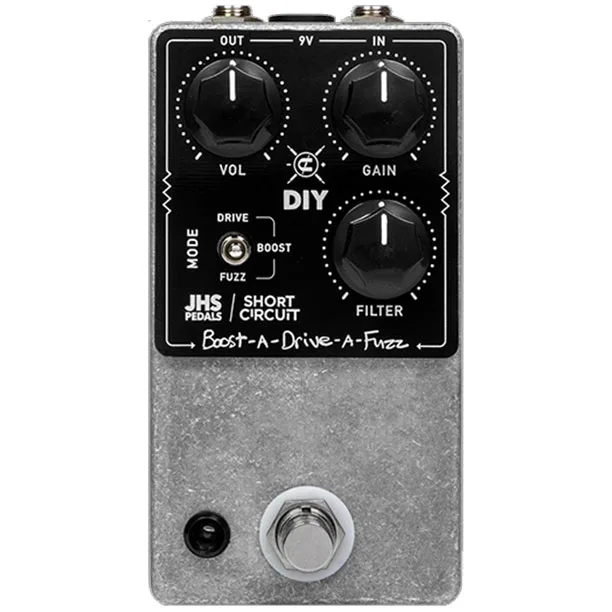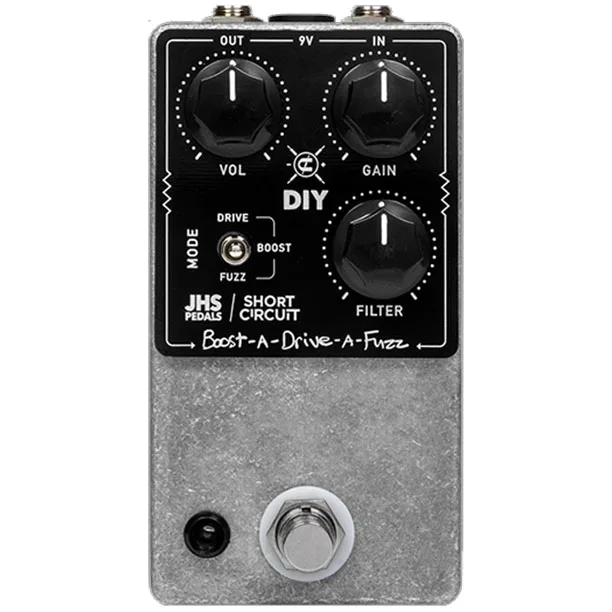


The Coppersound/JHS Boost-a-Drive Fuzz is a DIY pedal kit, a circuit you solder and assemble yourself rather than a finished pedal. It was born from Josh Scott's Short Circuit series and produced in collaboration with CopperSound, and it packs three gain behaviors into one board: a mode selector switches between Boost, Drive and Fuzz1.
What it is and where it came from
The kit is a joint release: Delicious Audio describes it as "a DIY kit released in collaboration with the folks at Coppersound"1. The design comes from Josh Scott's Short Circuit series, JHS's project for putting circuit designs in players' hands, and CopperSound produces it alongside JHS1.
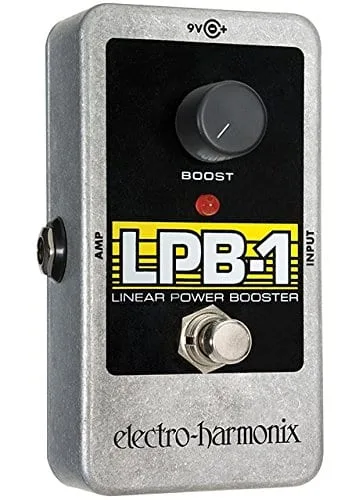
At its core the circuit "takes the classic two-transistor LPB-1 architecture and evolves it into a dynamic, multi-mode saturation engine"1. The LPB-1 is a simple two-transistor boost design, and here that topology is described as a dual high-gain transistor layout, which is what lets a single board cover three different gain behaviors1.
The three modes and the controls
The Mode selector offers three positions, and Delicious Audio describes the pedal as one that "merges cascading gain behaviors that channel the feel of high-headroom boosters, amp-like dynamic overdrive, and aggressive Fuzz Face-style square-wave fuzz"1. In practice that means one circuit covering territory you would otherwise spread across Boost Pedals, Overdrive Pedals and Fuzz Pedals.
| Control | What it does |
|---|---|
| Mode selector | Three-way switch: Boost, Drive, Fuzz1 |
| Gain | Dedicated gain pot for the amount of saturation1 |
| Master Volume | Dedicated output level pot1 |
| Tone | Passive low-pass filter, comparable to a RAT-style EQ knob1 |
| Internal trim pots | Biasing trimmers for fine-tuning the transistors1 |
On the gain control, Delicious Audio reports that "Independent builder communities and gear roundups praise its broad, highly responsive sweep. Reviewers note that because" every millimeter of the gain sweep yields distinct, usable textures bridging transparent line-pushing and jagged, touch-sensitive breakup1.
"Independent builder communities and gear roundups praise its broad, highly responsive sweep."
This is a kit, not a finished pedal: it requires assembly and soldering before it goes on a board. The internal biasing trim pots are adjusted after the build, not during normal play1.
Videos
JHS Pedals
CopperSound Pedals
Should Be Fine
Questions
Is the Coppersound/JHS Boost-a-Drive Fuzz a kit or a finished pedal?
It is a DIY pedal kit, released in collaboration between JHS and CopperSound. The buyer solders and assembles the circuit themselves rather than receiving a finished pedal. It grew out of Josh Scott's Short Circuit series, JHS's project for sharing circuit designs with players who build their own gear.
What circuit is the Boost-a-Drive Fuzz based on?
The circuit takes the classic two-transistor LPB-1 architecture and evolves it into a dynamic, multi-mode saturation engine. Delicious Audio describes its topology as a dual high-gain transistor design, which is what allows one board to cover boost, drive and fuzz duties.
What are the three modes on the Boost-a-Drive Fuzz?
A three-way Mode selector switches between Boost, Drive and Fuzz. Delicious Audio describes the pedal as merging cascading gain behaviors that channel the feel of high-headroom boosters, amp-like dynamic overdrive, and aggressive Fuzz Face-style square-wave fuzz.
What do the internal trim pots do?
The Boost-a-Drive Fuzz has internal biasing trim pots. On a fuzz-style circuit, biasing trimmers let the builder fine-tune the operating point of the transistors, shaping how the fuzz responds and cleans up, without having to reach for a soldering iron.
Who designed the Boost-a-Drive Fuzz?
The design is born from Josh Scott's Short Circuit series and was produced in collaboration with CopperSound. Josh Scott is the founder of JHS Pedals, and the Short Circuit series is where the circuit originated before the two companies released it as a kit.
Sources (1)
- New Pedal Kit: Coppersound/JHS Boost-a-Drive Fuzz, Delicious Audio, 2026-08-07