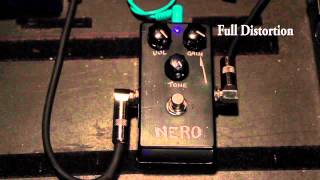
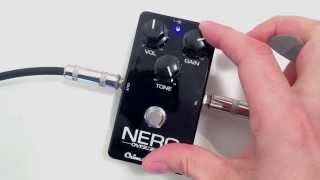

The Crimsontone Nero Overdrive is an overdrive pedal from Crimsontone, built to sit on a pedalboard without taking up much room. The maker describes it as staying "wrapped nicely in a perfect-sized enclosure," a compact footprint aimed at players who need to make the most of limited board space1.
Pedal of the Day's reviewer, Mike B, summed up its range like this1:
"Great as a boost, awesome as a drive and even reaching into slight distortion territory when cranked"
That puts it in territory shared with boost pedals at one end and light distortion at the other, depending on where you set the Gain1.
Versions: standard and Dual Gain
The Nero Overdrive was available in two versions1:
- Standard: a three-knob unit
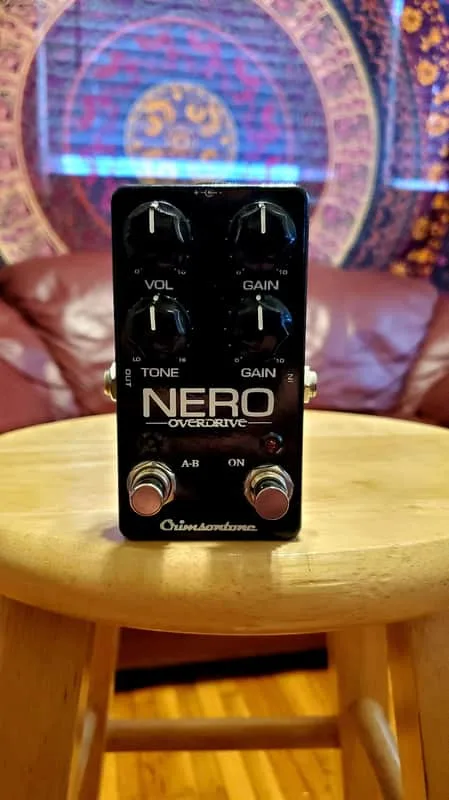
- Dual Gain: the upgraded version reviewed by Pedal of the Day, with two Gain knobs and two footswitches
The Dual Gain model is the version Pedal of the Day reviewed in December 2015; the standard three-knob unit does not have the A/B switching described below1.
The controls
On the Dual Gain model, the four knobs divide the work between the two settings1:
| Control | What it does |
|---|---|
| Gain A | Sets the gain for the A setting |
| Gain B | Sets the gain for the B setting |
| Volume | Shared output level for both A and B |
| Tone | Shared tone control for both A and B |
"There are 2 separate Gain knobs, one controlling the A, one controlling the B, so you can set them however you'd like."
The reviewer found the shared Volume and Tone easy to live with: "it's really easy to find a sweet spot to set these both, so you don't have to worry about fiddling with them on stage"1.
The footswitches
The Dual Gain model carries two stomp switches, Bypass and A/B, for toggling between two overdrive settings1. In practice that means you can set the A side as a lighter boost and the B side as a fuller drive, then move between them mid-song without bending down to turn knobs.
On the board
Of the Dual Gain model overall, the reviewer's verdict was that it is "for a super-versatile drive that's sure not to disappoint", calling the pedal "a bit of a breath of fresh air, in that it features some great op[tions]" that differ from the norm1.
Videos
crimsontoneamps
crimsontoneamps
gearmanndude
Questions
Does the Crimsontone Nero Overdrive have two channels?
The Dual Gain model effectively does. It carries two separate Gain knobs, one for the A setting and one for B, and two footswitches, Bypass and A/B, so you can toggle back and forth between two completely different overdrive settings. The Volume and Tone knobs are shared between both sections. The standard version is a three-knob unit without the second Gain control or the A/B switch.
What is the difference between the standard Nero and the Dual Gain model?
The Nero Overdrive is available as a standard three-knob unit, while the Dual Gain model is the upgraded version. The Dual Gain adds a second Gain knob and a second footswitch, letting you set and switch between two different overdrive settings. Volume and Tone work the same across both A and B sections on the Dual Gain.
Is the Crimsontone Nero Overdrive based on an MXR Distortion+?
Partly. Vintage Guitar magazine described the Nero Overdrive as an LM741-opamp-based hybrid of the '70s script logo MXR Distortion+ and a Microamp, so it draws on both circuits rather than copying one outright.
Can the Nero Overdrive be used as a boost?
Yes. Pedal of the Day's reviewer described it as great as a boost, awesome as a drive, and even reaching into slight distortion territory when cranked, so it covers boost duties as well as overdrive.
What do the A/B and Bypass footswitches do on the Nero Dual Gain?
The Bypass switch turns the pedal on and off, while the A/B switch toggles between the two Gain settings, A and B. Each setting has its own Gain knob, so you can set one as, say, a lighter boost and the other as a fuller drive, and switch between them without touching the knobs.
Sources (1)
- Crimsontone Nero Overdrive, Pedal of the Day, 2015-12-02