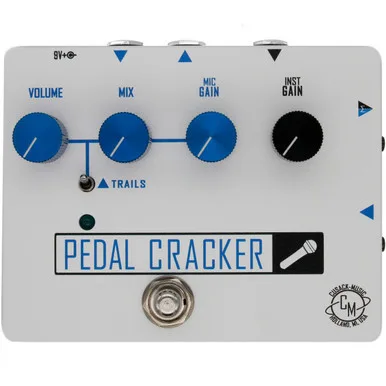
The Cusack Music Pedal Cracker v2 is a mic effects loop pedal: it takes the XLR output of a microphone and converts it so standard guitar stompboxes can be used on the signal. Cusack Music describes it as a microphone level to guitar effects pedals converter with transformer impedance matching, built so anyone with an XLR microphone output can use ordinary pedals1. The idea came from vocalists, keyboardists, horn players and percussionists who wanted effects on their own signals2. The v2 is the successor to the discontinued Pedal Cracker v1, and it is made in Holland, Michigan, USA3.
The signal path is simple. Your microphone goes into the XLR input, the FX LOOP SEND jack feeds your pedals, the pedals' output comes back into the FX LOOP RETURN, and the processed signal leaves through the XLR output, which you connect to a powered speaker or PA board input43. The loop is buffered and low noise2.
Stompbox effects for an XLR microphone signal
The Pedal Cracker exists to solve one problem: guitar pedals expect an instrument-level, high-impedance signal on a 1/4" jack, while a microphone delivers a low-level balanced XLR signal. The Pedal Cracker is a mic preamp with an effects loop that bridges the two, letting a singer or horn player put overdrive, delay, reverb or any other pedal in their live signal chain5. Cusack Music positions it alongside its other pedals as part of a board built for non-guitarists as much as guitarists.
The v2 also adds a 1/4" instrument input alongside the XLR microphone loop, and both are summed to the XLR output4. That means a second source, such as a keyboard or another instrument, can share the same output without needing a separate mixer channel.
The controls
The v2 front panel is built around three gain stages and a blend, plus a single footswitch and two slide switches3.
| Control | What it does |
|---|---|
| MIC GAIN | Adjusts the gain/level of the XLR input3 |
| INST GAIN | Adjusts the gain/level of the instrument input3 |
| MIX | Adjusts the dry/wet blend of the soundboard or FX loop; left is dry, right is wet3 |
| VOLUME | Balances the FX loop level after MIX3 |
| Footswitch | Tap to engage/bypass the FX loop; hold for momentary3 |
| TRAILS switch | Engage (up) to preserve reverb/delay decay when disengaging the FX loop3 |
| 48V switch | Slide right to engage 48V phantom power for condenser microphones on the XLR input3 |
| GND LIFT switch | Slide right to disconnect the ground connection in the event of ground loop hum3 |
The single footswitch is one of the v2's headline changes: it allows both latching and momentary function, so you can tap it to switch the loop on and off, or hold it to invert the loop's status only while pressed43. The MIX control is worth noting for anyone running time-based effects, since blending wet against dry at the box itself means you can keep some clean vocal signal underneath whatever your pedals are doing.
The TRAILS switch works with the loop switching: with trails engaged, delay and reverb decays are preserved when you bypass the loop rather than being cut off abruptly3. On the earlier design, the equivalent Trails/Pre-send toggle determined how the send and return of the loop were switched, with NORMAL, TRAILS and PRE-SEND modes; in PRE-SEND mode the return was switched, so switching the loop off stopped the effects immediately even though the pedals were still receiving signal5.
Power and connections
The v2 runs on a standard center negative 9-18V DC supply, which is not included, and draws about 190mA4. That is a wider voltage range than the v1, which ran on 9V DC center negative and drew around 54mA by the maker's product page, or about 70mA by its manual25.
Cusack Music advises using a transformer-based or linear power supply for the Pedal Cracker, not a digital switching supply such as the 1 Spot5. The v2's ~190mA draw also rules out a battery; plan on a dedicated pedalboard power outlet.
Connection points on the box:
- XLR IN: from your microphone3
- INST IN: connect an instrument here; its signal is summed to XLR OUT and does not utilize the FX loop3
- FX LOOP SEND: connect from pedal output to pedal input3
- FX LOOP RETURN: returns the pedals' signal to the unit3
- XLR OUT: to your powered speaker or PA board input4
The loop's impedances are a send under 100 ohms and a return of 600k ohms, figures that match what guitar pedals expect to see at both ends41. The v2 measures 4.7" long by 3.8" wide by 2.3" high4.
Changes from the Pedal Cracker v1
The Pedal Cracker v1 is discontinued2. Cusack Music summarizes the v2 changes as a single footswitch with latching and momentary function, a beefed up power supply accepting 9-18V, and the added 1/4" input summed to the XLR output4. The v1 shipped with a power supply in the USA and used recessed slide switches for ground lift and 48V phantom power2; on the v2 these are slide switches for the same functions3.
The v1's three-way toggle for trails, normal and pre-send modes is replaced on the v2 by the simpler TRAILS slide switch32. The v1 also carried separate wet and dry controls, momentary functions and on-board phantom power, features the v2 continues in updated form5.
Availability and pricing
The v2 carries an MSRP of $250.00, with B-Stock units listed at $220.00; Cusack Music describes its B-Stock as factory blemished but in perfect working condition, shipped with the original box, box goodies and warranty4.
Questions
Can I use guitar pedals on vocals with the Pedal Cracker?
Yes. The Pedal Cracker is a mic preamp with an effects loop that converts a microphone-level XLR signal so standard guitar stompboxes can process it. You plug your mic into the XLR input, run cables from the loop send and return to your pedals, and take the XLR output to a powered speaker or PA board.
Does the Pedal Cracker v2 provide phantom power?
Yes. A slide switch on the v2 engages 48V phantom power for condenser microphones on the mic input. There is also a separate GND LIFT slide switch that disconnects the ground connection if you get ground loop hum.
Does the Pedal Cracker v2 come with a power supply?
No. The v2 runs on a standard center negative 9-18V DC supply, which is not included. Cusack Music advises a transformer-based or linear supply rather than a digital switching type such as the 1 Spot, and the v2 draws about 190mA.
Do the instrument input signals go through the effects loop?
No. The 1/4 inch instrument input on the v2 is summed straight to the XLR output and does not go through the effects loop. Only the XLR microphone signal passes through the loop where your pedals are connected.
Where is the Cusack Pedal Cracker made?
The Pedal Cracker v2 is manufactured in Holland, Michigan, USA, and Cusack Music states that all of its products are made there.
Sources (5)
- Pedal Cracker V2 Mic Effects Loop Preamp, Cusack Music
- Pedal Cracker V1 Original Mic Effects Loop, Cusack Music
- Pedal Cracker v2 manual design.ai, Cusack Music, 2023
- Pedal Cracker V2 Mic FX Loop, B-Stock, Cusack Music
- PedalCracker.pub, Cusack Music, 2022