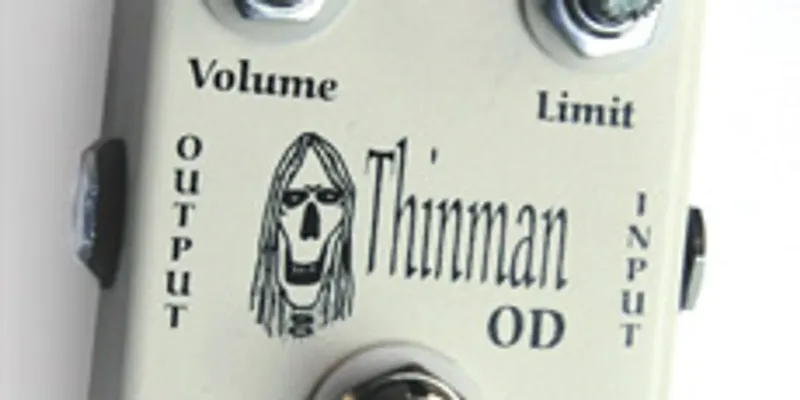


The DDyna Music Company Thinman OD is an overdrive pedal described as a "light-medium overdrive," sitting in the gentler half of the drive range rather than in distortion territory1. What sets its circuit apart is the topology: instead of the usual single clipping stage, the Thinman is built around two distinct signal-limited types, a medium-hard signal limiter and a bias limiter, each with its own control1. If you are weighing it against more familiar drives like the Tube Screamer family, our Boss SD-1 vs Ibanez TS9 comparison covers that classic pairing, and our overdrive page places pedals like this in the wider field.
Controls
| Control | What it does |
|---|---|
| Limit | Sets the medium-hard signal limiter's threshold; the reviewer found it the most responsive control alone, producing a rounder sound at lower settings and an edgier sound at its highest point1 |
| Bias | Controls the bias limiter, the second of the pedal's two limiter thresholds1 |
| Volume | With the Bias control, covers ground from semi-clean boost to full-on bite1 |
The two-limiter design means the Limit and Bias knobs work as a pair rather than as gain and tone in the usual sense. Premier Guitar's reviewer found the Limit knob to be the most responsive on its own, "producing a rounder sound at lower settings and an edgier, elect[ric]" character as it climbs1. The Bias limiter, meanwhile, is the stage that lets the pedal stretch from a semi-clean boost up to full-on bite when helped along by the Volume knob1. Players looking for that boost-only use may also want to read about dedicated boost pedals.
Build and appearance
The Thinman OD is housed in a die-cast aluminum enclosure with Neutrik connectors and 2-layer thru-hole PCBs1. Visually, radiation green LEDs shine from underneath, lighting up the controls brilliantly1.
What reviewers said
Premier Guitar's reviewer came away impressed with how the pedal handles chord work1:
The same review notes that with the knobs at noon, the pedal became the reviewer's secret weapon for beefy rhythm tracks1.
The same review notes that with all the knobs sitting at noon, the pedal became the reviewer's secret weapon for beefy rhythm tracks, with the low end and rhythm tone holding up1. That combination of fatness and definition is consistent with what the two-limiter circuit is aiming for: limiting rather than hard clipping keeps chords intact while adding body.
Videos
gearmanndude
Brett Kingman
Kristin Grady
Questions
Is the DDyna Thinman OD true bypass?
Yes. Premier Guitar's review describes the Thinman OD as using true bypass circuitry, so when the pedal is off, your guitar's signal passes straight through to the amplifier without going through the overdrive circuit. That matters if you run a longer pedalboard chain and want the pedal out of the signal path entirely when it is not engaged.
Can the Thinman OD be used as a clean boost?
Premier Guitar's reviewer found that the Bias limiter, with the help of the Volume knob, can cover a lot of ground, from semi-clean boost to full-on bite. So yes, at lower Bias settings the pedal can act as a semi-clean boost, while pushing the controls harder takes it into fuller overdrive territory.
What does the Bias knob do on the Thinman OD?
The Bias control sets the pedal's bias limiter, which is one of the two limiter thresholds the circuit is built around. The other is the medium-hard signal limiter adjusted by the Limit knob. Together they shape how hard and where the circuit clips your signal, which is what gives the Thinman its light-medium overdrive character.
What is the Thinman OD's enclosure and wiring made of?
The pedal is housed in a die-cast aluminum enclosure with Neutrik connectors, and its circuitry is built on 2-layer thru-hole PCBs. Radiation green LEDs shine from underneath, lighting up the controls. Premier Guitar's review describes these build details as part of what sets the pedal apart.
Sources (1)
- DDYNA Music Co Thinman OD Overdrive Pedal Review, Premier Guitar, 2009-05-20