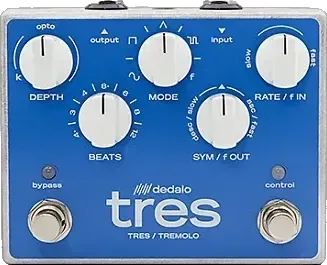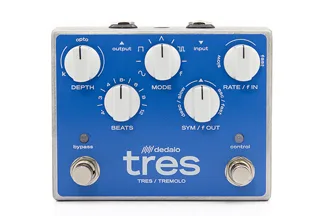


The Dedalo Tres (model TRS-5, from 2015) is a tremolo pedal built by Dedalo Fx, an Argentine brand of pedals. What sets it apart from most tremolos is that it carries two modulation circuits in one box: an optical path using a custom optocoupler developed by Dedalo Fx, and a FET path. The signal path is analog, while a digital micro-control layer handles the advanced functions such as tap tempo and rhythmic subdivisions1.
The pedal offers four waveforms, sine, square, triangle and pulse, plus a special Fade mode, and the Depth control doubles as the switch between the optical and FET circuits. RockBoard's PedalPedia describes it as a FET/LDR analog circuit with what RockBoard's PedalPedia calls μ-control technology, letting a player move from the classic "vibrato" of old amplifiers to modern rhythmic patterns and Fade and Kill effects2.
What the Dedalo Tres does
The Tres shapes volume, not pitch: it is a tremolo, raising and lowering the signal level in a repeating cycle. The character of that cycle depends on which of the two circuits the Depth control has selected. Turned up from zero, the pedal runs in Opto mode, where depth increases from zero to maximum and the waveform choices are available. At the minimum position the pedal activates KILL mode, which engages the FET modulation with sharp edges and more than 50dB of depth1.
The four waveforms each have a distinct character, as the maker describes them1:
| Mode | Waveform | Character |
|---|---|---|
| Sine | Sine wave | The classical "vibrato" of old amplifiers |
| Triangle | Triangular waveform | Softer tremolo |
| Square | Square wave | Deeper tremolo |
| Pulse | Two rhythmic pulses | One pulse on beat 1, the second on beat 3 of a bar |
| f (FADE) | LFO stopped | Output level controlled by the Control switch |
In Kill mode the FET modulation uses a square kind of wave which, in Dedalo Fx's words, "cuts through any distortion applied after the pedal"1. That makes it a practical choice for players running gain pedals later in the chain, on a distortion or fuzz board, where a softer optical tremolo can get buried.
Controls, modes and footswitch functions
The pedal has three main controls. DEPTH sets the depth of the tremolo effect and, at its minimum, switches into KILL mode. MODE selects among the four waveforms and the special "f" (FADE) position. The third control, called CONTROL, is an optical switch that handles the tap tempo and related functions1.
The MODE positions in detail1:
- Sine: sine wave, the classical "vibrato" of old amplifiers.
- Triangle: triangular waveform, softer tremolo.
- Square: square wave, deeper tremolo.
- Pulse: two rhythmic pulses per bar, the first on beat 1 and the second on beat 3.
- f (FADE): the LFO stops and the output level is controlled by the Control switch, between full level and silence. Fading time is set by f IN and f OUT. With KILL active, switching has no transition time, giving a Kill Switch effect.
The CONTROL switch covers four functions1:
- Tap Tempo: tap between three and sixteen times; the resulting tempo is the average of the taps and stays until a new tempo is set.
- Tap Sync: a single tap synchronizes the LFO to the beginning of the cycle; only active when the rate was previously set by Tap Tempo.
- Foot-Speed: the rate rises gradually to maximum speed while the switch is pressed, returning to the set speed when released.
- Fade: in FADE mode, the switch controls the output level between full level and silence.
A separate BEATS control is active only in Pulse mode. It divides the oscillation cycle into beats: 4 (dotted), 3, 4, 8 (dotted), 6, 8, or 121. This is where the Tres goes beyond simple speed and depth, letting a player lock the pulse to a rhythmic subdivision rather than a free-running rate.
The TRUE BYPASS footswitch turns the effect on and off, with the sound remaining intact when off. Each time the pedal is activated, the LFO is synchronized to the start of the cycle, a behavior Dedalo Fx calls Bypass Sync and lists as an undocumented feature1. An LED serves as a speed and mode change indicator, blinking when modes change1.
Power, size and specifications
The Tres runs on a 9V DC center negative power supply or a 9V alkaline battery, drawing 40mA at 9V DC1. The enclosure measures 12cm x 9.4cm x 5.4cm and weighs 475gr, finished in light blue, with an input impedance of 700Kohm1. Dedalo Fx covers all its products under a two-year warranty1.
The Tres ships from Argentina by FedEx International Priority, taking 7 days to most places, and shipping is not available in the United Kingdom1.
Where it came from and how it compares
The Tres is a tremolo pedal from Dedalo Fx, an Argentine brand of pedals1. Its signal path is analog, with a digital u-control section handling several advanced functions1. The same pedal appears in RockBoard's PedalPedia as the Dedalo FX Tremolo TRS-52.
For comparison, the Black Arts Toneworks Tres Diablos Ruidosos is a differently named tremolo from another maker that operates on a 9 VDC power supply only, with no battery option, where the Tres accepts either a supply or a 9V alkaline battery3.
Videos
dedalofx
dedalofx
dedalofx
Questions
Is the Dedalo Tres true bypass?
Yes. The pedal uses true bypass switching, so with the effect off the signal passes through untouched. Each time you switch the pedal on, a feature called Bypass Sync resynchronizes the tremolo cycle to its start, so the effect always begins at the beginning of its pattern rather than partway through.
Does the Dedalo Tres run on a 9V battery?
Yes. The Tres runs on a 9V alkaline battery, and it also accepts a 9V DC center negative power supply. Current draw is 40mA at 9V DC, which is modest enough for most isolated pedalboard power supplies.
How does tap tempo work on the Dedalo Tres?
Tap the Control switch between three and sixteen times at the speed you want. The pedal averages your taps and holds that tempo until you set a new one. A single tap after that, called Tap Sync, restarts the LFO at the beginning of its cycle so you can line the pulse up with the music.
What is Kill mode on the Dedalo Tres?
Kill mode is the deepest setting of the Depth control, where the pedal switches from optical to FET modulation. It produces a square-type wave with more than 50dB of depth, which the maker says cuts through any distortion placed after the pedal. In Fade mode with Kill active, switching between full level and silence is instant, working as a kill switch.
How much does the Dedalo Tres cost?
The list price is 145 USD plus shipping, as listed by Dedalo Fx in October 2026. The pedal ships from Argentina by FedEx International Priority, taking about 7 days to most destinations, though shipping is not available to the United Kingdom.
Sources (3)
- Tres / Tremolo, Dedalo Fx
- Tremolo TRS-5 by Dedalo FX, RockBoard PedalPedia, 2026
- Tres Diablos Ruidosos, Black Arts Toneworks