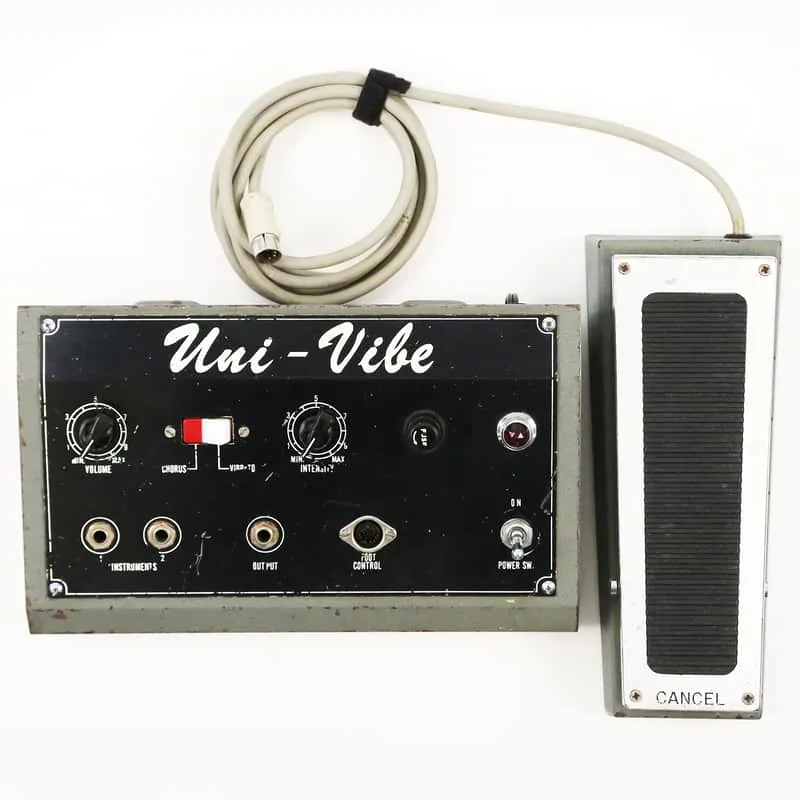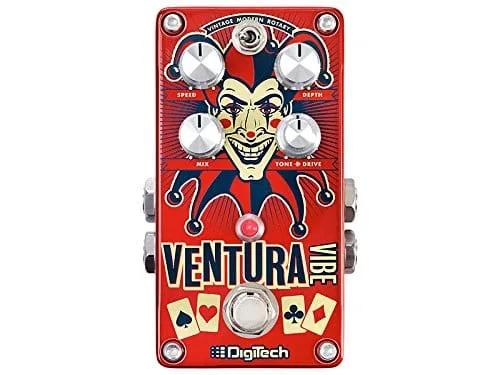


The DigiTech Ventura Vibe is a digital vibe and rotary pedal that gathers two of the most recognizable modulation sounds in rock into one box: the swirling phasing and pitch vibrato of the Shin-ei Uni-Vibe, and the sound of a Leslie rotary speaker. Announced by HARMAN's DigiTech in October 2015 and available from November that year, it offers three effect types selected from a single toggle: Vintage, Modern and Rotary12.
Guitar.com's reviewer, Richard Purvis, described the design plainly: "This digital unit offers two variants on the Uni-Vibe sound, vintage and modern, plus a fresh stab at the Leslie thing"3. The Uni-Vibe it draws on dates back to 1967-68, when the original Shin-ei unit was made4.
What the Ventura Vibe does
The pedal is built around the two sounds players most often chase when they reach for this category. The launch announcement said the Ventura Vibe "faithfully delivers iconic vibe and rotary effects," aiming at the classic phase and pitch vibrato and rotary speaker sounds heard on recordings like "Machine Gun," "Bridge of Sighs" and "Cold Shot"1. Rather than making you choose between a vibe pedal and a rotary pedal, it puts both circuits, plus a second take on the vibe sound, behind one footswitch.
A Speed control adjusts the rate of the modulation, from a slow sweep to a fast warble1. The dual-function footswitch turns the effect on and off, and holding it down controls the speed of the modulation effect, which is how a player would ramp between slow and fast rotary speeds the way a Leslie motor does1. Other features include a bright bi-color LED indicator and a road-tough metal housing1.
The three modes: Vintage, Modern and Rotary
A toggle switches between the three effect varieties5. Guitar.com's review found each mode has its own character:
| Mode | What the reviewer found |
|---|---|
| Vintage | "Like an asymmetrical phaser with a deeply liquid quality"3 |
| Modern | Brighter and more chorus-like, quite flange-y at low speeds, with more pronounced pitch wobble at high depth and mix settings3 |
| Rotary | A more gentle, almost mid-scooped voice; with drive it takes on a Leslie grind3 |
The Vintage mode is the one aimed at players after the original Uni-Vibe character, while Modern is a brighter, more chorus-flavored alternative. Rotary mode is the Leslie simulation, and it is where the tone control earns its place, according to the review, for bringing out the sound when driven3.
Power and stereo connections
The Ventura Vibe runs from a 9V power input and has mono and stereo inputs and outputs31. Used in stereo, the pedal creates dramatic left-to-right movement and spatial effects, which suits the rotary mode especially well, since a real Leslie's sound comes from two rotating elements throwing sound around a room1.
There is no battery compartment. The pedal needs a nine-volt power supply to feed its digital processor, so it cannot run on a standard 9V battery the way many analog pedals can3.
An expression pedal input adds hands-free control of the modulation5, useful for swelling the speed up and down mid-phrase rather than stepping between fixed rates.
What reviewers said
Guitar.com's overall verdict was positive on the pedal's range and features: "All in all, the Ventura Vibe is a fun pedal to use, with three highly creative effects, plus useful acceleration and overdrive features"3.
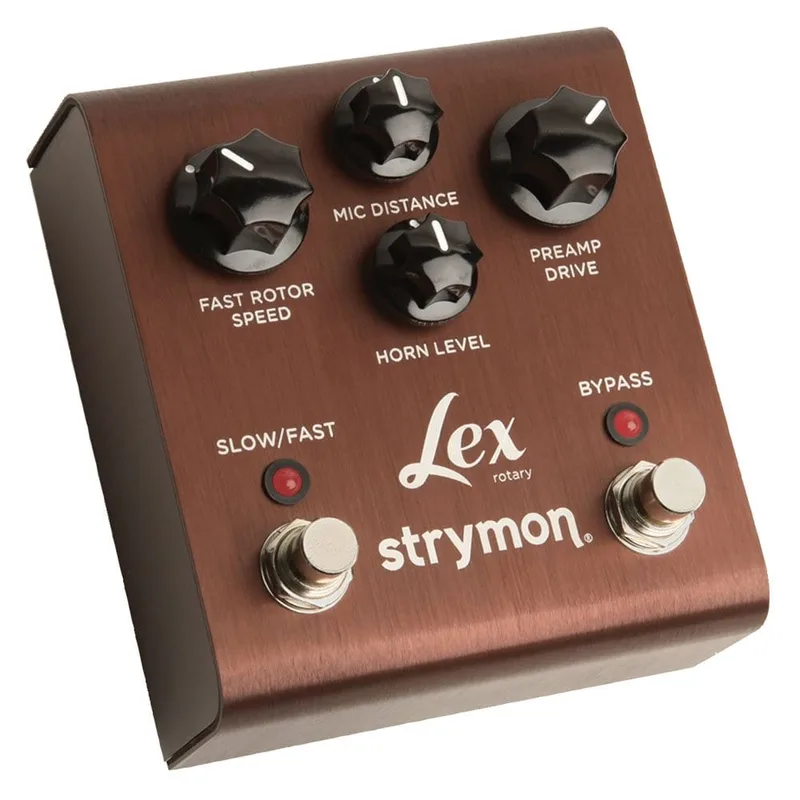
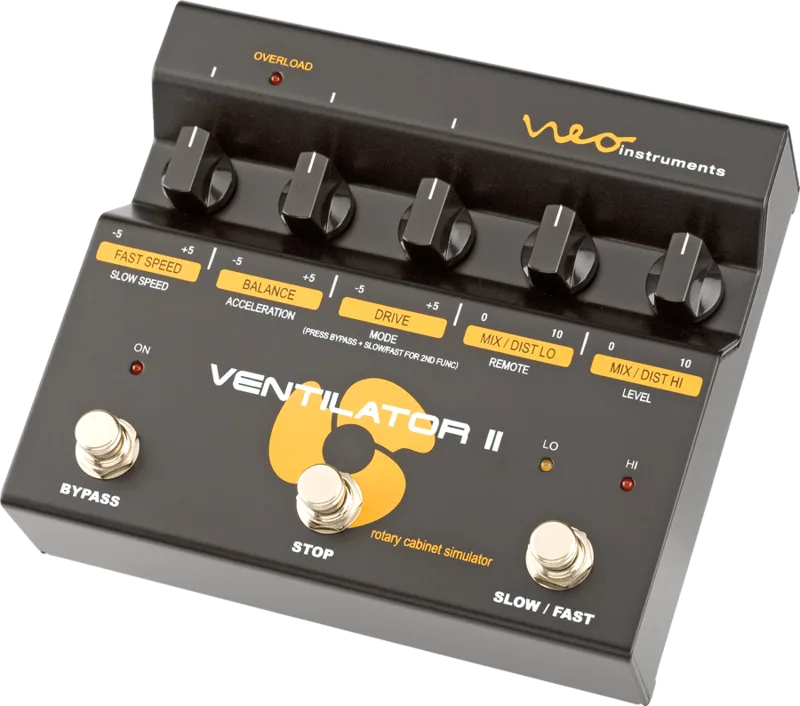
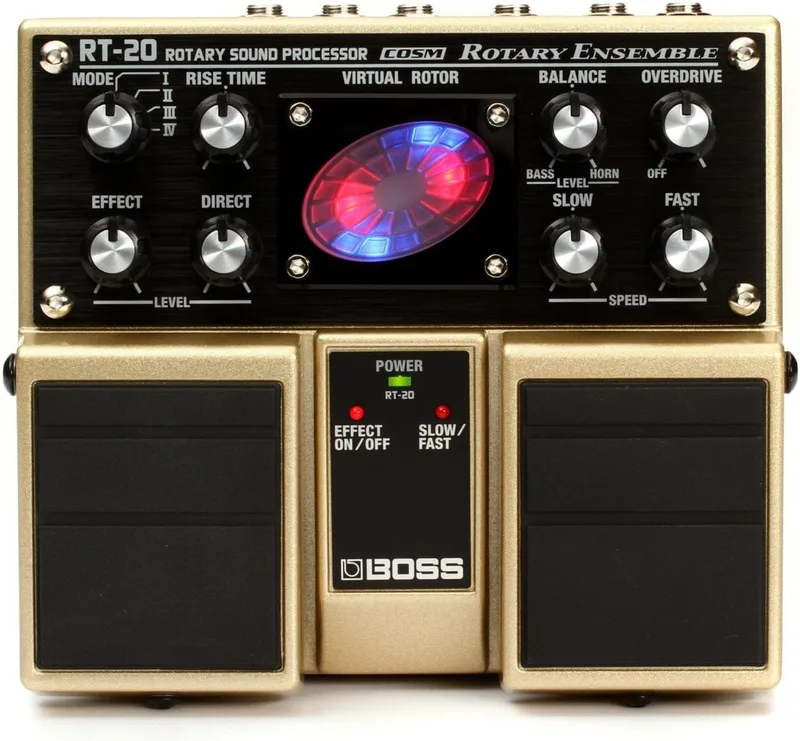
In Delicious Audio's 2023 round-up of rotary pedals and Leslie emulations, Christopher Scapelliti noted its popularity among players shopping the category, writing that "it's by far the most popular pedal in this article"5. That round-up places the Ventura Vibe alongside dedicated rotary emulations such as the Strymon Lex, the Neo Instruments Ventilator and the Boss RT-20 Rotary Ensemble, where its appeal is that it also covers the vibe side of the family rather than rotary alone.
Videos
ProGuitarShopDemos
ProGuitarShopDemos
Sweetwater
Questions
Is the DigiTech Ventura Vibe analog or digital?
It is a digital pedal. Guitar.com's review describes it as a digital unit offering two variants on the Uni-Vibe sound, vintage and modern, plus a rotary speaker simulation. The digital processor is also why it needs a nine-volt power supply rather than a battery.
Does the DigiTech Ventura Vibe take a battery?
No. The pedal has no battery compartment, so it requires a 9V power supply to run. Guitar.com's reviewer noted the digital processor needs that external power.
Is the DigiTech Ventura Vibe true bypass?
Yes. The launch announcement described true bypass operation that preserves the tone of the unaffected signal when the pedal is not engaged.
Does the Ventura Vibe have an expression pedal input?
Yes. The pedal has an expression pedal input, which lets you control the modulation hands-free while playing, alongside its mono and stereo inputs and outputs.
When did the DigiTech Ventura Vibe come out?
It was announced in October 2015 and MusicRadar reported it would be available from November 2015, priced at £142 in the UK at launch.
Sources (5)
- DigiTech Ventura Vibe Puts a New Spin on Rotary/Vibrato Pedals, Guitar Interactive Magazine, 2015-10-16
- DigiTech's Ventura Vibe pedal delivers Uni-Vibe, vibrato and Leslie effects, MusicRadar, 2015-10-09
- DigiTech Ventura Vibe review, Guitar.com, 2016-08-04
- The Ghost Vibe, tru-fi.com
- Best Rotary Pedals & Leslie Simulators In 2023: Compare Price And Features, Delicious Audio, 2023-02-13