

The Riemann's Grave Octave Bit Crusher Distortion Filter is a stereo filter pedal from Discomfort Designs that combines a multi-mode filter with a three-way distortion section. At its core it is a stereo filter pedal whose cutoff can be modulated by a random sample and hold wave or a Wandering Sine, and whose Zeta Function stage adds distortion by wave folding, bit crushing, or octave up distortion1. Delicious Audio describes it as more than a simple distortion pedal: "a powerful, self-contained workstation for timbral sculpting"2.
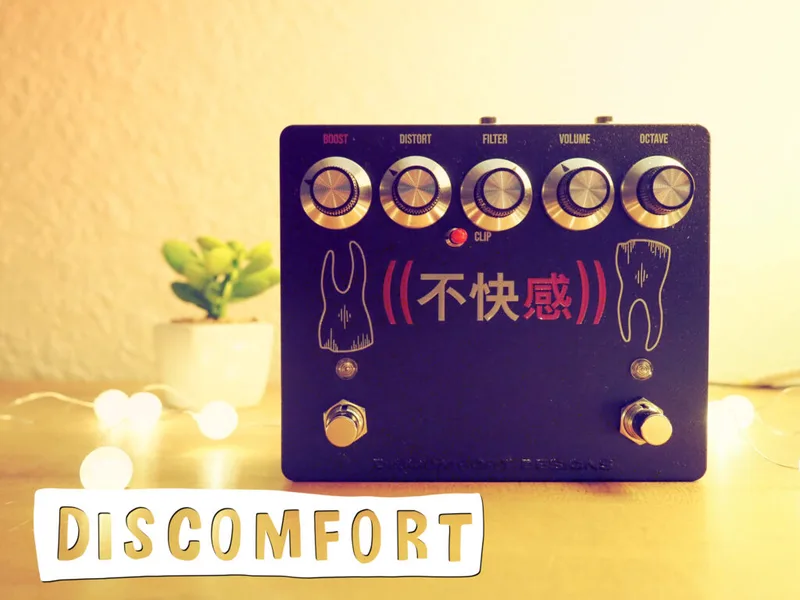
The pedal is named for Bernhard Riemann, a German mathematician who made contributions to analysis, number theory, and differential geometry3. Discomfort Designs also makes the Black Tooth Doom Octave Distorter and the Doomsailor Distortion.
A stereo modulated filter with three distortion modes
The circuit is built around a curated trio of biquad filters paired with a sample rate reducer2. Two low pass filters sit at the heart of the design, and you can apply modulation randomly or with precision3. The pedal runs as a dual-engine system, with distortion on the right and filter on the left2.
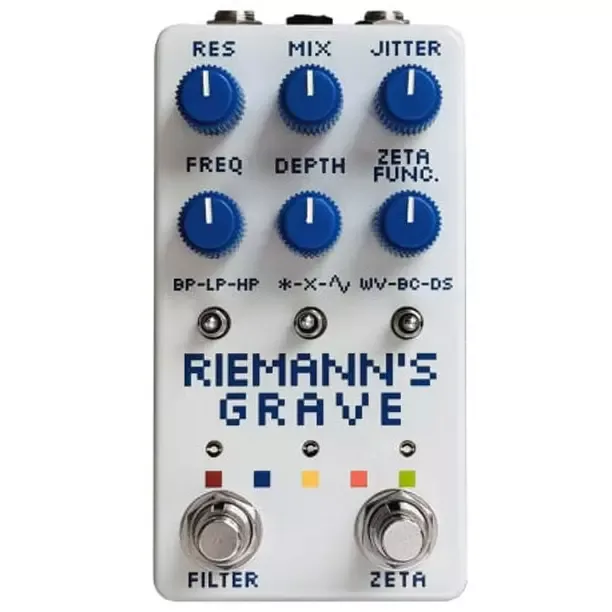
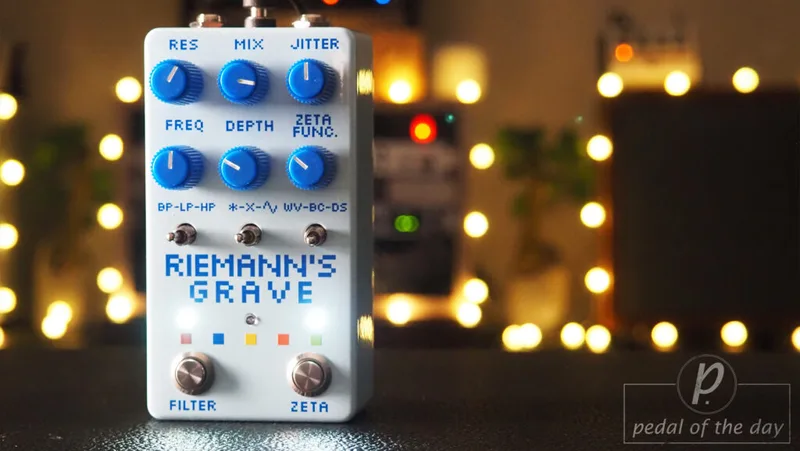
The filter section is a state-variable design you sculpt with Frequency and Resonance controls, and a three-way switch toggles between Band Pass, Low Pass, and High Pass modes2. The distortion side is the Zeta Function, which can add mild saturation or distortion in three ways: wave folding, bit crushing, or octave up distortion1.
| Section | Controls and modes |
|---|---|
| Filter | Frequency, Resonance; Band Pass / Low Pass / High Pass42 |
| Modulation | Depth; Random Sample & Hold / Static / Wandering SineWave42 |
| Distortion (Zeta Function) | Wavefolder / Bitcrusher / Octave Distortion14 |
Not just for guitar, the effect works on drums, synths and any other input signal you can think of3.
The modulation sources and the Zeta Type switch
A central switch routes either static, random, or a wandering sine wave to modulate the filter's frequency, with an adjustable modulation Depth control setting how far it moves2. The three positions on the modulation switch are Random Sample & Hold, Static, and Wandering SineWave4.
On the distortion side, the Distortion / Zeta Type switch selects between Wavefolder, Bitcrusher, and Octave Distortion4. Higher Zeta Function settings will mangle and crush, and create some wonderfully ugly atonal messy sounds, which Delicious Audio notes drums love2.
"Higher settings will mangle and crush, and create some wonderfully ugly atonal messy sounds. Drums love that kind of thing."
A wavefolder and a bitcrusher work differently. A wavefolder folds the waveform back on itself as the level rises, adding harmonics through folding rather than clipping. A bitcrusher, as used here through the sample rate reducer, drops the sample rate so the signal breaks into coarse, lo-fi steps. The original version's second filter, also a resonant LPF, had its cutoff modulated by a curvy sine wave or a pointy ramp wave LFO, with a rate knob for speed, one toggle for the LFO shape, and another choosing constant or random modulation2.
The compact version
In October 2025, Discomfort Designs shrank the original 1590BB Edition into a compact stereo device4. The pedal is named for a dead mathematician4. The enclosure is baby blue1.
What reviewers said
Pedal of the Day reviewed the original Modulated Allfilter version in 2022, calling it "an effects unit that defies all logic and convention" and describing how it transforms the input into "a fury of bits, bleeps, pops and more"3.
On the compact version, the same site found it "a fun little thing that has a mind of its own," flipping the script on what normal effects should be, and concluded that "this one will keep a smile on your face and innovation in your playing" thanks to its wide array of controls, knobs and switches1.
Guitar Pedal X found the sum of the parts gives a range of useful textures, from robot-talk through various fluttery, zithery, and swooshy textures allied to lo-fi distortion flavors4.
Videos
Discomfort Designs
The Pedal Zone
Signal Path
Questions
Is the Riemann's Grave a stereo pedal?
Yes. Pedal of the Day describes it as a stereo filter pedal at its core, and Guitar Pedal X calls the compact version a compact stereo device. The original was built in a 1590BB enclosure before being shrunk into the smaller pedalboard-friendly format.
What is a Wandering Sine in a filter pedal?
It is one of the modulation sources for the filter's cutoff frequency. A central switch routes either a static setting, a random source, or a wandering sine wave to modulate the filter, and a Depth control sets how far the modulation pushes the frequency around.
What does the Distortion / Zeta Type switch do?
It selects one of three distortion modes for the Zeta Function section: wavefolder, bitcrusher, or octave up distortion. According to Pedal of the Day, the Zeta Function can add anything from mild saturation to heavier mangling and crushing depending on the setting.
What is the difference between a wavefolder and a bit crusher?
A wavefolder folds the waveform over on itself, adding harmonics as the signal is bent back, while a bitcrusher reduces the sample rate and bit depth so the signal breaks up into coarse, lo-fi steps. The Riemann's Grave offers both, plus octave up distortion, on one switch.
Is the Riemann's Grave also sold in a smaller enclosure?
Yes. The original 1590BB Edition has been shrunk into a compact stereo device, reported by Guitar Pedal X in October 2025. The compact version was listed at £295 in two editions at the time of that report.
Sources (4)
- Discomfort Designs Riemann's Grave Octave Bit Crusher Distortion Filter, Pedal of the Day, 2025-10-16
- Discomfort Designs Riemann's Grave V2, Delicious Audio, 2025-10-14
- Discomfort Designs Riemann’s Grave Modulated Allfilter, Pedal of the Day, 2022-10-31
- Guitar Pedal X, Guitar Pedal X, 2025-10-17