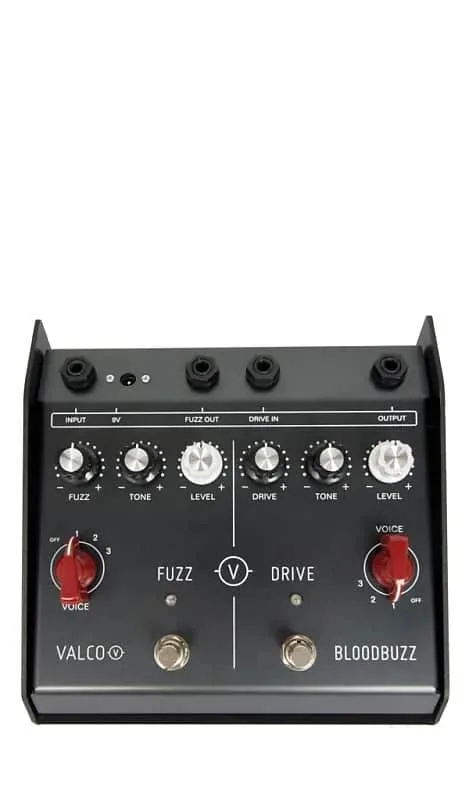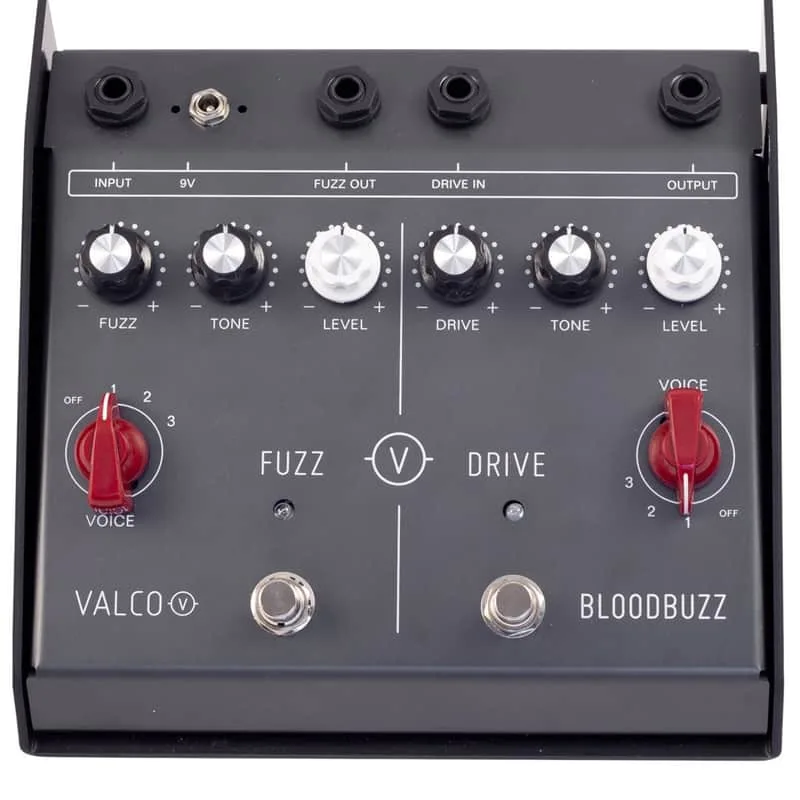


The Eastwood VALCO BloodBuzz Fuzz Overdrive is a dual pedal that houses a fuzz and an overdrive in one enclosure. Pedal of the Day calls it "basically two completely separate FX pedals housed together in one enclosure," and it was made by Eastwood Guitars under the Valco name as the first pedal in the Valco series1. GuitarPlayer, reviewing the follow-up KGB Fuzz, notes that the BloodBuzz was "inspired by the rare Lovetone Cheese Source" and combined fuzz and overdrive2.
Two pedals in one
The BloodBuzz's defining feature is that its two effects are fully independent. Each has its own input and output jacks, so the circuits can be used on their own or in any order. Pedal of the Day lays out the possibilities: "Fuzz into Drive; Drive into Fuzz; Fuzz out to" other pedals and back into the drive1. Delicious Audio puts it the same way: "Each effect is independent and is designed to be used on their own or in any configuration, thanks to separate input out" jacks3.
That flexibility matters in practice. Because the two circuits run in parallel rather than being hard-wired in series, a player can treat the BloodBuzz as two pedals on the board instead of one, with each effect usable on its own or in any order via the separate input and output jacks, including routing the fuzz out to other pedals and then back into the drive31.
The fuzz side: four voices
The fuzz circuit carries a 4-way Voice Selector that Pedal of the Day describes as offering "four distinct and unique fuzz sounds"1. Delicious Audio describes what the switch does:
"The powerful 4-way Voice switch gives the Fuzz side a tone bypass for classic two-knob 60s pych sound, a muffy 1kHz mid scoop or familiar gated, sputtery sound"
One of those four positions is the Tone Bypass. With the Voice Selector set to OFF, the tone shaping is removed and the fuzz runs as a two-knob design, using only the FUZZ and LEVEL controls1. The other positions add the mid-scooped, Muff-style voicing or the gated, sputtery character described above3.
The drive side
The overdrive half is a separate circuit. Pedal of the Day describes its topology as a transistor emitter-follower at the input feeding a variable feedback JFET op-amp that provides up to 40dB of gain with symmetric clipping1. In plain terms, that is a drive circuit with a lot of gain on tap and a clipping stage that shapes both the top and bottom of the waveform evenly.
Where it came from: the Lovetone Cheese Source
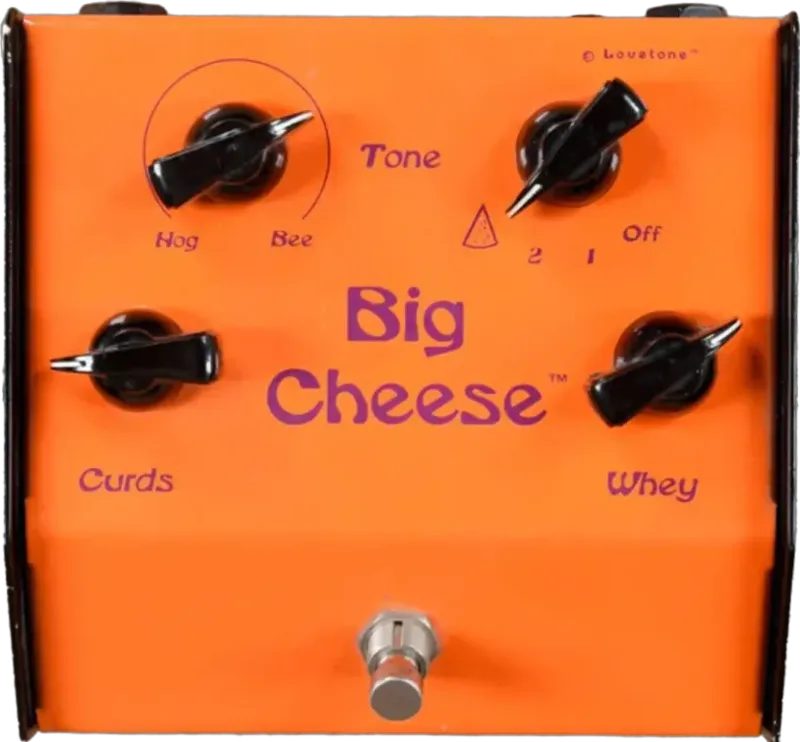
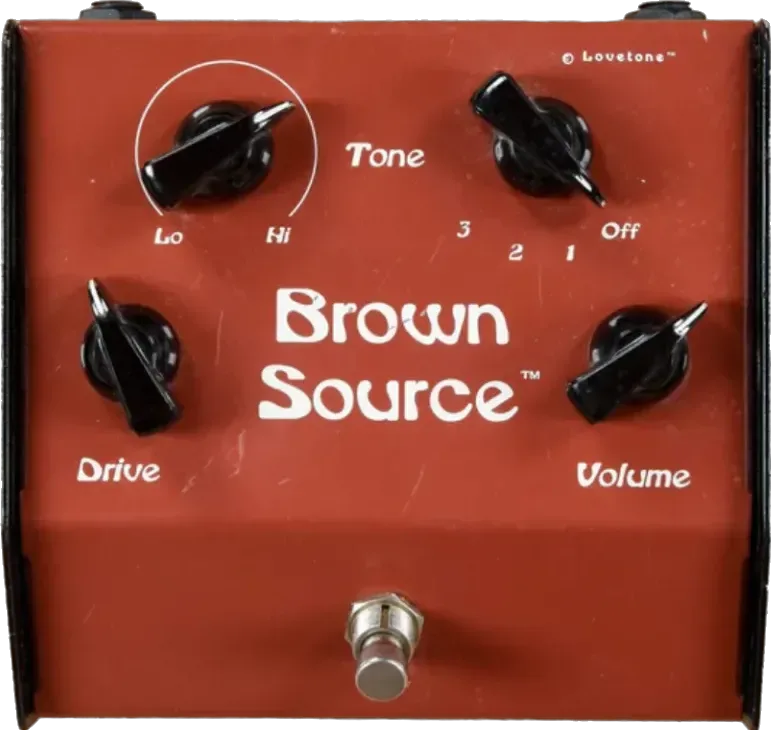
The BloodBuzz is explicitly a tribute. Pedal of the Day calls it "A tribute to the now legendary Lovetone Cheese Source," a pedal it says harnesses "power, tone and grit"1. Delicious Audio dates the original to the 1990s and describes it as stacking "gated fuzz with a wah" friendly drive3. JHS Pedals, in a history of Lovetone, explains the concept directly:
"The Cheese Source is simply this: it's the Big Cheese and the Brown Source. Buzz and overdrive, two in one."
So the BloodBuzz's two-in-one layout is not an arbitrary pairing: it follows the template of a rare Lovetone pedal that combined the Big Cheese fuzz with the Brown Source overdrive4.
Construction
Pedal of the Day's review describes the build as fully analog, with a regulated analog ground intended to keep the circuit immune to hum, power supply variations and battery aging1. All active components are surface mounted, with PCBs and ribbon cables used throughout, in lead and cadmium-free RoHS construction1.
Videos
Eastwood Guitars
Eastwood Guitars
Eastwood Guitars
Questions
What does the Tone Bypass do on the Eastwood VALCO BloodBuzz?
On the fuzz side's four-way Voice Selector, the OFF position is a Tone Bypass. It turns the BloodBuzz into a two-knob fuzz, using only the FUZZ and LEVEL controls. Delicious Audio describes the Voice switch as also offering a muffy 1kHz mid scoop or a familiar gated, sputtery sound, so the Tone Bypass is the plainest, most classic setting of the four.
Is the Eastwood VALCO BloodBuzz analog?
Yes. Pedal of the Day describes the BloodBuzz as analog, with a fully regulated analog ground that the review says gives maximum immunity from hum, power supply variations and battery aging. All active components are surface mounted, with PCBs and ribbon cables used throughout, in lead and cadmium-free RoHS construction.
Can the fuzz and drive sections be used separately?
Yes. Each effect is independent and can be used on its own or in any configuration, thanks to separate input and output jacks. Pedal of the Day notes it can be set up as fuzz into drive, drive into fuzz, or with the fuzz sent out to other pedals and back into the drive.
What is the Lovetone Cheese Source?
The Cheese Source was a 1990s Lovetone pedal that combined two effects in one: JHS Pedals describes it as the Big Cheese and the Brown Source together, fuzz and overdrive in a single box. The Valco BloodBuzz is a tribute to it, stacking gated fuzz with a wah-friendly drive circuit.
Sources (4)
- Eastwood VALCO BloodBuzz Fuzz Overdrive, Pedal of the Day, 2020-05-02
- Valco KGB Fuzz Review, GuitarPlayer, 2021-12-17
- Valco BloodBuzz, Delicious Audio, 2020-10-14
- THE LEGEND OF LOVETONE, JHS Pedals