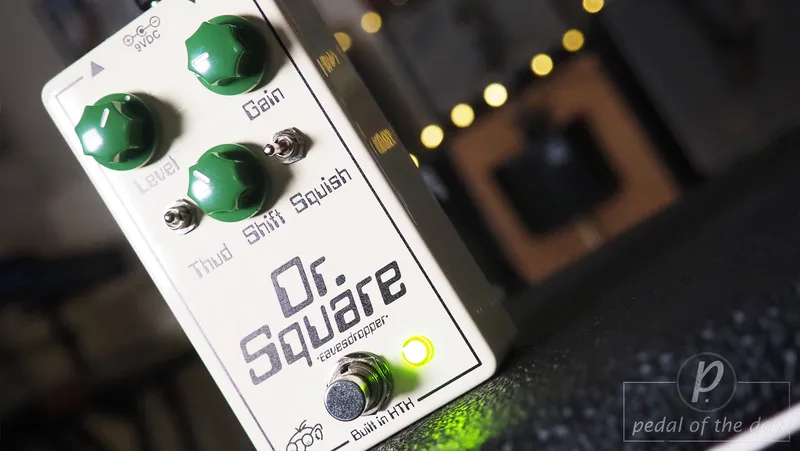


The Eavesdropper Pedals Dr. Square Distortion is a distortion pedal that recreates the DeArmond Square Wave Distortion Generator, a vintage design related to the classic DOD 250 but with component value changes that gave the original Distortion Generator a unique sound. Eavesdropper has built on that circuit with added controls of its own: a Tone knob that was not on the original DeArmond design, a Thud control for low end, and a Squish toggle at the input. A combination of silicon and LED clipping gives a little more output, and a unity gain buffer at the output helps the pedal stack with other drives.1
The controls: Gain, Tone, Thud and Squish
The Dr. Square keeps a compact layout of three knobs and two toggles, each with a distinct job.1
| Control | What it does |
|---|---|
| Gain | Altered from the original design to provide a better range throughout the sweep of the pot1 |
| Tone | Added control not on the original DeArmond design; boosts the highs fully counter clockwise or cuts the highs fully clockwise1 |
| Thud | Changes the frequency response, allowing more or less low end into the guitar signal; great for higher gain settings1 |
| Squish toggle | Adds a more "open" or "full" sound and feel by altering the cutoff frequency at the input1 |
The Tone control is wide ranging, and the reviewer noted it gives the player full command of the pedal's high end depending on where it is set. The Thud control works from the other end of the spectrum, deciding how much bass the circuit takes in, which shapes how tight or loose the distortion feels at higher gain.1
Circuit and clipping
The Dr. Square is a faithful recreation of the DeArmond Square Wave Distortion Generator. Pedal of the Day placed it in context this way1:
"There's also an added Tone control that was not on the original DeArmond design."
The Tone control is the main departure from the original DeArmond circuit, letting players shape the top end in a way the earlier design did not allow1. Pedal of the Day's reviewer found plenty of range in it, writing that they "loved the Dr. Square Distortion from the moment" it was plugged in, and describing the tones as huge and the pedal as versatile overall1.
Two departures from the original design matter to a player: the added Tone control, and the clipping arrangement. A combination of silicon and LED clipping gives a little more output, as well as the pedal's harder edge.1
Stacking and what reviewers said
The pedal carries a unity gain buffer at its output, which Pedal of the Day said helps this dirtbox stack well with other overdrives and distortions. That makes it straightforward to place the Dr. Square alongside other gain stages on a board without it fighting them.1
The review was positive from the first plug in:
Pedal of the Day's reviewer said they loved the Dr. Square Distortion from the moment it was plugged in, and found the range big, the tones huge, and the versatility impressive overall1.
The reviewer's overall verdict was that the range is big, the tones are huge and the versatility is impressive overall, coming from a box with just three knobs and two toggles. In their words, a good distortion pedal should give you a harder edge, more grit and a beefier tone, but it can also shape your sound, get to the edge of breakup and give a wimpy signal some much-needed love.1
Videos
Pedal of the Day
Matt Dunn
Matt Foy
Questions
What circuit is the Eavesdropper Dr. Square based on?
The Dr. Square is a faithful recreation of the DeArmond Square Wave Distortion Generator. Pedal of the Day notes that while the circuit is not too different from the classic DOD 250, changes in component values gave the Distortion Generator a unique sound of its own. Eavesdropper has also added controls that were not on the original DeArmond design, including a Tone knob and a Squish toggle.
What does the Thud control do on the Dr. Square?
The Thud control changes the frequency response, allowing more or less low end into the guitar signal. Pedal of the Day's reviewer called it great for higher gain settings, where controlling how much bass the pedal takes in makes a real difference to how the distortion sits in a mix.
What does the Squish toggle do?
The Squish toggle adds a more open or full sound and feel by altering the cutoff frequency at the input of the pedal. Together with the Thud control, it gives the player a way to shape how much low end and how much openness the distortion carries, from a tighter edge to a fuller voice.
Does the Dr. Square have a buffer?
Yes. The Dr. Square includes a unity gain buffer at the output of the pedal. According to Pedal of the Day, this buffer helps the pedal stack well with other overdrives and distortions, which matters when the Dr. Square is placed alongside other gain stages on a board.
What type of clipping does the Dr. Square use?
The Dr. Square uses a combination of silicon and LED clipping. Pedal of the Day notes that this pairing gives a little more output than the clipping arrangement would on its own, on top of the pedal's harder edge and grit as a distortion.
Sources (1)
- Eavesdropper Pedals Dr. Square Distortion, Pedal of the Day, 2026-02-01