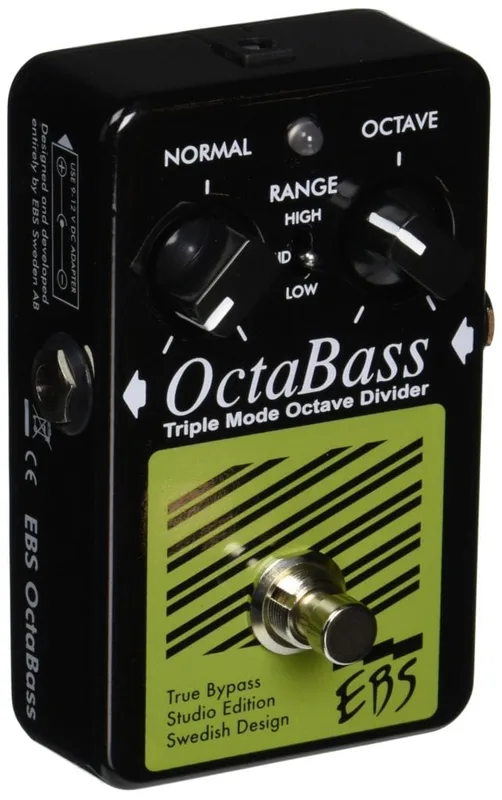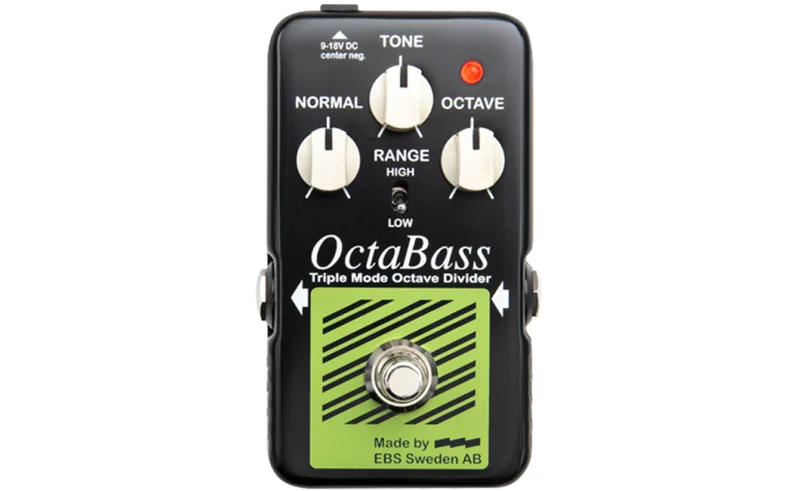


The EBS OctaBass Blue Label is an analog octave pedal for bass. It creates an analog note one octave below the note you play and lets you blend that lower octave into your original bass tone, according to EBS's product page1. The pedal was announced in October 2019 as the third version of the OctaBass, following the Studio and Black Label editions, and EBS said it was shipping as of October 11, 201923.
Controls
The Blue Label carries over the OctaBass level controls and adds two things new to the series: a Range switch and a tone knob142.
| Control | What it does |
|---|---|
| Octaver Level | Sets the octave level, from -∞ to 12 dB min/max1 |
| Dry Level | Sets the dry signal level, from -∞ to 0 dB min/max1 |
| Tone | Changes the character of the octave sound from sub-bass to natural bass tone, and to a more synth-like sound when turned up all the way4 |
| Range switch | A toggle that moves the optimized tracking area up or down the fretboard, to better match your playing style14 |
EBS's press release described the tone control's reach this way: "The tone control enhances the sound palette to even achieve a synthesized bass tone when turned up all the way."2
The Range switch and tracking
The Range switch is the Blue Label's headline feature and the main difference from the earlier Studio and Black Label editions12. EBS describes it as a High or Low-optimized fretboard tracking-range switch, and says it lets you adjust tracking focus higher or lower on the fretboard to better match your playing style1.
In EBS's own support article on getting the best from an analog octave pedal, the company explains the two positions: the Up position suits higher playing, while the Low position is for lower lines. On the Low setting, EBS says the Blue Label is "very close to triggering the open low E and follows steady below the G on the E string"4.
Analog octave pedals track best within a set range of the fretboard. EBS's guidance is to pick the Range switch position that matches where you play: Up for higher lines, Low for rock bass lines lower on the neck4.
Signal and power specifications
| Specification | Value |
|---|---|
| Nominal Input Level | -10 dBv1 |
| Input Impedance | 1.8 Mohms1 |
| Output Impedance | 100 ohms1 |
| Dry Bandwidth | 20 to 20k Hz (+0/-2 dB)1 |
| Triggering Threshold | -70 dBv @ 200 Hz1 |
| Octaver Tone Filter | Low Pass, slope >18 dB/octave, range 60 to 350 Hz1 |
| Power | 9 to 18V DC1 |
| Dimensions (W x H x D) | 2.6" x 4.5"1 |
The 9 to 18V DC power range, EBS says, gives the Blue Label flexible pedalboard compatibility1. The octave tone filter is a low-pass filter with a slope greater than 18 dB per octave over a range of 60 to 350 Hz, which shapes the generated octave note into the sub-bass territory the tone knob then adjusts1.
The footswitch
The Blue Label uses EBS's two-part footswitch design. The switch consists of two separate parts: the switching mechanism attached to the top cover, and a relay circuit triggered by a magnet, a design EBS says puts minimal stress on the mechanism1.
OctaBass versions
| Version | Notes |
|---|---|
| Studio | Earlier OctaBass edition2 |
| Black Label | Earlier OctaBass edition2 |
| Blue Label | Adds the Range switch and tone control; announced October 201912 |
For more on where a pedal like this fits on a board, see the site's page on Octave & Pitch Pedals or Bass Pedals.
Videos
EBSSweden
EBSSweden
EBSSweden
Questions
What does the Range switch do on the EBS OctaBass Blue Label?
The Range switch is a toggle that moves the pedal's optimized tracking area up or down the fretboard to better match your playing style. EBS says the Low position is suited to lower playing, noting the pedal is very close to triggering the open low E and follows steadily below the G on the E string when Low is engaged, while the Up position suits higher fretboard work.
What voltage does the EBS OctaBass Blue Label run on?
The OctaBass Blue Label can be powered with 9 to 18 volts DC, which EBS says gives it flexible pedalboard compatibility. That range means it works with standard 9V pedalboard supplies as well as higher-voltage outputs on many supplies.
How much does the EBS OctaBass Blue Label cost in the US?
At launch in October 2019, the OctaBass Blue Label was listed at $229.99 in the US, with a price of 159 EUR in the EU, according to the press release announcing the pedal.
Is the EBS OctaBass Blue Label analog or digital?
It is analog. EBS describes the OctaBass Blue Label as an analog octave pedal that creates an analog note one octave below the note you play and lets you blend that lower octave into your original bass tone.
What is the difference between the OctaBass Black Label and Blue Label?
The Blue Label is the third version of the OctaBass, following the Studio and Black Label editions. Compared with those earlier editions, the Blue Label adds a Range switch that adjusts tracking focus higher or lower on the fretboard, and a tone control knob that changes the octave sound's character from sub-bass to a more synth-like tone when turned up.
Sources (4)
- Octabass, EBS Professional Bass Equipment
- EBS presents the new OctaBass ‘Blue Label’, MusicPlayers.com, 2019-10-11
- EBS launches the new OctaBass 'Blue Label' pedal, EBS Professional Bass Equipment, 2019-10-11
- How to improve the performance of your analog octave pedal, EBS Sweden (ebssweden.com), 2021-06-03