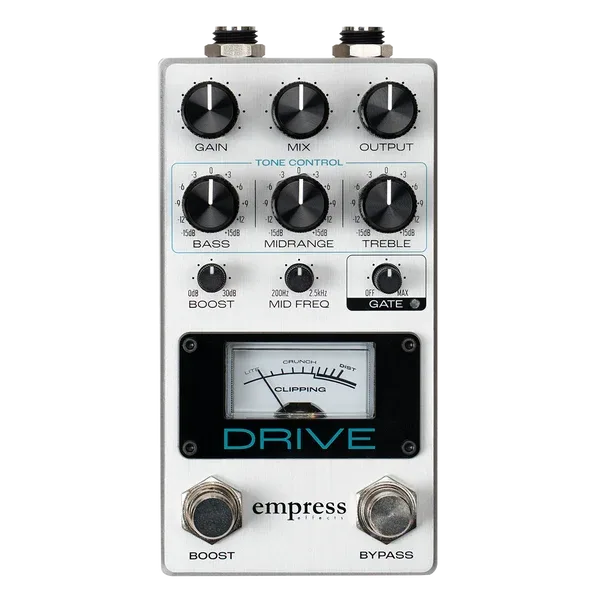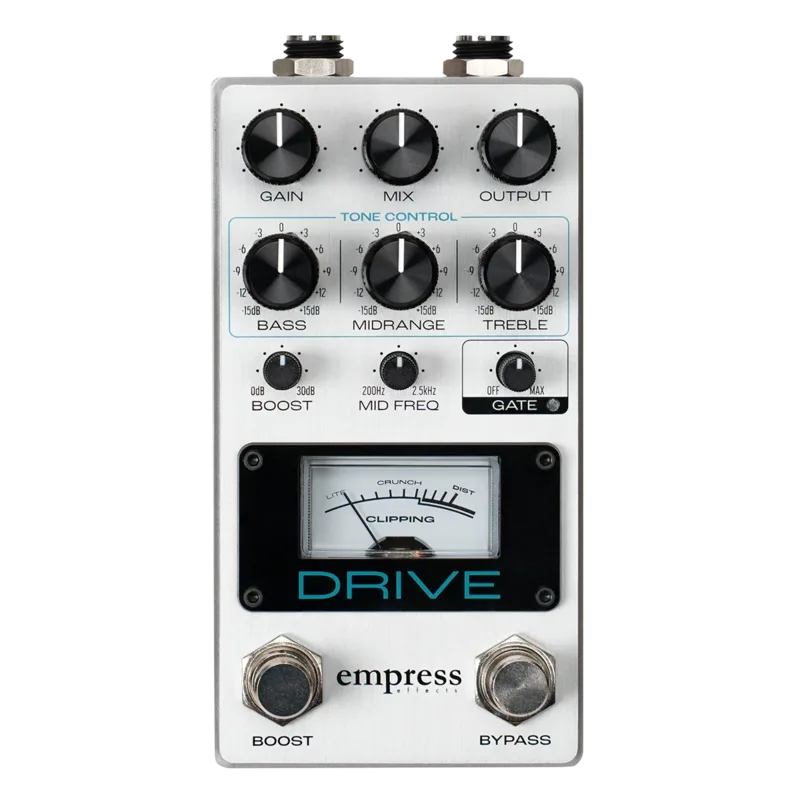
The Empress Drive is an analog overdrive pedal from Empress Effects, announced in May 2026. Where most overdrives are built around one fixed character, Empress positions the Drive as a set of tools for shaping your own: a sweepable midrange that sits before the gain stage, active Bass and Treble shelving filters after the Mix control, a clean blend, a built-in noise gate, and a footswitchable boost of up to 30 dB that can be routed before or after the clipping12.
The pedal runs on a fully analog signal path, which Empress describes as designed for organic breakup and natural compression1. Coverage at launch called it a versatile analog overdrive offering drive tones from subtle breakup to full-on drive23.
Controls and layout
The standard Gain, Mix and Output controls sit across the top of the pedal, with two footswitches below: a dedicated Boost footswitch and a standard Bypass footswitch2. A large VU meter shows how hard you are hitting the clipping circuit, with a selectable LED color2.
| Control | What it does |
|---|---|
| Gain, Mix, Output | Standard drive controls across the top row2 |
| Mid Frequency | Sweeps 200 Hz to 2.5 kHz; sits before the gain stage, deciding which frequencies create the distortion4 |
| Bass, Treble | Active shelving filters, placed after the Mix control so they affect clean and driven signals equally4 |
| Gate | Adaptive noise gate, from off (all the way left) to maximum gate (all the way right)46 |
| VU meter | Shows the amount of clipping, with selectable LED color2 |
The placement of the EQ is the unusual part. Because the Mid Frequency knob lives before the gain stage, it changes which frequencies get distorted rather than EQing the result. The Bass and Treble shelves, by contrast, live after the Mix control, so tweaking them affects the clean and driven signals equally4.
The Boost: up to 30 dB, pre or post
The Drive carries up to 30 dB of boost, footswitchable and assignable either pre- or post-overdrive1. The two modes do different jobs:
- Pre-overdrive pushes the clipping stage harder: it increases saturation and tightens the low end with a high-pass filter4.
- Post-overdrive raises volume without changing the gain, working like a conventional solo boost4.
The two Boost modes are switched by holding down both footswitches while powering the pedal up2. Delicious Audio's reviewer was blunt about the feature: "The Boost is a monster."4
The Gate
The noise gate is aimed at high-gain use, which is where analog drive pedals get noisy. It is adaptive rather than a simple threshold: it watches your input, opens when you play and closes when you stop, with a red LED indicating when the gate is closed4. On That Pedal Show, the presenters noted it "can be handy if you're using lots of high gain," with the knob all the way to the left for off and all the way to the right for maximum gate6.
Where the circuit comes from
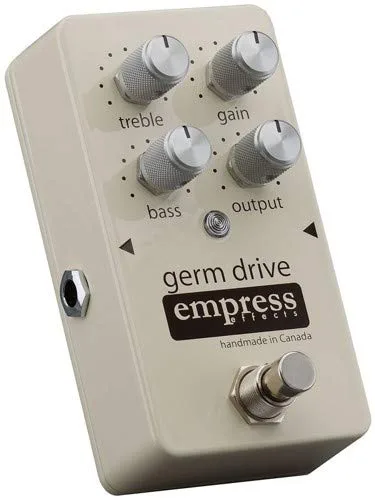
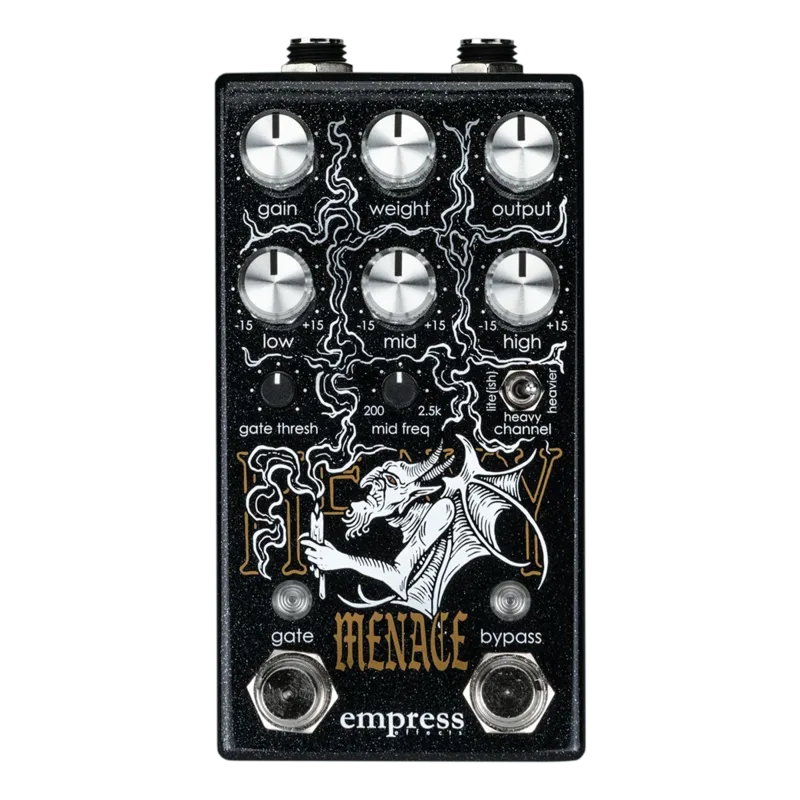
The Drive is not a from-scratch design. Premier Guitar reports the circuit is based on Empress' earlier Germ Drive, which simulated the breakup characteristics of an old Tweed amp7. Delicious Audio tells the story of how it came together: "Until they patched a discontinued Germ Drive circuit into the middle of a Heavy Menace prototype."4
On That Pedal Show, the presenters also heard family traits from further back: "there's some DNA from older Empress drive pedals."6 That lineage runs through Empress' earlier Germ Drive, a discontinued circuit that simulated the breakup characteristics of an old Tweed amp, and which Empress patched into a Heavy Menace prototype on the way to the Drive674.
What reviewers said
That Pedal Show's presenters found the Drive "really flexible but dialable to sound amazing," with "more life, more oomph, much more output and a wider band of EQ than standard overdrives," and said it reminded them of a color driver and the Timmy6. On the EQ, they found it "very powerful and boost-and-cut" and "super ampy," able to dial different guitars into a sweet place, though the downside is that you can get lost and must understand the EQ to get the most from it6.
"It kind of reminds me of what you'd get from something like a color driver, you know? I was thinking exactly the same thing"
They found it really flexible but dialable to sound amazing, with more life, more output and a wider band of EQ than standard overdrives6. Their caveat concerned the EQ: it is boost-and-cut and "so so so powerful," super ampy and able to dial different guitars into a sweet place, but the downside is that you can get lost in it and need to understand how the EQ works6.
Delicious Audio's reviewer focused on the meter and the boost, calling the VU meter honest reading of the clipping circuit and the Boost "a monster"4. Launch coverage at Guitar Pedal X summed up the tone-shaping angle: a sweepable midrange paired with active Bass and Treble shelving filters greatly expands the ability to sculpt the drive tone precisely2.
Questions
Is the Empress Effects Drive fully analog?
Yes. Empress describes the Drive as running on a fully analog signal path designed for organic breakup and natural compression. The pedal was announced in May 2026 as a versatile analog overdrive with mid shaping, boost routing, a clean blend and post-mix EQ.
How much does the Empress Effects Drive cost?
Published prices differ. Launch coverage in May 2026 put it at $299 USD, while a June 2026 review listed it at $399. Gearnews reported it available at Thomann for €299 at launch. Check the maker's current product page for the live price.
What does the Gate do on the Empress Drive?
The Gate is an adaptive noise gate aimed at high-gain settings. It watches your input signal, opens when you play and closes when you stop, with a red LED showing when the gate is closed. The knob goes from off, all the way left, to maximum gate, all the way right.
How do you switch the Boost modes on the Empress Drive?
The boost can be assigned pre- or post-overdrive, either to reshape saturation or simply to raise output level. The two distinct Boost modes are accessed by holding down both footswitches while powering the pedal up.
What does the VU meter show on the Empress Drive?
The large VU meter shows how hard you are hitting the clipping circuit, with a selectable LED color. Delicious Audio's reviewer put it simply: the VU meter doesn't lie, since it reads the actual clipping level rather than a knob position.
Does the Empress Drive have a Mid Frequency control?
Yes. The Mid Frequency knob sweeps from 200 Hz, for thick lower-mid emphasis, to 2.5 kHz, for biting upper-mid clarity. It sits before the gain stage, so it decides which frequencies create the distortion rather than shaping the finished tone.
Sources (7)
- Drive - Empress Effects Inc., Empress Effects Inc.
- Empress Effects Drive: Analog Drive with VU Meter!, gearnews.com, 2026-05-05
- Empress Effects Releases New Overdrive, Bass Magazine, 2026-05-11
- Empress Effects Drive, Delicious Audio, 2026-06-23
- Guitar Pedal X, Guitar Pedal X, 2026-05-05
- Four Fantastic Gain Pedals Empress Drive, CTC Triptychøn, Mad Prof Simble 2, EAE Citadel, That Pedal Show (YouTube), 2026-05-08
- Empress Effects Releases New Overdrive, Premier Guitar, 2026-05-05