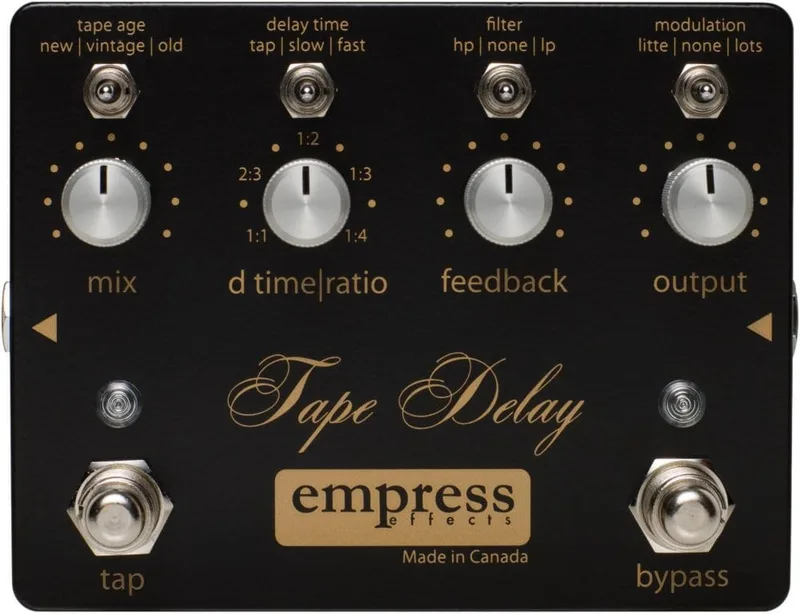


The Empress Effects Tape Delay is a compact delay pedal from Empress Effects that emulates the sound of tape echo in a small die cast box. Empress describes it as "rich, lush tape delay in an incredibly small box," and it carries the features players usually want from a tape-style unit: a tape age control for how dark the repeats get, a modulation control, and tap tempo with a ratio multiplier for rhythmic subdivisions like dotted eighths1.
What sets it apart from many tape emulations is its flexibility. In a 2013 demo, Pete Thorn noted that while its "sole Express purpose was obviously to create awesome tape delay type sounds," it also does "great digital delay type sounds" and "analog delay with modulation"2. It lists at $249.00 USD1.
What it does
The pedal produces repeats modeled on tape echo, the oldest type of delay effect in the studio world, originating in the fifties and sixties3. Tape delay gets its character from the medium itself: as JHS Pedals' Josh explains, "tape delay has this high-end roll-off, sort of flat sound," because each pass over the tape head wears away a little more top end and adds its own coloration4. The Empress pedal recreates that behavior digitally, with a signal to noise ratio around 103 dB, which Empress presents as a mark of its sound quality1.
The history behind the effect goes back further than the pedals. Tape delay was invented in the late 40s when Les Paul strung two Ampex Model 200A reel-to-reel tape recorders together5, and even earlier, in the 1920s, engineers learned they could copy a recorded track, splice it in, and hear the repeat4.
Tape age
The tape age control is the heart of the pedal's tape character. Empress says its "3 flavors of tape age let you choose how dark and gritty the repeats will get"1. In practice the switch has three positions: off, Vintage, and Old. Pete Thorn demonstrated the range in his 2013 review, switching the tape age "to its off position" for clean repeats, then engaging the aged settings; Old adds more saturation and more high-end rolloff than Vintage, simulating a more worn tape2.
Modulation and tap tempo
Modulation is handled with a single control that sweeps from none to lots, with no other adjustment over it. On That Pedal Show, Dan and Mick summed it up as "Modulation little none lots"6. Tap tempo comes with a ratio multiplier, so rhythms like dotted eighths are available by tapping quarter notes and selecting the subdivision1.
How it is controlled and powered
| Control or feature | What it does |
|---|---|
| Tape age switch | Off, Vintage, or Old; controls how dark and gritty the repeats get12 |
| Modulation control | One knob, from none to lots of modulation on the repeats6 |
| Tap tempo with ratio multiplier | Tap a tempo and select subdivisions such as dotted eighths1 |
| Presets | 0, 2, or 3 presets via advanced configuration1 |
| Bypass switching | True bypass, or buffered bypass with trails1 |
Power comes from a 9V DC supply with a negative tip on a 2.1mm barrel connector, drawing around 280mA1.
At roughly 280mA, this pedal draws far more current than a typical analog stompbox. A dedicated 9V power output is the practical choice; a small daisy chain supply shared with several other pedals may not keep up.
How it differs from the alternatives
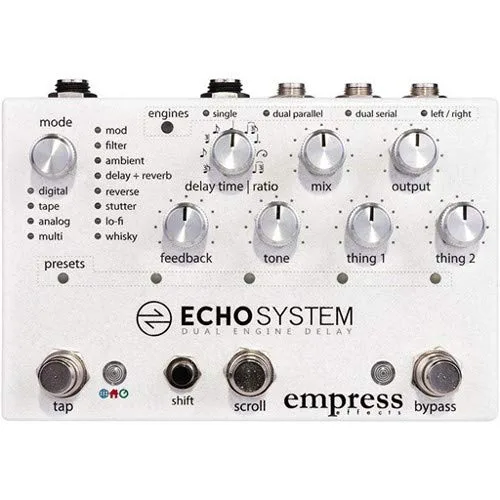
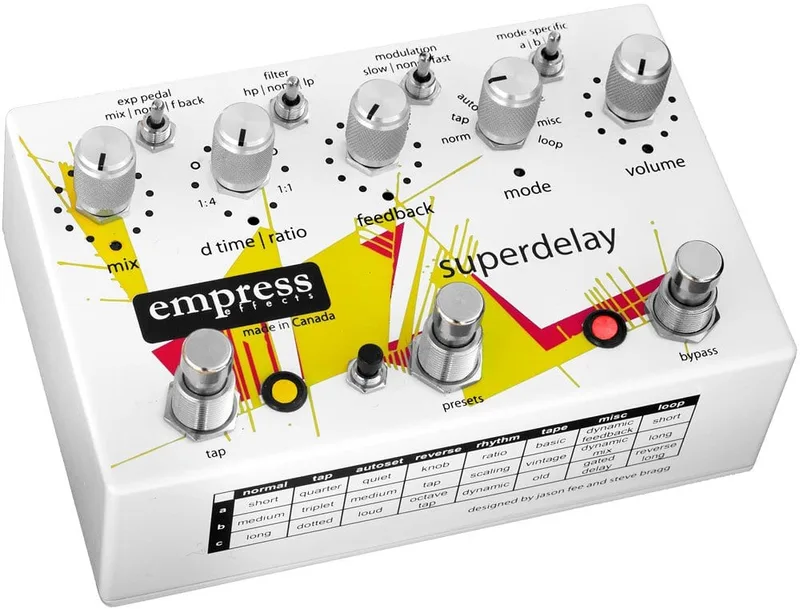
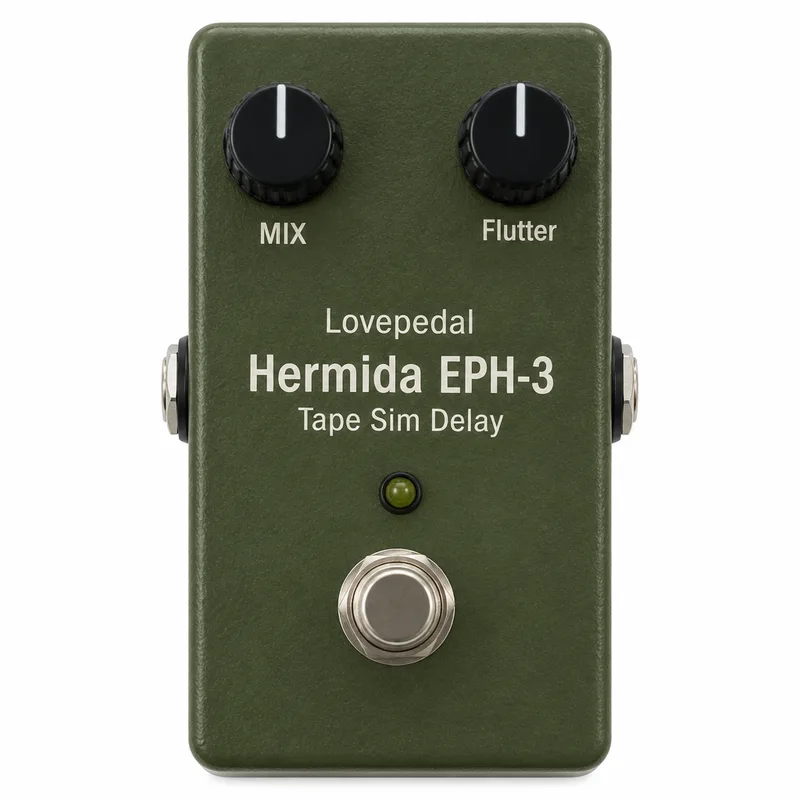
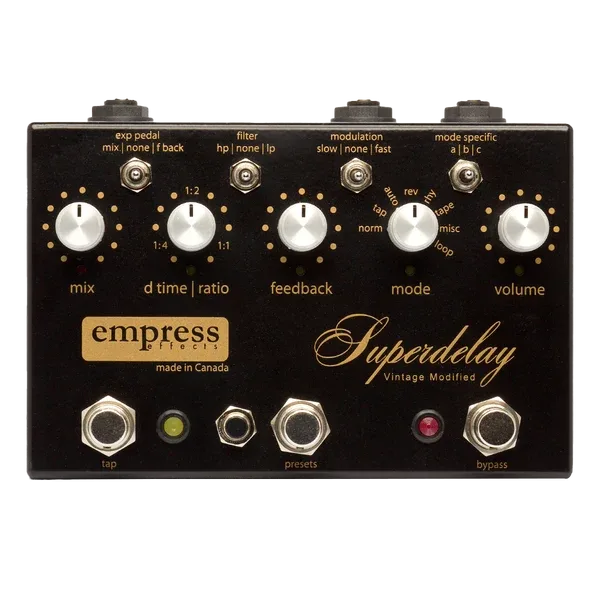
Within the Empress lineup, the Tape Delay is the focused, single-purpose option. Players who want a broader delay workstation can look at the Empress Effects Echosystem or the Empress Effects Superdelay, which trade the Tape Delay's small footprint for more engines and routing options. Against other makers' tape-style pedals, such as the Lovepedal Hermida EPH-3 Tape Sim Delay, the Empress unit's distinguishing features are its tape age switch, its preset configuration, and its choice of true or buffered bypass12.
Placement in the signal chain is worth thinking about with any tape-style delay. On Guitar World, Phillip McKnight argued "it's preferable to place it in front of the preamp because the tape delay has its own preamp that helps to boost your guitar signal"7.
What reviewers said
Pete Thorn's 2013 demo covered the pedal's range of tape, digital, and analog-flavored delay sounds2. On That Pedal Show in 2017, Dan and Mick found the delay "doesn't get in the way. Doesn't swap the sound," meaning the repeats support the guitar rather than dominating it, and they called the controls "extremely cool" overall6.
"doesn't get in the way. Doesn't swap the sound."
Buying notes
Empress also sells Scratch and Dent units of the Tape Delay at $199.00 USD, discounted from the regular $249.00. These are functionally perfect pedals with small cosmetic flaws such as a smudge on the screenprint, scratches, or a powdercoating defect, and they carry the same 2 year warranty, extendable to 4 years for free by registering the pedal8.
Videos
Pete Thorn
ProGuitarShopDemos
Empress Effects
Questions
Is the Empress Tape Delay true bypass?
Yes. The pedal employs true bypass, but you can choose buffered bypass with trails instead, so repeats continue to ring out after you switch the effect off. Both modes are available on the same unit.
Does the Empress Tape Delay have presets?
It can. Out of the box it runs without presets, but advanced configuration lets you set it up with 2 or 3 presets, so you can switch between stored delay settings from the pedal itself.
What does the tape age switch do?
It controls how dark and gritty the repeats get, with three flavors of tape age. The switch has an off position plus Vintage and Old settings; Old adds more saturation and rolls off more high end than Vintage.
What power supply does the Empress Tape Delay use?
It takes 9V DC with a negative tip on a 2.1mm barrel connector, and draws around 280mA. That current draw is high for a compact pedal, so a dedicated 9V supply is the practical choice.
Sources (8)
- Tape Delay, Empress Effects Inc.
- Empress Tape Delay, demo by Pete Thorn, youtube.com, 2013-12-30
- Best Tape Delay Pedal: Get the Sounds of Echoplex and Space Echo on your Board!, gearnews.com, 2025-06-16
- ORIGIN OF DELAY, JHS Pedals, 1920
- 3 SERIES TAPE DELAY, JHS Pedals
- That Pedal Show, That Pedal Show (YouTube), 2017-02-17
- Why Tape Delay Goes in Front of Your Amp, Guitar World, 2018-08-15
- S&D Tape Delay, Empress Effects Inc.