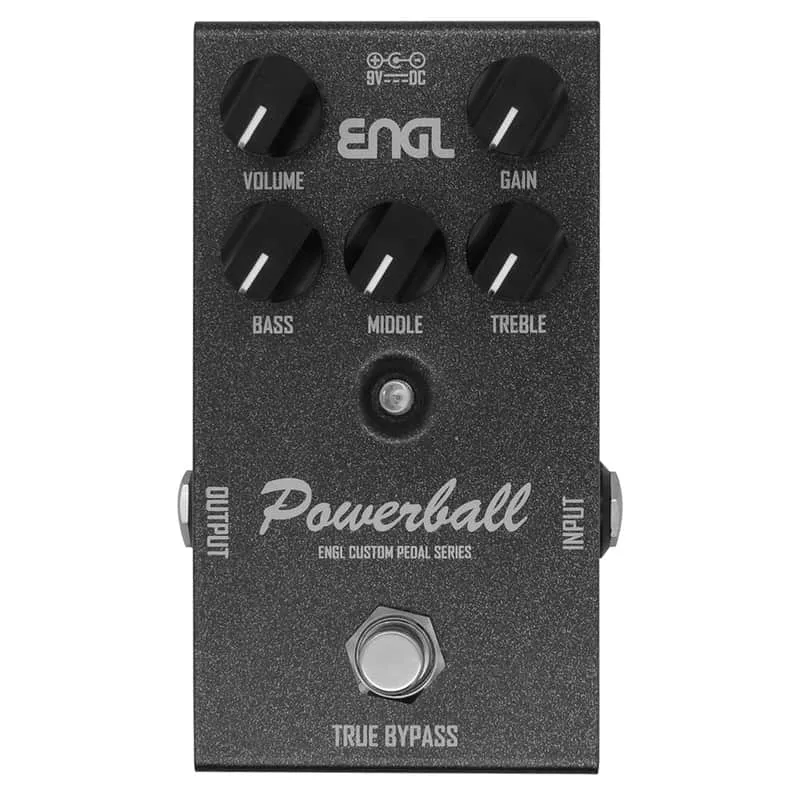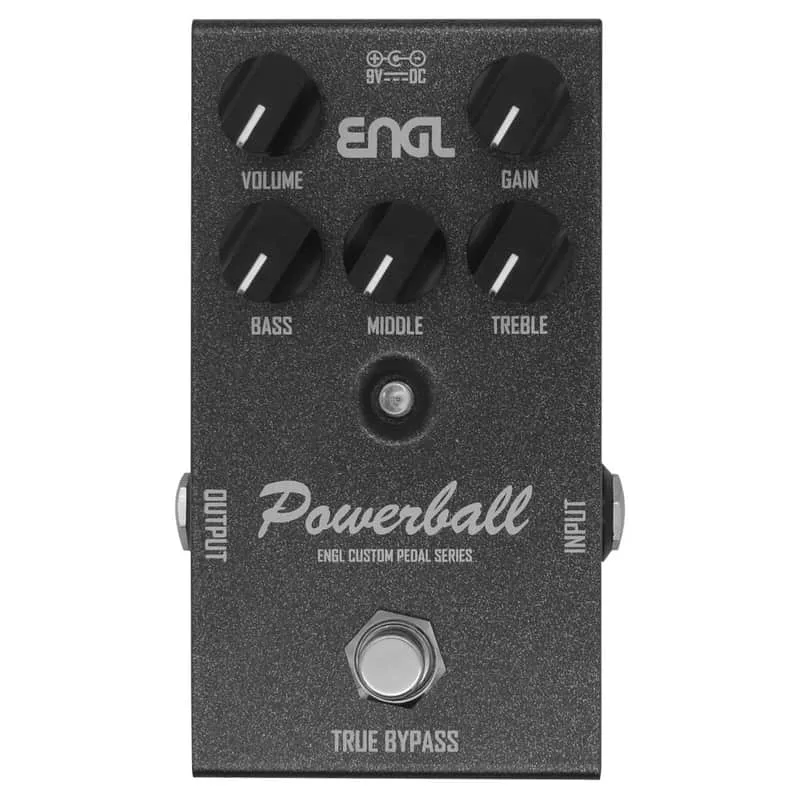


The Engl Powerball Distortion Pedal is a distortion pedal from German amp maker Engl, built as a compact stompbox. Its electronics assembly is protected by a high durable housing, which Engl says offers a pedal with the highest possible long time permanency1. A TRUE BYPASS footswitch turns the pedal effect on and off, and when the effect is off, the signal is routed directly from the input jack to the output jack1.
For players of distortion pedals weighing amp-in-a-box options, the appeal is straightforward: a high-gain channel from a known amp design, in a format that sits on a board rather than in a rack. Engl's own product listing for the related ENGL Powerball EP645 describes the pedal as "True bypass and completely analog"2, and Delicious Audio's Paolo De Gregorio called it "a high-quality analog distortion for the aggressive guitarist"1.
Controls
The pedal keeps its panel to three knobs plus the footswitch. Delicious Audio's control rundown1:
| Control | What it does |
|---|---|
| GAIN | Controls the amount of gain. Left is less, right is more |
| BASS | Controls the amount of low frequencies. Left is -7.5 dB, right is +7.5 dB |
| MIDDLE | Controls the amount of middle frequencies. Left is -7.5 dB, right is +7.5 dB |
| TRUE BYPASS footswitch | Turns the effect on and off; when off, the signal is routed directly from the input jack to the output jack |
The Bass and Middle knobs each cover a 7.5 dB cut-to-boost range, which is a fairly tight EQ sweep: enough to shape the pedal for a darker or brighter guitar, but not a full tone-stack replacement. Players used to a treble knob on amp-style pedals will notice its absence; the documented controls are Gain, Bass and Middle only1.
Circuit and bypass
The pedal is fully analog, both in its effect circuit and in its bypass scheme. Engl's product information lists the circuit type as analog with true bypass2, and Delicious Audio concurred: "It uses a true bypass and is designed completely analog"1. In practice, true bypass means that with the effect switched off, your guitar's signal passes straight from input to output with no buffering in the way, which matters on larger boards where several pedals sit in series.
Where it came from
The pedal's true bypass switching means that when the effect is off, the signal runs straight from the input jack to the output jack with the pedal out of the path1. Physically, the electronics assembly sits inside a high durable housing that Engl describes as protecting the circuit for long time permanency1.
Build
Delicious Audio notes that "the electronics assembly is protected by a high durable housing to offer you a pedal with the highest possible long time" permanency, framing the enclosure as built for years of floor use1.
Videos
Ola Englund
Science of Loud
Guitar Bonedo
Questions
Is the Engl Powerball distortion pedal true bypass?
Yes. Engl's product information lists the Powerball pedal as true bypass and completely analog, and Delicious Audio's Paolo De Gregorio likewise wrote that it uses a true bypass and is designed completely analog. When the effect is off, the signal is routed directly from the input jack to the output jack, so the pedal stays out of your signal path.
Is the Engl Powerball pedal analog or digital?
It is analog. Engl's product information lists the circuit type as analog, and Delicious Audio described it as a high-quality analog distortion for the aggressive guitarist, designed completely analog with true bypass switching.
Which Engl amp channel is the Powerball pedal based on?
The Powerball pedal is tonally based on the Lead2 channel of the Engl Powerball II amplifier, recreating the gain stages of that channel in pedal form. Guitar Pedal X described it as Engl delivering its Powerball amp lead channel in a compact high gain pedal format.
Does the Engl Powerball pedal have a treble control?
The pedal's tone shaping comes from its Bass and Middle knobs, each of which cuts or boosts its frequency band by up to 7.5 dB. A dedicated treble knob is not among the controls documented for the pedal, which lists Gain, Bass and Middle.
How much can the Bass and Middle knobs boost or cut?
Each of the two EQ knobs has a range of 7.5 dB in either direction: turned fully left the Bass and Middle controls cut their bands by 7.5 dB, and turned fully right they boost by 7.5 dB, according to Delicious Audio's control rundown.
Sources (2)
- Engl Powerball Distortion Pedal, Delicious Audio, 2020-09-29
- Powerball EP645 by ENGL, RockBoard PedalPedia, 2026