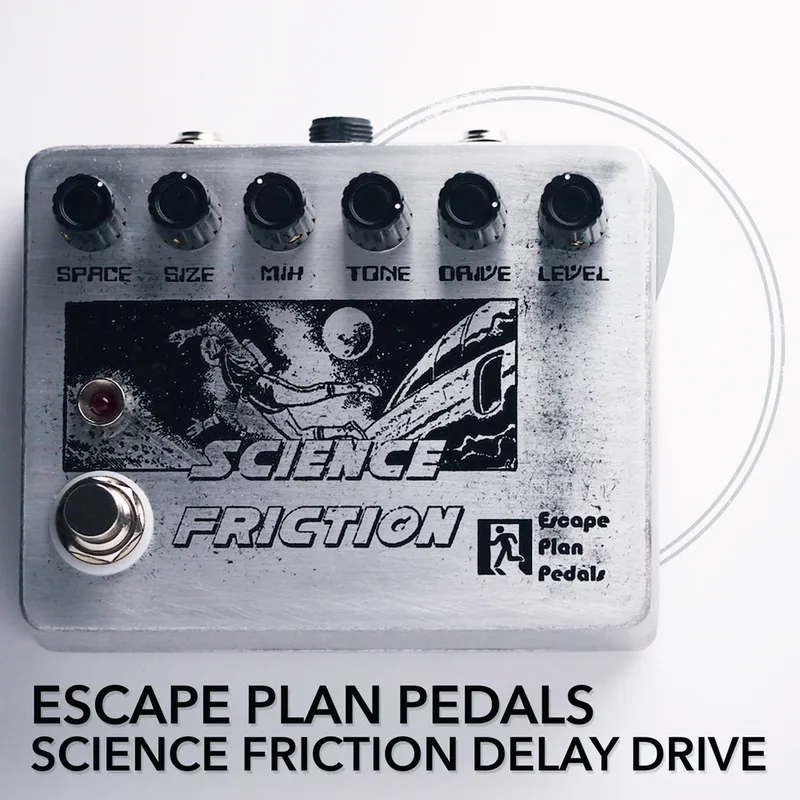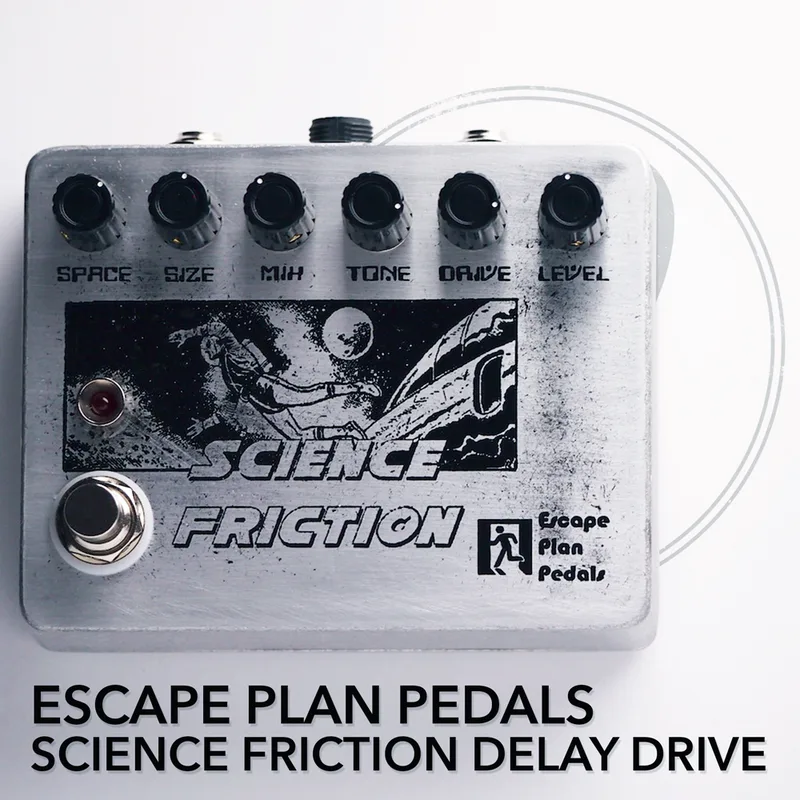
The Science Friction Interplanetary Delay Drive is a delay and overdrive combination pedal from Escape Plan Pedals. Pedal of the Day described it as a pedal that "mixes the grit of overdrive with the echoes of delay," built around a control panel of six knobs and nothing else1. Delicious Audio, announcing the pedal in August 2016 as the Science Friction delay, called it a design that "marries delay and overdrive into a creative combination design"2.
How the signal order works
The unusual part of the Science Friction is which circuit comes first. Pedal of the Day noted that it "actually takes the delay and feeds IT into the drive section, rather than having the delay AFTER the dirt"1. Delicious Audio's description matches: "the circuit is designed with the dirt AFTER the delay circuit, giving the effect focus on the delay aspect while integrating the overdrive underneath it"2.
For a player, that order means the overdrive acts on the echoes as well as the dry signal, so the drive sits under the delay rather than smearing it. It is a different arrangement from running a standalone delay pedal into a separate overdrive pedal, where the dirt would come first and the repeats would stay clean.
The controls
Both reviews describe the same six-knob layout, which Delicious Audio called "an array of six simple knobs, making it easy to use and extremely fun to experiment with"2.
| Control | What it does |
|---|---|
| Space | Controls the time between echo repeats1 |
| Size | Adjusts the number of the repeats, much like a Feedback knob2 |
| Tone | A versatile tone section that also affects the delayed signal; Delicious Audio calls it an EQ that affects the delayed signal1 |
| Drive | Sets the overall gain level of the overdrive, "from slight to furious" per Pedal of the Day; Delicious Audio describes it as setting the input gain level of the overdrive1 |
| Level | The pedal's master volume control1 |
Space and Size are the two that set the delay itself: Space is the time between repeats, and Size is how many repeats come back. Tone reaches into the delayed signal, so it shapes the character of the echoes, not just the dry tone12.
What reviewers said
Pedal of the Day's reviewer heard a wide range from the time knob: "allowing for spacey, post-punk sounds, surf rock-style slap back tones and even add a little reverb with the echo time turned down"1. The same reviewer found a lead use for it: "This wicked rad pedal can also be a great lead/solo effect, as you basically can set it to be a tasty delay for lead licks"1.
Delicious Audio suggested the pedal for players after vintage-flavored echo: "musicians into psychedelia and post-punk tones, or even classic rock style Echoplex sounds, should find plenty of inspiration"2. The pedal was newly announced at the time of that write-up, with Delicious Audio inviting players to try it at the Brooklyn Stompbox Exhibit at Main Drag Music2.
Videos
gearmanndude
Pedal of the Day
Questions
Is the delay before or after the overdrive on the Interplanetary Delay Drive?
The delay feeds into the drive section, rather than the delay sitting after the dirt. Delicious Audio describes the circuit as having the dirt after the delay circuit, which puts the focus on the delay aspect while the overdrive sits underneath it. That order shapes how the repeats take on grit as they pass through the drive.
What does the Tone knob affect on the Science Friction?
Tone is a versatile tone section that also affects the delayed signal, according to Pedal of the Day. Delicious Audio describes it as an EQ that affects the delayed signal, so turning it shapes the character of the echoes as well as the overall voice of the pedal.
Can the Science Friction do slapback echo?
Pedal of the Day's reviewer says so: with the echo time turned down, the pedal can produce surf rock-style slapback tones, reverb-like tones, and spacey post-punk sounds. The Space knob controls the time between echo repeats, which is what makes those short settings possible.
What is the difference between the Space and Size knobs?
Space controls the time between echo repeats, which is the delay time. Size adjusts the number of repeats, much like a Feedback knob on a conventional delay. In short, Space sets how far apart the echoes are, and Size sets how many of them you hear.
Sources (2)
- Escape Plan Pedals Science Friction Interplanetary Delay Drive, Pedal of the Day, 2016-05-16
- New Pedal: Escape Plan Pedals Science Friction Delay, Delicious Audio, 2016-08-30