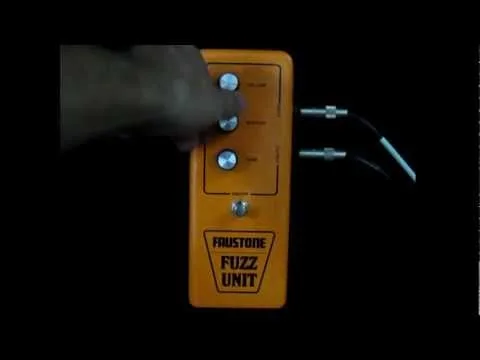
The Faustone Fuzz Unit is a DIY vero board layout of the Barnes and Mullins (B&M) Champion Fuzz Unit, a rare British fuzz pedal. The layout was published on the Guitar FX Layouts blog in January 2016, and the author based it on an April 1977 original that he "carefully dissected, studied and re-assembled"1. For players who build their own pedals, it offers a way to reproduce a fuzz that few will ever see in the flesh, and one that sits in the same family as the Big Muff style circuits most fuzz players know.
What it does
As a fuzz, the Fuzz Unit produces the thick, sustaining distortion the fuzz family is known for, but its lineage shapes the character. The layout's author describes the original B&M circuit as "electronically the British cousin of the Electro Harmonix Big Muff", essentially a Big Muff with the fourth transistor position removed1. Where a Big Muff uses the ubiquitous BC184C transistors, the Fuzz Unit features Zetex brand transistors instead1.
The transistor choices are central to the sound. Two ZTX383C transistors, with a gain of around 600, occupy the first two positions (Q1 and Q2), while a lower gain ZTX382B, with a gain of 150, sits at Q3. The author credits that lower gain third stage as "the key to achieving the characteristic musical flute-like sound of the original pedal"1.
Building it
The layout went through one revision. In the first version, the author forgot to swap lugs 1 and 3 of the tone control, and the layout was updated and tagged on 19 January 2016 once that was fixed. The author reports the build working, and commenters verified it as well1.
A few details worth knowing before you build:
- The layout omits the 220K output resistor for increased output1.
- The tone control lugs 1 and 3 must be wired per the corrected layout; the first version had them flipped1.
- On the 470K feedback resistor on Q3, the author offers a theory: "My theory is that the 470K feedback resistor on q3 mixes in some clean signal", which he ties to how single-clipping-stage muff variants behave1.
This is a DIY layout, not a commercial product. It is aimed at players who etch or order their own vero boards and source their own parts, including the Zetex transistors the circuit calls for1.
Questions
Is the Faustone Fuzz Unit a Big Muff clone?
Close, but not identical. The layout's author describes the original Barnes and Mullins Champion Fuzz Unit as the British cousin of the Electro Harmonix Big Muff, essentially a Big Muff circuit minus the fourth transistor position. It also uses Zetex brand transistors instead of the BC184Cs commonly found in Big Muff style circuits, and the lower gain third transistor is credited with the pedal's flute-like character.
What does the Faustone Fuzz Unit sound like?
The layout's author attributes a characteristic musical flute-like sound to the original pedal, and ties it to the lower gain transistor in the third position of the circuit. He also suggests that fuzz variants with only one clipping stage mix a bit of clean-ish signal into the output through the 470K feedback resistor on Q3, which would soften the fuzz somewhat compared with a full Big Muff.
Sources (1)
- Guitar FX Layouts: Faustone Fuzz Unit, Guitar FX Layouts (tagboardeffects.blogspot.com), 2016-01-16