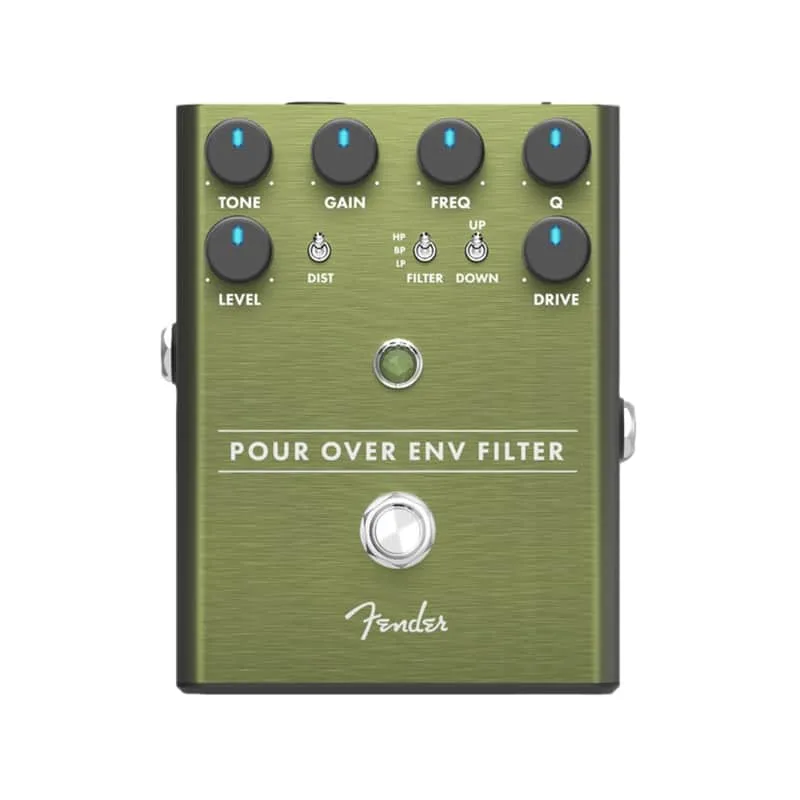


What sets the Pour Over apart from most pedals in its class is a switchable onboard distortion circuit with its own tone and gain controls1. That means you can run the filter clean, or push grit into the sweep for a more aggressive, synth-like character.
How the Pour Over works
The Pour Over is an analog envelope filter, as Sweetwater's demo presenters Don Carr and Stan Cody put it plainly: "This is an analog envelope filter, does low pass, band pass, high pass"3. The filter switch selects which part of the frequency spectrum the sweep moves through:
- Low-pass (LP): the filter opens from the bottom up, letting highs in as you play harder. The most common auto-wah sound.
- Band-pass (BP): the sweep focuses on a band of frequencies, giving a more vocal, quacky character.
- High-pass (HP): the filter moves from the top down, thinning the sound and emphasizing the low end as the sweep engages.
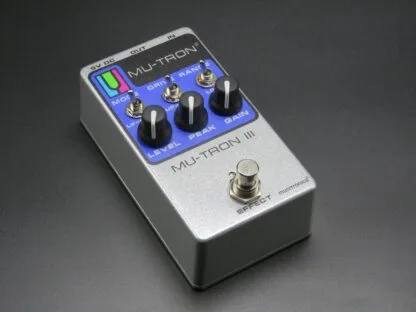
A separate Up/Down switch reverses the direction of the sweep, so the filter can close down as you play harder instead of opening up. Guitar World's reviewer Trevor Curwen noted that this control layout follows a familiar lineage: "Fender's first foray into the genre has a similar set of controls to a Mu-Tron on the right with the familiar three-way" filter choice and Up/Down switch2. Players who know the classic Mu-Tron envelope filters will recognize the format immediately.
Controls
The Pour Over carries a deep control set for an envelope filter. Guitar.com's reviewer Richard Purvis observed that "the Pour Over has more knobs and switches than most pedals of its type and scores highly for versatility"1.
| Control | What it does |
|---|---|
| Tone | Shapes the character of the distortion circuit21 |
| Gain | Sets the gain of the distortion circuit21 |
| Freq | Sets the base frequency of the filter sweep21 |
| Q | Sets the intensity or resonance of the filter peak21 |
| Level | Sets the output level21 |
| Drive | Sets the sensitivity of the envelope response to your attack21 |
| Distortion switch | Turns the onboard distortion circuit on or off21 |
| Filter switch | Selects high-pass, band-pass or low-pass filter type21 |
| Up/Down switch | Sets the direction of the filter sweep21 |
| LED kill switch | Turns the pedal's indicator LEDs off21 |
| Bypass footswitch | True bypass on/off2 |
The Drive control is the heart of any envelope filter: it determines how much attack it takes to trigger the sweep. Set it high and a light touch sets the filter moving; set it low and you need to dig in.
The onboard distortion
The distortion section is what makes the Pour Over more than a straight filter pedal. MusicRadar's editor Michael Astley-Brown described the pedal as coming "with an onboard distortion circuit" when Fender announced the range5. The distortion has its own Tone and Gain knobs, and Guitar.com's reviewer found it "can get pretty gnarly by itself"1. Running grit into the filter sweeps pushes the effect toward synth territory, which is where Guitar World's reviewer found its appeal: "There's plenty to explore with the Pour Over Envelope Filter if you're up for taking your pedalboard in a more leftfield" direction, with the onboard gain adding grit and a synth-esque quality to the sweeps2.
Power and practicalities
The Pour Over runs on a 9V battery or a 9V DC adapter, drawing 75mA2. The adapter is not supplied, so plan on supplying your own power. The pedal is true bypass, so it leaves your signal alone when switched off2. It is housed in Fender's anodized aluminum enclosure, the same housing used across the company's pedal range, and it is made in China21. Its dimensions are listed as 95 (w) x 125 (d) x 64mm (h)2, so it takes up a moderate slice of pedalboard real estate.
The 75mA current draw is modest by modern standards, but the pedal ships without a power supply. A standard 9V DC center-negative pedal supply or a 9V battery will run it.
Where it came from
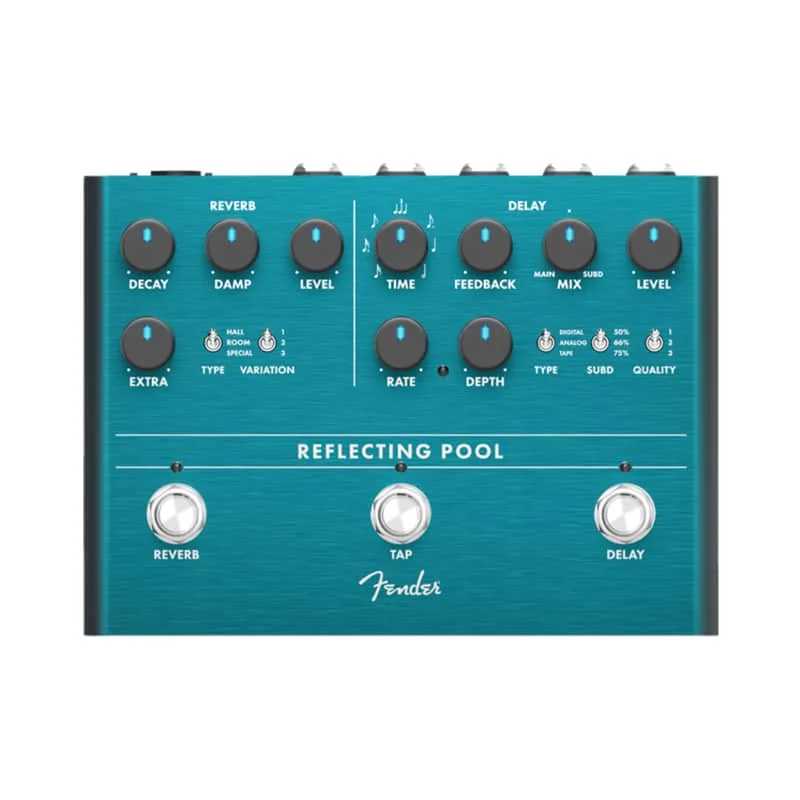
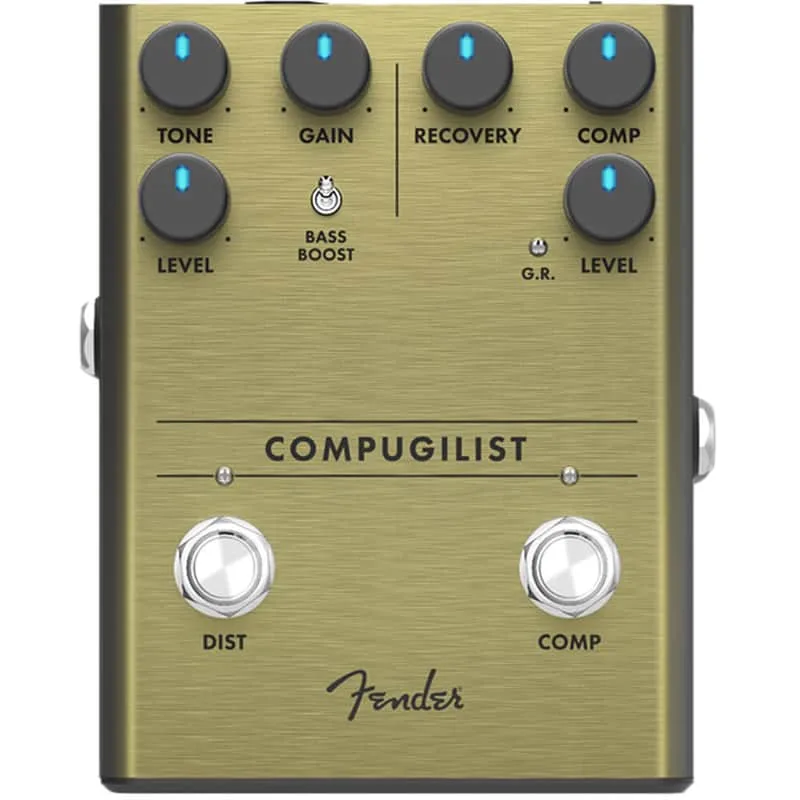
Fender introduced the Pour Over at Summer NAMM in July 2019 as part of a six-pedal expansion of its effects line, alongside the Reflecting Pool delay, the MTG: LA, the Compugilist, The Trapper fuzz and the Smolder4. At announcement, Gearnews listed the Pour Over's recommended retail price as USD 1494; by the time of Guitar World's review the price was listed at $179.992. Guitar World's news coverage of the launch highlighted the pedal's "selectable High-Pass, Low-Pass and Band-Pass filter types, as well as sweep direction" as part of a comprehensive control set6.
What reviewers said
Published reviewers were positive about the Pour Over's depth and versatility:
- Guitar World (Trevor Curwen): found "plenty to explore" for players taking their pedalboard in a more leftfield direction, with the onboard gain adding grit and a synth-esque effect to the filter sweeps, and called it "very cool" overall2.
- Guitar.com (Richard Purvis): noted the pedal "has more knobs and switches than most pedals of its type and scores highly for versatility," and that the switchable distortion "can get pretty gnarly by itself"1.
Sweetwater's demo video walks through the three filter modes and the distortion circuit352:
In the demo, Don Carr and Stan Carr cover the low-pass, band-pass and high-pass modes and show how the analog filter responds to picking dynamics3.
Videos
Fender
Fender
Ross Campbell
News
Questions
Is the Fender Pour Over made for bass or guitar?
It is an envelope filter pedal for guitar, part of Fender's six-pedal effects range announced at Summer NAMM 2019. An envelope filter, sometimes called an auto-wah, responds to how hard you pick, so it works with any instrument with a strong output. Fender's take on the format follows the classic Mu-Tron control layout.
Can the Fender Pour Over run on a battery?
Yes. It runs on a 9V battery or a 9V DC adapter, drawing 75mA. The adapter is not supplied with the pedal, so you need to supply your own power or use the battery option.
Is the Fender Pour Over true bypass?
Yes, the Pour Over has true bypass switching, so with the pedal off your signal passes through without active circuitry in the path. It also has an LED kill switch to turn the indicator lights off.
What filter modes does the Pour Over have?
It offers three filter types: low-pass, band-pass and high-pass, selected by a three-way switch. An Up/Down switch sets the direction of the sweep, so the filter can open up or close down as you play harder.
Where is the Fender Pour Over made?
The Pour Over is made in China, like the rest of Fender's pedal range from that era. It is housed in Fender's anodized aluminium enclosure, the same style used across the company's effects line.
Does the Pour Over include a power supply?
No. The pedal runs on a 9V battery or a 9V DC adapter, and the adapter is not supplied. You will need to provide your own power supply or keep a fresh 9V battery in the compartment.
Sources (6)
- Review: Six new Fender effects pedals, Guitar.com, 2020-02-03
- Fender Pour Over Envelope Filter review, Guitar World, 2020-07-24
- 6 New Fender Pedals at Summer NAMM 2019, Sweetwater, 2019-07-23
- Summer NAMM 2019: Fender pedal range expanded with 6 new models, gearnews.com, 2019-07-18
- Summer NAMM 2019: Fender grows effects line with 6 wide-reaching new pedals, MusicRadar, 2019-07-18
- Fender Introduces Six New Effects Pedals, Guitar World, 2019-07-25