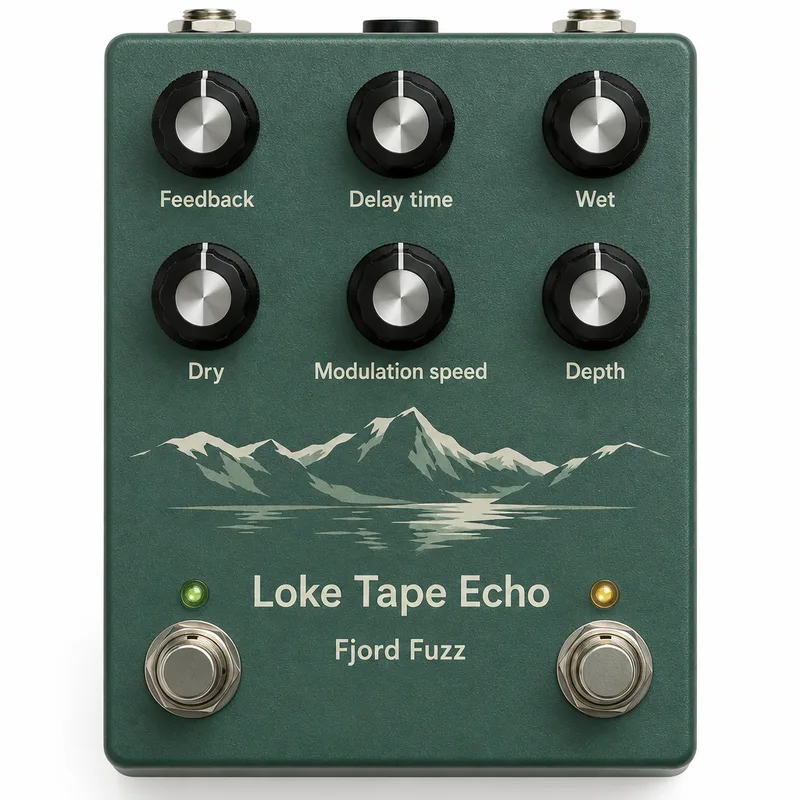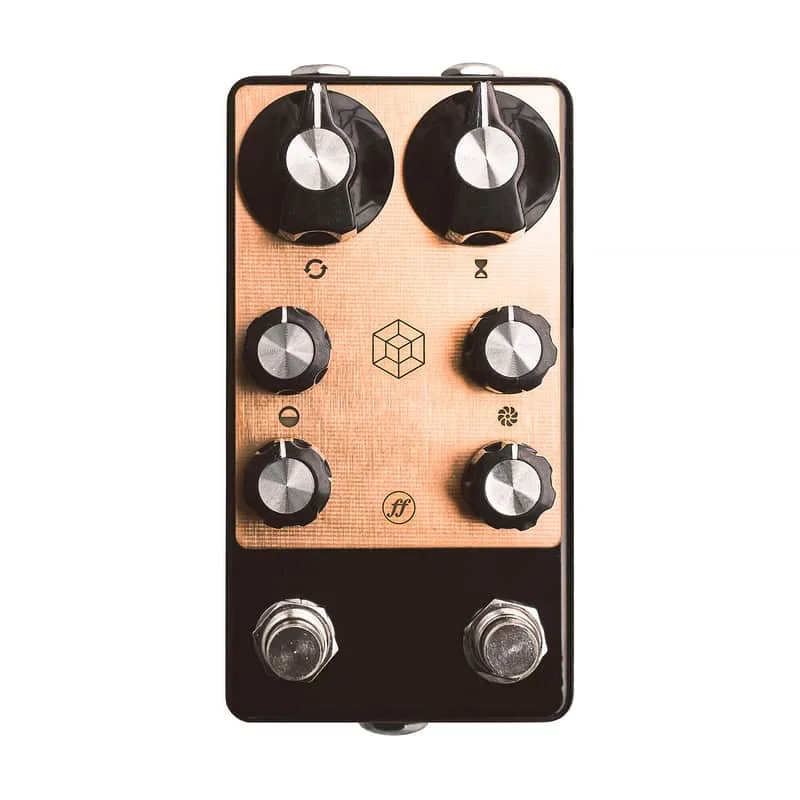


The Fjord Fuzz LOKE is a delay pedal from the Norwegian maker Fjord Fuzz that approaches the delay format from a different angle than most. Fjord Fuzz describes it as mimicking playing back tape recordings between different tape machines, letting you delay the time across one of them to warp the summed signal into double tracking, flanging, warble, chorus, vibrato and tape echoes1. Delicious Audio's Paolo De Gregorio called it "a very interesting reel-to-reel style delay pedal"2.
What it does to your sound
The core idea is duality. According to Delicious Audio, the pedal is named after Loke, the Norse god of mischief, the embodiment of duality, and "LOKE gives you two almost identical signals," each with enough output to drive your preamp into overdrive, one with a slight tape tint that can be shifted in time by 0 to 100ms or 0 to 400ms2. Because the two signals are so close, small shifts between them produce the classic tape-machine effects: flanging, chorus, vibrato, warble and doubled sound.
Delicious Audio sums up the range this way: "All of this together offers you the full suite of exciting effects found on old school reel-to-reel tape gear," including Beatles-style tape flange tricks, lofi warped vinyl textures, flanger, chorus, vibrato, distorted tape delays, artificial stereo-widening double tracking, faux reverb, percussive tape echo with machine errors, whale calls and full wet delay2. The pedal works as a virtual reel-to-reel tape deck in that sense2. Guitar Pedal X's Stefan Karlsson, reviewing it among 2023's time-based releases, wrote that it "not just covers you for Short to Medium Delays, but delivers Overdrive, Faux Reverb, Chorus, Tape Flanging and more," aided by randomised modulation4.
Fjord Fuzz says the LOKE takes its inspiration from 60s and 70s recording techniques, including the Beatles-style thumb-on-the-tape flanger sound1. The mixing section offers fully individual wet and dry controls, both of which allow for a good bit of preamp drive beyond midnight, in the maker's words, so the pedal can also push an amp or act as a boost into overdrive territory1.
Controls and footswitches
| Control | What it does |
|---|---|
| Delay time (large knob, top) | Sets the delay length; can also be controlled via the expression input2 |
| Feedback (large knob, top) | Sets delay repeats2 |
| Modulation speed (small knob, right side) | Sets modulation rate2 |
| Depth (small knob, right side) | Sets modulation amount2 |
| Wet and dry level | Fully individual mix controls, each with preamp drive available1 |
| Secondary footswitch | Toggles between 100ms and 400ms max delay length1 |
The secondary footswitch is worth understanding, because it is central to how the pedal works. Fjord Fuzz says it toggles between the two maximum delay lengths "not by switching a digital programme," but through resistor logic, producing a tape accelerating or decelerating sound in real time1. In practice, that means switching lengths sounds like a tape machine speeding up or slowing down rather than jumping between presets.
The random LFO behind the pedal's randomised modulation was designed by Fjord Fuzz's own Eirik Nordstrand, described by the maker as his grand opus1.
The summer and autumn version of the LOKE features internal switching that lets you swap between true bypass mode and a delay tails mode where the preamp stays on when you turn the delay off, a change Fjord Fuzz notes was made at the request of a player known as Hoochie1. Earlier units differ, so it is worth knowing which version you have.
Power and expression
The Loke runs on 9V DC, center negative, and draws 250mA according to RockBoard's PedalPedia listing3. That is a substantial draw for a single pedal, so a dedicated output on your power supply is the practical choice.
An expression input lets you alter the delay length in real time. Fjord Fuzz puts it simply: "You can also alter the delay length in real time via expression pedal control"1. Delicious Audio notes that the expression control gives you the option of warping the time parameter with hands-free operation, which is where much of the tape-warble character comes from in use2. Any standard expression pedal plugged into the input handles this.
Analog or digital?
Published sources describe the circuit differently. RockBoard's PedalPedia lists the circuit type as analog3, while Delicious Audio's November 2023 introduction of the Loke Tape Echo described it as Fjord Fuzz's first digital effect3. What both agree on is the concept: a pedal that behaves like a virtual reel-to-reel tape deck2, built around two nearly identical signals shifted against each other.
Price and availability
Fjord Fuzz lists the LOKE at $299.00 USD on its product page as of October 20261. When Guitar Pedal X covered it in its 2023 time-based effects roundup, it was listed at $1994, so the price has increased since launch. The maker says the pedal usually ships in about 2 to 6 weeks1.
Videos
Andertons Music Co
Fjord Fuzz AS
Fjord Fuzz AS
Questions
How much does the Fjord Fuzz Loke cost?
Fjord Fuzz lists the LOKE at $299.00 USD on its own product page as of October 2026. When Guitar Pedal X reviewed it in December 2023, it was listed at $199, so the price has risen since launch. The pedal usually ships in about 2 to 6 weeks from the maker.
What power supply does the Loke need?
The Loke runs on 9V DC, center negative, and draws 250mA according to RockBoard's PedalPedia listing. That current draw is high enough that a low-output daisy-chain supply may not be adequate, so a dedicated or higher-current output on your power supply is the safe choice.
Is the Fjord Fuzz Loke analog or digital?
RockBoard's PedalPedia lists the Loke's circuit type as analog. Delicious Audio's 2023 introduction described it as Fjord Fuzz's first digital effect, so published sources disagree on how the circuit is best described. What is consistent is that it models a virtual reel-to-reel tape deck.
Is the Loke true bypass?
Yes, and more. The summer and autumn version adds internal switching that lets you choose between true bypass mode and a delay tails mode where the preamp stays on when you turn the delay off.
What are the two delay length settings on the Loke?
A secondary footswitch toggles between a 100ms and a 400ms maximum delay length. Fjord Fuzz says this works through resistor logic rather than switching a digital programme, producing a tape accelerating or decelerating sound in real time.
Can you use an expression pedal with the Loke?
Yes. The Loke has an expression input that lets you alter the delay length in real time, giving hands-free warping of the time parameter while you play.
Sources (4)
- LOKE, Fjord Fuzz
- Fjord Fuzz Loke Tape Echo, Delicious Audio, 2023-11-10
- Loke by Fjord Fuzz, RockBoard PedalPedia, 2026
- Guitar Pedal X, Guitar Pedal X, 2023-12-20