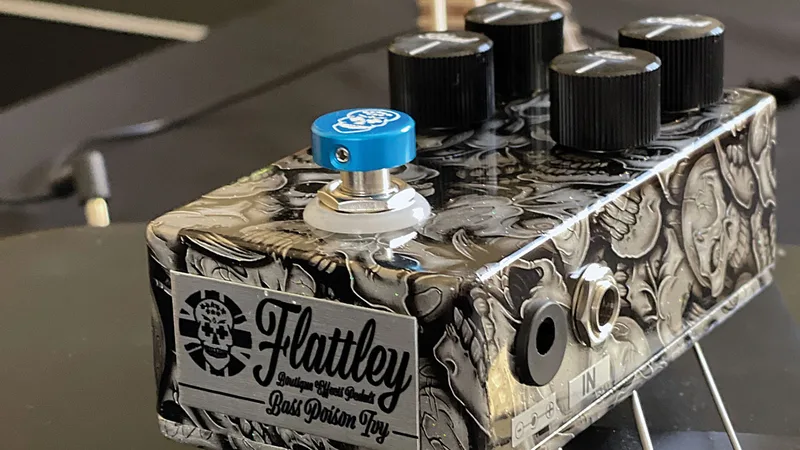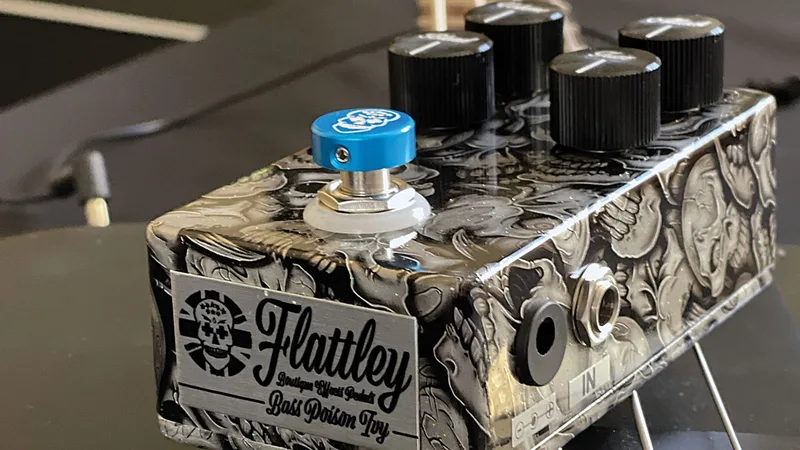


The Flattley Bass Poison Ivy is a bass fuzz and overdrive pedal from UK maker Flattley Guitar Pedals, listed at $3491. Reviewed by Guitar World's Joel McIver in July 2022 alongside its sibling, the Flattley Bass Chief, it is built to push a bass signal into overdriven and fuzzy territory. McIver described the pair as "highly user-friendly pedals"1.
Controls
The Poison Ivy has four controls, giving the player direct shaping of the drive character and how it sits with the clean signal1.
| Control | What it does |
|---|---|
| Volume | Sets the pedal's output level |
| Attack | Dials in welcome clarity, per Guitar World's reviewer |
| Blend | Mixes the effected signal with the clean bass signal |
| Fuzz | Maxing it out achieves "a thoroughly screamy distortion" |
The Blend control is the one bass players usually look for first on a drive pedal, since it lets the low end stay intact underneath the fuzzed-up top. The Attack control is what sets the Poison Ivy apart from the Bass Chief: McIver wrote that it "gives you an overdriven tone with more clarity than its sibling thanks to the presence of an Attack control"1.
How it compares with the Flattley Bass Chief
Guitar World reviewed the Poison Ivy and the Bass Chief together as "two bass overdrive and fuzz pedals", both listed at $349 each and both "recently updated for a more convenient layout"1. The practical difference for a player choosing between them is clarity: the Poison Ivy's Attack control lets you dial in a more defined overdriven tone, while the Chief is the sibling without that control. Both pedals cover the same ground of overdrive and fuzz for bass, and both weigh in at 12.3 oz and 11.4 oz respectively in the review's specifications1.
"Roll this into its second hemisphere and max out the Fuzz control, and you can achieve a thoroughly screamy distortion"
Power and practical details
The pedal runs on 9-volt DC power and is true bypass, so it switches out of the signal path completely when off1. At 11.4 oz it is light enough for any pedalboard1.
The figures here come from Guitar World's July 2022 review. The review notes both pedals were recently updated for a more convenient layout, so earlier versions may differ.
Videos
Flattley Guitar Pedals
Flattley Guitar Pedals
Mad Steex
Questions
Is the Flattley Bass Poison Ivy true bypass?
Yes. Guitar World's review lists the Poison Ivy as true bypass, meaning the pedal takes itself fully out of the signal path when switched off, so your bass's tone reaches the amp unchanged until you engage the fuzz or overdrive.
What power does the Flattley Bass Poison Ivy need?
The Poison Ivy runs on 9-volt DC power, as listed in Guitar World's review of the pedal. That is the standard pedalboard supply voltage, so it fits alongside most other pedals on a typical board.
Where is the Flattley Bass Poison Ivy made?
Guitar World's review lists the Poison Ivy as made in the UK. Flattley Guitar Pedals is the maker behind the pedal.
What does the Attack control do on the Poison Ivy?
According to Guitar World's reviewer Joel McIver, the Attack control dials in welcome clarity. It is the reason the Poison Ivy can produce an overdriven tone with more clarity than its sibling, the Flattley Bass Chief.
How does the Poison Ivy compare with the Flattley Bass Chief?
The two pedals were reviewed together by Guitar World as a pair of bass overdrive and fuzz pedals, both priced at $349 each and recently updated for a more convenient layout. The Poison Ivy gives you an overdriven tone with more clarity than the Bass Chief thanks to the presence of an Attack control.
Sources (1)
- Flattley Bass Chief and Bass Poison Ivy review, Guitar World, 2022-07-14