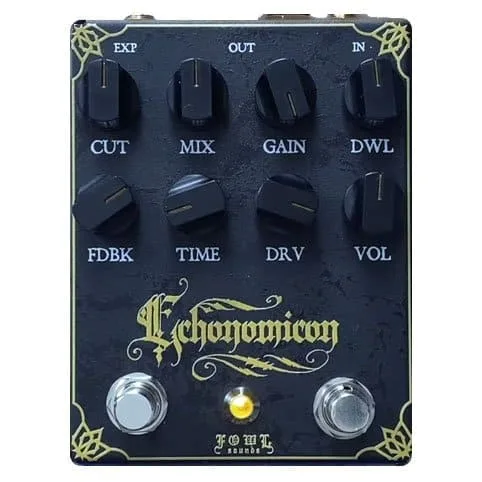


The Fowl Sounds Echonomicon is a parallel delay and reverb pedal with a distortion side built in. The incoming signal is buffered and split into two paths: one runs through the delay and then the reverb, while the other passes through a high headroom overdrive, and the two are blended back together at the output1. That parallel routing is the pedal's defining idea, letting the wet echo and the drive sit side by side rather than stacked in series.
The circuit is built around a companded PT2399 delay chip with almost 1 second of delay time, feeding a Belton reverb brick1. Both are familiar, affordable building blocks, and the design leans into their character rather than hiding it.
"This allows for a really rich lofi echo that can go from subtle analog sounding warmth to crackling madness."
Controls
| Control | What it does |
|---|---|
| VOL | Controls overall volume. The pedal can get very loud. |
| MIX | Blends wet and dry signal. |
| TIME | Controls the delay time of the PT2399. The logarithmic taper keeps a good portion of the sweep in reverb territory; longer times get more lofi and staticky. |
| CUT | High-cut tone for the wet signal, from brassy, clanky echo to dark waves of gaze. |
| GAIN | Controls gain of the wet signal. Fully counterclockwise it is a little more traditional; fully clockwise you get into crackling madness. |
| FDBK | Feedback for the wet path, controllable by expression pedal. |
| Momentary switch | Causes the reverb brick to self oscillate, momentarily of course. |
All control descriptions come from the maker's coverage on Delicious Audio1.
Expression pedal and bypass
The FDBK feature can be controlled with an expression pedal, and a value of 50K is recommended, such as a Moog EP-31. If you already own an expression pedal with a 50K pot, it should pair well.
The Echonomicon is a buffered pedal, not true bypass: the buffered signal is split into two as it enters, which is how the parallel routing works1.
Where it sits
Delicious Audio included the Echonomicon in its roundup of hybrid reverbs, describing it as "a parallel delay/reverb + distortion" in which the signal is split in two, one side to the delay and then the reverb, the other through a high headroom overdrive2. Compared with a straightforward delay pedal or reverb pedal, it covers more ground in one box, and the drive side places it in the company of distortion pedals and overdrive pedals as much as time effects.
Videos
collector//emitter
Anne Sulikowski
Eric Merrow
Questions
Is the Fowl Sounds Echonomicon true bypass?
No. The Echonomicon is a buffered pedal: when your signal enters it, the buffered signal is split into two paths, one for the delay and reverb and one for the overdrive, before the wet and dry sides are blended back together. That buffering is part of how the parallel routing works, so the pedal is not true bypass.
How long is the delay time on the Echonomicon?
The companded PT2399 delay circuit offers almost 1 second of delay time. The TIME knob uses a logarithmic taper so a good portion of the sweep stays in reverb territory, and the longer the delay time is set, the more lofi and staticky the repeats get.
Can you use an expression pedal with the Echonomicon?
Yes. The FDBK feature can be controlled with an expression pedal, and a 50K value is recommended, such as a Moog EP-3. That lets you sweep the feedback of the wet path with your foot while playing.
What does the momentary switch do on the Echonomicon?
The momentary switch causes the reverb brick to self oscillate, momentarily of course. Held down, it pushes the Belton reverb into self oscillation for washes and swells, then returns to normal when released.
Is the Echonomicon analog or digital?
It is a hybrid. The delay side uses a companded PT2399 chip, a digital delay chip often voiced to sound warm and lofi, and the reverb side uses a Belton reverb brick. Delicious Audio described the result as a rich lofi echo that goes from subtle analog sounding warmth to crackling madness.
Sources (2)
- Fowl Sounds Echonomicon Parallel Delay+Reverb And Distortion, Delicious Audio, 2020-12-17
- The Best Reverb Pedals With Modulation Or Fuzz/Distortion In 2023, Delicious Audio, 2023-01-30