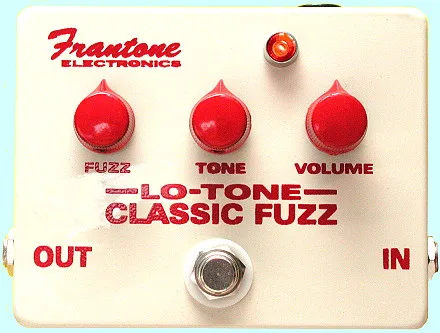


The Frantone Lo-Tone Classic Fuzz is a fuzz pedal built specifically for bass. Frantone says it "actually boosts the bottom to give you awesome sustain with rich creamy fuzztone. Wonderful overtones and plenty of thump," positioning it as a classic fuzztone for bass rather than a guitar fuzz adapted for low tunings1. It sits in the wider family of fuzz pedals and, more broadly, bass pedals.
What it does to a bass signal
Most fuzz designs are voiced around guitar, and bass players often find the low end collapsing when they engage one. Frantone's pitch for the Lo-Tone Classic is the opposite: the circuit boosts the bottom instead of cutting it, so the fundamental stays put while the fuzz adds sustain and overtones on top1. The clipping comes from germanium diodes, which the maker says gives soft knee clipping, a gentler shaping of the waveform than the harder clipping of silicon1. The circuit is transistorized, built around transistors rather than an op-amp chip1.
Controls and switching
The pedal carries Fuzz and Volume controls, with a Tone control also noted by builders who have traced the circuit2. Switching is full signal bypass with a status light, and Frantone states that all new Frantone effects come with this arrangement, along with a red indicator LED to show when the pedal is on1.
Build and where it comes from
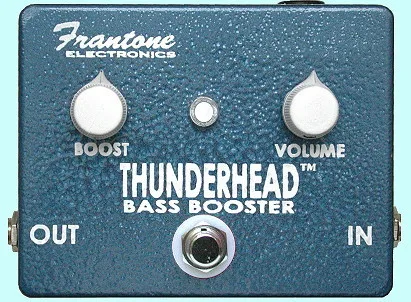
Frantone builds the pedal by hand in the USA1. The enclosure is a tough cast aluminum case finished in beige enamel1. Frantone also makes other bass-oriented effects, such as the Frantone Thunderhead.
What builders say about the circuit
The Lo-Tone Classic has been traced and published as a DIY layout on Guitar FX Layouts, and the comments there give a picture of the circuit from the inside. Builders experimenting with transistor choices found the pedal sensitive to them: one builder "tried it with MPSA18s and it was too much - replaced them with BC108Cs instead (Hfe of 400 - roughly half of the MPSA18s)" and reported it "works great and has a TON of bass"2.
"I made the changes above without making a new board just to test it out. It sounds so much better now."
The published layout itself went through corrections. The original version had the 10k resistor connected to Fuzz 1 down one row too far, which should have been connected to ground on row G. A later update added a 1nF capacitor from B to C on Q2 and a 1uF capacitor in series with the 10K that goes to Fuzz 2. Builders who made those changes reported the circuit "sounds so much better" and, on the updated layout, "works great"2. One builder also noted that the 11v zener in the layout is just over voltage protection and can be omitted or replaced with a 12v zener2.
Anyone building the DIY layout should use the corrected and updated version from Guitar FX Layouts, not the original posting, since the early version had a misplaced resistor and lacked two components later added to the design2.
Videos
Frantone
Fran Blanche
Coolpapabear
Questions
Is the Frantone Lo-Tone Classic Fuzz true bypass?
Yes. Frantone says all of its effects come with full signal bypass and a status light, which the company describes as true bypass switching. That means the pedal takes itself completely out of the signal path when off, and a red indicator LED shows when it is engaged.
Does the Lo-Tone Classic Fuzz use germanium diodes?
Yes. According to Frantone, the Lo-Tone Classic Fuzz uses germanium diodes for soft knee clipping, the component choice that shapes the pedal's fuzz character. The circuit is transistorized rather than built around an integrated circuit.
Where is the Frantone Lo-Tone Classic Fuzz made?
Frantone builds the Lo-Tone Classic Fuzz by hand in the USA. The pedal is housed in a tough cast aluminum case with a beige enamel finish.
Is the Lo-Tone Classic Fuzz made for bass?
Yes. Frantone markets the pedal just for bass players, describing it as a classic fuzztone for bass that actually boosts the bottom end rather than thinning it out, for sustain, overtones and thump.
Sources (2)
- Classic, Frantone Electronics, 2026
- Guitar FX Layouts: Frantone Lo-Tone Classic Fuzz, Guitar FX Layouts (tagboardeffects.blogspot.com), 2021-05-06