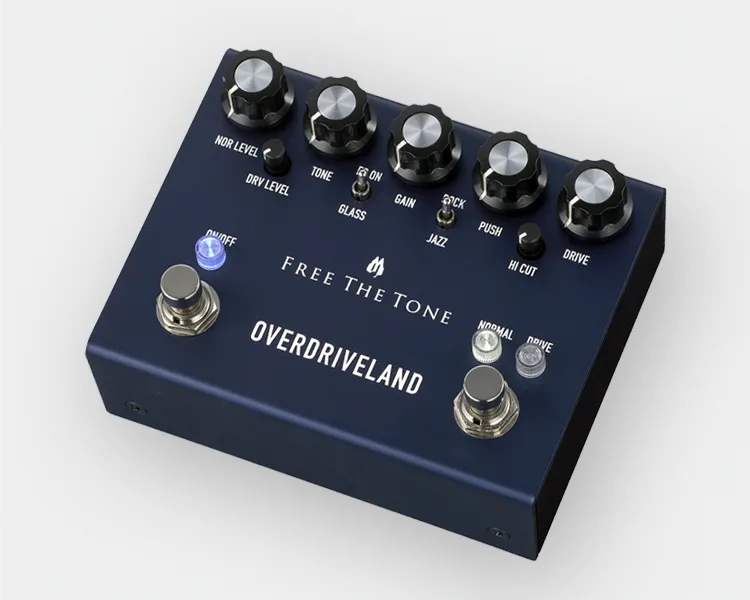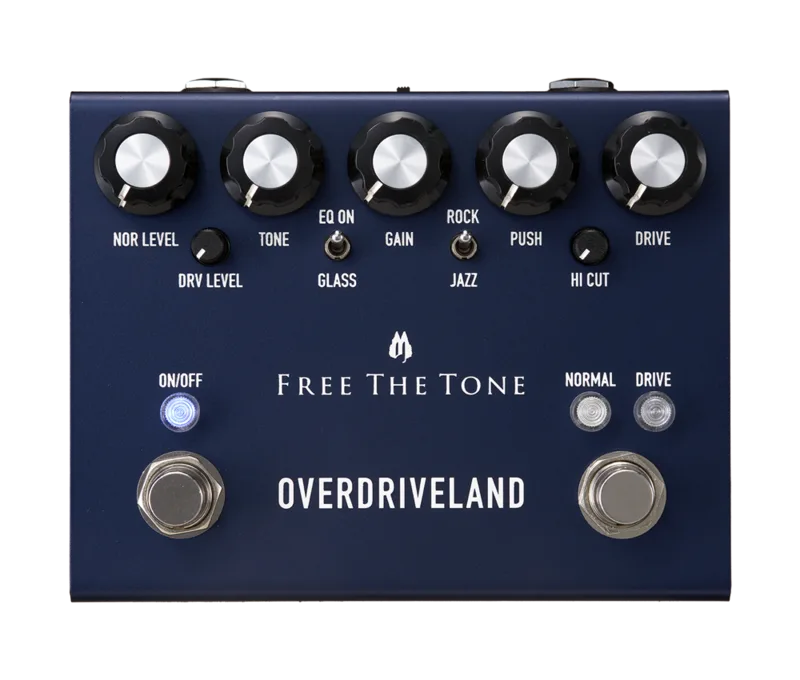


The Free The Tone OVERDRIVELAND is an overdrive pedal built around the sound of a specific amplifier: the late model of the Dumble Overdrive Special, an amp that Free The Tone describes as now difficult to obtain. The company says the pedal was born to express a player's individuality with the glossy, commanding character of those amps1. Guitar Pedal X calls it a two-channel Dumble overdrive with Normal and Drive sections2.
What makes the OVERDRIVELAND different from a single-knob overdrive is its structure. It is built as two sections: a Normal channel circuit and a Drive circuit. In the Drive channel, the signal flows through the Drive circuit first and then through the Normal channel circuit, so the drive stage feeds the clean channel rather than replacing it3. Delicious Audio describes this as featuring the amp's clean channel and letting you overdrive it by inserting an extra drive circuit before it4.
A Dumble-style dual channel overdrive
The reference point matters here. Free The Tone states plainly that the amp studied for the OVERDRIVELAND's development was the later type of the Dumble Overdrive Special1. Delicious Audio notes the circuit was inspired by the latest model of the Overdrive Special, which the site says differs from earlier versions5. For a player, that means the pedal aims at the later Dumble voicing rather than a generic "Dumble-style" approximation.
The two channels work the way the amplifier's channels do. The Normal Channel encompasses the Tone circuit, with its EQ ON/GLASS switch, and gain adjustment via the ROCK/JAZZ switch5. The Drive Channel sends the signal through the Drive circuit, activating the Push and Drive knobs and the Hi Cut filter, before returning it into the Normal Channel circuit5. RockBoard's PedalPedia entry summarizes the design as separate Normal and Drive circuits with extensive tone and response controls, including the EQ On/Glass and Rock/Jazz switches7.
The pedal also carries Free The Tone's HTS (Holistic Tonal Solution) circuit. The company says HTS differs from a conventional buffer: it performs impedance conversion while drawing out the guitar's sound character, prevents sound quality degradation when the effect is off, and outputs in phase with the input6.
The controls
The control set splits between the two channels. On the Standard version, Guitar Pedal X lists the Normal section as Nor Level, Tone, Gain, Dry Level and an EQ switch with On/Glass positions, and the Drive section as Push (Mids), Drive and Hi Cut, alongside the On/Off footswitch and the Normal/Drive footswitch2.
| Control | Channel | What it does |
|---|---|---|
| NOR LEVEL | Normal | Sets the volume when the Normal channel is selected1 |
| DRV LEVEL | Drive | Sets the volume when the Drive channel is selected1 |
| TONE | Normal | Tone shaping, active when EQ ON is selected1 |
| GAIN | Normal | Gain adjustment for the Normal Channel2 |
| PUSH | Drive | Adjusts the signal level sent from the Drive circuit to the Normal Channel, controlling sound pressure3 |
| DRIVE | Drive | Drive control for the Drive circuit32 |
| HI-CUT | Drive | Hi Cut filter, active in the Drive Channel5 |
| EQ ON/GLASS | Normal | EQ ON activates the TONE circuit; GLASS bypasses it365 |
| ROCK/JAZZ | Normal | Fine-tunes frequency response and gain of the Normal Channel5 |
The ROCK/JAZZ switch works as a voicing choice for the clean side: Delicious Audio reports that ROCK increases gain while reducing low-frequency gain, while JAZZ decreases overall gain and accentuates low-frequency richness5.
The EQ ON/GLASS switch is the other Normal Channel toggle. Set to EQ ON, the TONE circuit operates; set to GLASS, the TONE circuit is bypassed, which Free The Tone says delivers a glassy tone like a blackface Fender Vibroverb with its Bright switch on1. Delicious Audio describes the GLASS position as a crystalline tone reminiscent of engaging the Bright switch on a Blackface Fender Vibroverb5.
The Push knob is the link between the two sections. It adjusts the level sent from the Drive circuit into the Normal Channel, and Free The Tone says it is how you control the sense of sound pressure3. Because the Drive channel's signal always passes through the Normal Channel circuit on its way out, Push sets how hard the drive stage drives everything downstream of it.
Designer and versions
The OVERDRIVELAND was designed by Yuki Hayashi, Free The Tone's representative4. The company says Hayashi has serviced and repaired more than 20 Dumble amps and owned several himself1, a background that explains the specific late-model Overdrive Special reference. Delicious Audio calls him a veteran engineer4.
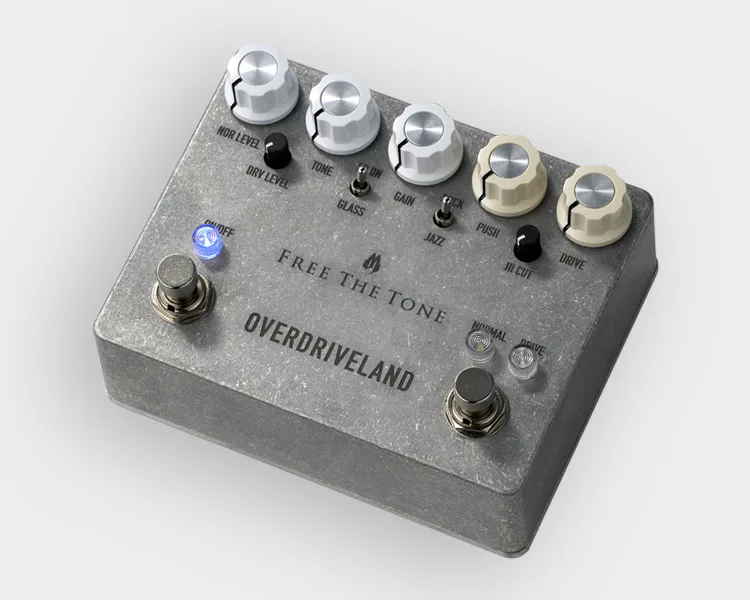
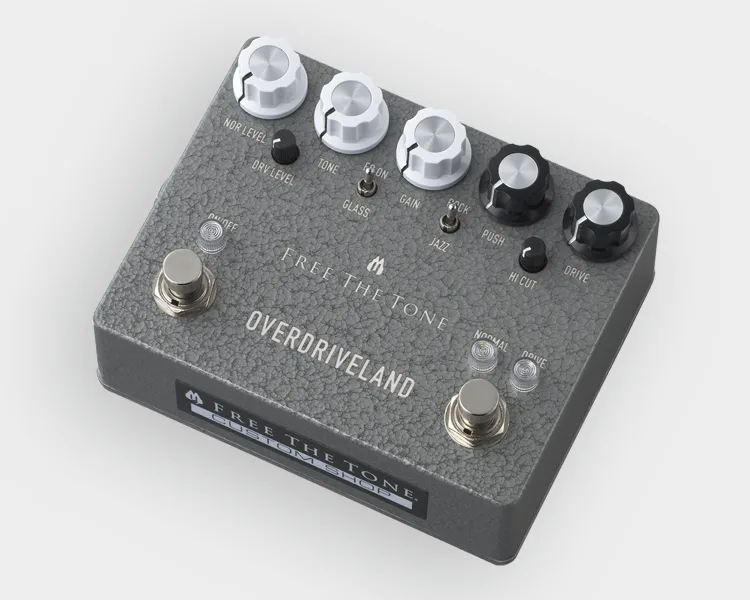
The pedal exists in several versions. The Standard ODL-1 carries the control set listed above with a DC9V/DC14.5V selector switch1, and Guitar Pedal X notes it comes in a fetching tone of blue2. The Custom Shop versions, the ODL-1-CS and ODL-1A-CS, replace the fixed DC14.5V option with a DC9V/VARIABLE switch and a voltage adjustment trimmer, letting the player set the internal voltage directly361. Guitar Pedal X also notes that on the Custom Shop version the two Drive knobs are a different color from the three Normal Channel knobs, visually demarcating the channels2.
The Custom Shop versions add a voltage adjustment trimmer and a DC9V/VARIABLE switch in place of the Standard's DC9V/DC14.5V switch361. Players who want to fine-tune internal voltage rather than choose between two fixed settings should look at the CS models.
Power is flexible. The pedal can run on a 9V battery (006P type)1, or through its DC9V input jack with a regulated center-negative adapter; Free The Tone names its separately sold SP-9, FA-W0905-DJA and FA-0905D-JA adapters as compatible6.
Videos
楽器好きにはたまらない! フーチーズ 渋谷店 / Guitar Shop Hoochie's
Mike Hermans
Simon Gotthelf Music
Questions
What amp is the Free The Tone Overdriveland based on?
Free The Tone says the reference for the Overdriveland's circuit was the late model of the Dumble Overdrive Special. The designer, Yuki Hayashi, has serviced more than 20 Dumble amps and owned several himself, so the pedal draws on direct experience with the amplifiers rather than secondhand descriptions.
How do you switch channels on the Overdriveland?
The right footswitch toggles between the Normal Channel and the Drive Channel. In the Drive Channel the signal passes through the Drive circuit, which activates the Push and Drive knobs and the Hi Cut filter, and then returns into the Normal Channel circuit before the output.
What does the Push knob do on the Overdriveland?
Push adjusts the signal level sent from the Drive circuit into the Normal Channel circuit. Because the Normal Channel shapes what reaches the output, Push controls the sense of sound pressure, letting you set how hard the drive section pushes the rest of the pedal.
What does the GLASS position do on the Overdriveland?
The EQ ON/GLASS switch controls the Normal Channel's equalization. EQ ON activates the TONE circuit; GLASS bypasses it entirely, which Free Tone describes as producing a glassy tone like a blackface Fender Vibroverb with its Bright switch engaged.
Sources (7)
- OVERDRIVELAND / ODL-1|Products 商品紹介|Free The Tone, Free The Tone
- Guitar Pedal X, Guitar Pedal X, 2024-02-12
- OVERDRIVELAND / ODL-1-CS|CUSTOM SHOP カスタムショップ|Free The Tone, Free The Tone (freethetone.com)
- Best Dumble-Style Pedals For Your Needs & Budget, Delicious Audio, 2024-09-25
- New Pedal: Free The Tone Overdriveland, Delicious Audio, 2024-02-09
- OVERDRIVELAND / ODL-1A-CS|CUSTOM SHOP カスタムショップ|Free The Tone, Free The Tone
- OVERDRIVELAND / ODL-1 by Free The Tone, RockBoard PedalPedia, 2026