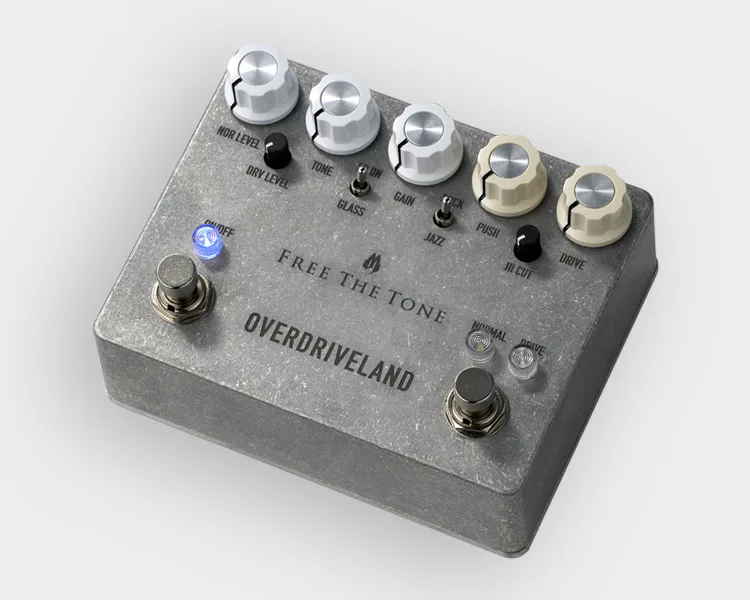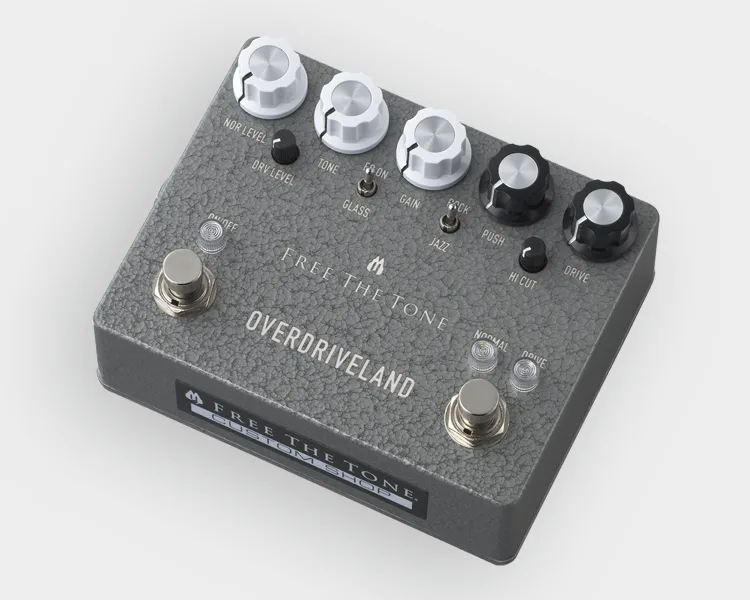


The Free The Tone OVERDRIVELAND ODL-1A-CS is an analog overdrive pedal from Free The Tone's Custom Shop line. Free The Tone says it was built to express a player's individuality with the glossy, commanding character of Dumble amplifiers, which the maker notes are now hard to obtain1. The reference circuit for the design was the later-type Dumble Overdrive Special1.
The designer is Free The Tone's representative, Hayashi, who the maker says has serviced and repaired more than 20 Dumble amplifiers and owned several himself1. That service history is the basis of the circuit: the normal channel deliberately uses no clipping diodes or LEDs, so the overdrive comes from the amplifier-style circuit itself rather than from diode clipping1.
The ODL-1A-CS is a customized version of the ODL-1-CS: the sound is unchanged, but a CH.CONT terminal has been added so an external switch can select between the NORMAL and DRIVE channels1.
A Dumble Overdrive Special in a pedal
Dumble amplifiers, and the Overdrive Special in particular, are hand-built amps that rarely change hands, which is why so many pedal makers try to capture their character in a stompbox. Free The Tone's approach differs from most Dumble-inspired pedals in one stated way: the normal channel of the OVERDRIVELAND uses no clipping diodes or LEDs at all1. Most overdrive pedals get their distortion from diodes shunting the signal, so a diode-free circuit behaves more like a small amplifier being pushed.
Free The Tone describes the result this way: raising the normal channel's GAIN gradually adds distortion, and even with the GAIN knob below 12 o'clock the clean sound contains rich harmonic content1. The DRIVE channel adds the second voice, and the two channels have independent level controls, so the pedal can work as a clean-ish platform on one channel and a lead voice on the other.
The controls
The control set is shared with the ODL-1-CS and is dense for a compact pedal12:
| Control | What it does |
|---|---|
| NOR LEVEL | Sets the volume of the normal channel1 |
| DRV LEVEL | Sets the volume when the drive channel is selected1 |
| GAIN | Sets the amount of overdrive; on the normal channel, raising it gradually adds distortion1 |
| TONE | Tone circuit for the normal channel, active when EQ ON is selected1 |
| PUSH | Drive channel voicing control1 |
| HI-CUT | Rolls off high frequencies1 |
| DRIVE | Drive channel control1 |
| EQ ON/GLASS switch | EQ ON activates the TONE circuit; GLASS bypasses it1 |
| ROCK/JAZZ switch | Voicing switch1 |
| DC9V/VARIABLE switch | Selects the supply voltage mode for the analog circuit1 |
| Voltage adjustment trimmer | Sets the boosted supply voltage in VARIABLE mode1 |
The GLASS position is the one Free The Tone explains in detail: with the TONE circuit bypassed, the normal channel takes on a glassy tone the maker compares to a blackface Fender Vibroverb with its Bright switch on1. That makes the EQ ON/GLASS switch a choice between a shaped tone and a brighter, more open one, in the way an amp's bright switch works.
Power: 9V, 120mA, with an internal boost to higher voltage
The pedal runs from a DC9V center-negative AC adapter and draws 120mA1. Free The Tone lists its own separately sold SP-9, FA-W0905-DJA and FA-0905D-JA adapters as compatible, and says any regulated DC9V center-negative adapter can be used1.
The ODL-1A-CS cannot run on a battery because of its high current consumption, and at 120mA it needs a proper isolated or adequately rated 9V output, not a shared low-current daisy chain1.
The interesting part of the power design is inside. The pedal contains a boost power circuit that raises the voltage supplied to the analog circuit from DC9V up to a maximum of DC19V1. In the standard version the choice is between the external DC9V input and the internal boost supply at DC14.5V1. The DC9V/VARIABLE switch and the voltage adjustment trimmer are how the player selects and sets this1.
For a player, this matters because a higher internal supply voltage gives the op-amp circuit more headroom before it clips, which changes both the clean headroom and the character of the overdrive, in the same way an amp's supply voltage shapes its breakup.
External channel switching
The difference between this pedal and the ODL-1-CS is the CH.CONT terminal, a 1/4-inch standard phone jack that accepts Free The Tone ARC series control terminals or latch-type footswitches1. With a latch-type footswitch connected, you can switch between the NORMAL and DRIVE channels remotely, which suits a larger board where the pedal sits out of foot reach, or a rig where you want channel changes on a secondary switcher1.
Videos
maruhachi08
Scott Lerner
Amelia Island Fine Guitars
Questions
Can the Free The Tone Overdriveland run on a battery?
No. Free The Tone states that the ODL-1A-CS draws too much current to run on a battery, because of its high current consumption. It needs a regulated DC9V center-negative AC adapter, such as the separately sold SP-9, plugged into its DC9V input jack.
How do you switch Overdriveland channels with an external footswitch?
The ODL-1A-CS adds a CH.CONT jack, a 1/4-inch standard phone jack, that the ODL-1-CS does not have. You connect a Free The Tone ARC series control terminal or a latch-type footswitch to it and switch between the NORMAL and DRIVE channels externally, leaving the pedal's own footswitch free.
What does the GLASS switch do on the Overdriveland?
The EQ ON/GLASS switch sets the equalizing function of the normal channel. In EQ ON the TONE circuit is active. In GLASS the TONE circuit is bypassed, which Free The Tone describes as giving a glassy tone like a blackface Fender Vibroverb with its Bright switch on.
How big is the Free The Tone Overdriveland?
The ODL-1A-CS measures 97mm deep by 123mm wide by 51mm high, including protruding parts such as the footswitch and jacks, and weighs 420g. That is a compact-but-not-mini enclosure that still needs real board space.
Sources (2)
- OVERDRIVELAND / ODL-1A-CS|CUSTOM SHOP カスタムショップ|Free The Tone, Free The Tone
- OVERDRIVELAND / ODL-1-CS|CUSTOM SHOP カスタムショップ|Free The Tone, Free The Tone (freethetone.com)