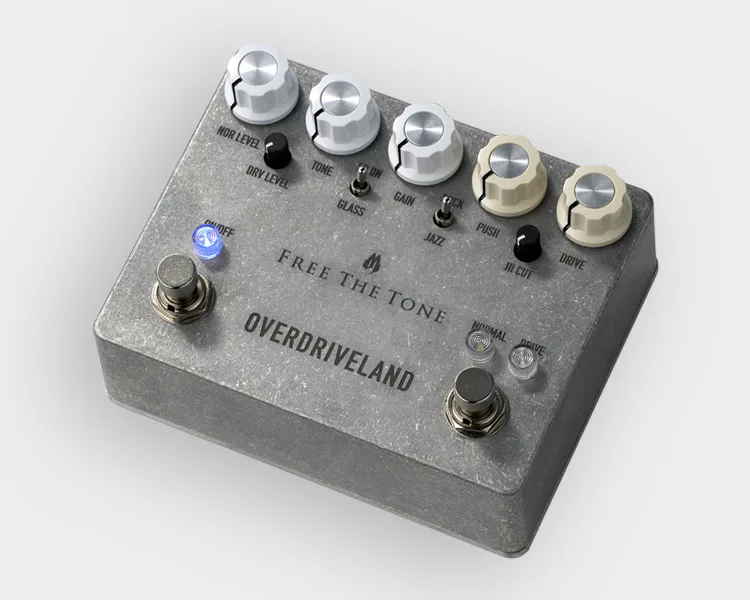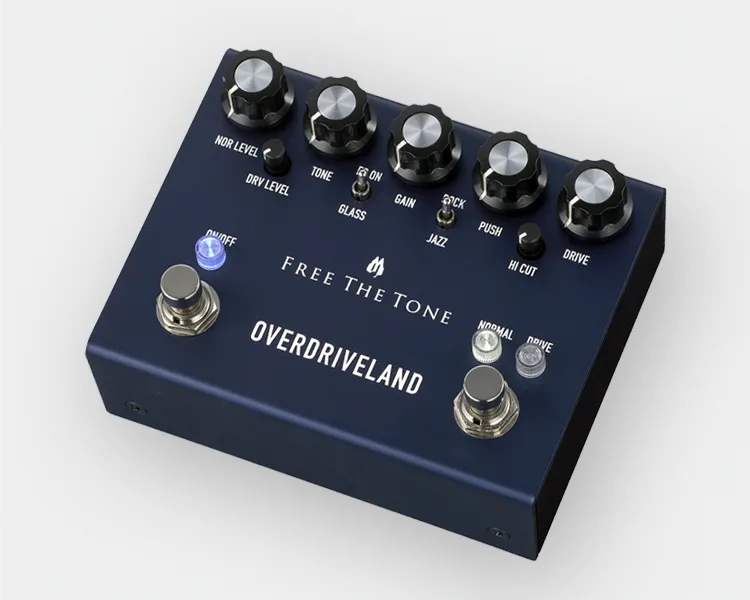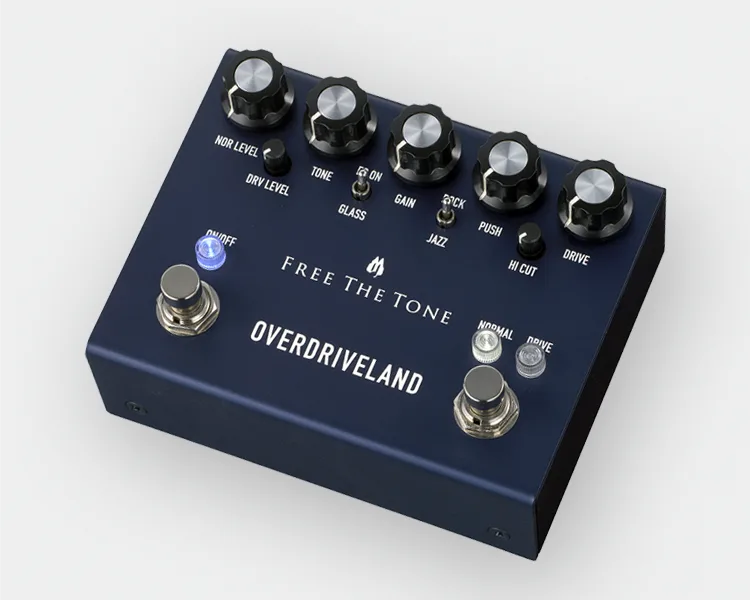


The Free The Tone Overdriveland ODL-1 Standard is a two-channel overdrive pedal from Japanese maker Free The Tone. Guitar Pedal X described it in February 2024 as "a two-channel Dumble overdrive with Normal and Drive sections"1, and Free The Tone says the design was developed with the late-model Dumble Overdrive Special as its reference2. The Standard version comes in a blue enclosure and, per Guitar Pedal X, was already in worldwide distribution as of February 20241.
Free The Tone describes the pedal's aim in its own words: it was created to let a player express their own character, with a glossy, present quality like the Dumble amplifiers that are now hard to obtain2. The pedal is built as two main sections: a normal channel circuit and a drive circuit. In the drive channel, the signal passes through the drive circuit first and then through the normal channel circuit3.
A two-channel Dumble-style overdrive
The ODL-1 splits its controls between the two sections. Guitar Pedal X counted 9 controls in total1, arranged by the maker as follows21:
| Section | Controls |
|---|---|
| Normal | NOR LEVEL, TONE, GAIN, Dry Level, EQ switch (On / Glass)1 |
| Drive | PUSH (mids), DRIVE, HI-CUT1 |
| Switching | EQ ON/GLASS switch, ROCK/JAZZ switch, DC9V/DC14.5V power switch2 |
| Footswitches | On/Off footswitch, Normal/Drive footswitch1 |
The two footswitches mean you can bring the whole pedal in and out, and move between the Normal and Drive channels, without bending down to the knobs1.
The EQ switch has two positions with distinct jobs. In EQ ON, the Tone circuit operates normally. In GLASS, the Tone circuit is bypassed, and Free The Tone says this yields a glassy tone like a blackface Fender Vibroverb with its Bright switch turned on2. The Push control on the Drive section is a mids control, listed by Guitar Pedal X as Push (Mids), so it shapes where the drive channel's midrange sits rather than adding gain1.
The pedal also carries Free The Tone's HTS (Holistic Tonal Solution) circuit. The maker says this prevents sound quality degradation even when the effect is off, and that the output is in phase with the input2. For a player, that means the pedal is designed not to color your clean signal when bypassed, and not to flip phase in a way that thins your sound when it is mixed with another amp path.
An earlier Custom Shop version of the pedal exists in a raw enclosure, listed at $425 by Guitar Pedal X in February 20241. The Standard version at $279 is the one in regular distribution1.
"I typically like the Free The Tone gain pedals - they all sound great - and this is well priced!"
Power and connections
The ODL-1 can be powered three ways: a 9V battery (006P type), or a DC9V center-negative AC adapter through its DC input jack2. A switch on the pedal selects between the external DC9V supply and an internal boosted supply that runs the circuit at DC14.5V2.
When running on a 9V battery, Free The Tone says to set the power switch to the DC9V side. In the internal boosted (DC14.5V) setting the battery drains faster2.
Connections are straightforward: a 1/4-inch standard phone jack for input, another for output, and the DC9V adapter jack23. Input impedance is 500kΩ or higher and output load impedance is 10kΩ or higher2, figures that suit it to typical guitar-amp and pedalboard chains.
Where it sits in the Free The Tone range
The Overdriveland ODL-1 Standard sits in Free The Tone's line of gain pedals with its On/Off footswitch and Normal/Drive footswitch, and it is already in worldwide distribution1. Guitar Pedal X's reviewer, who typically likes the maker's gain pedals as a group, found this one well priced and sounding great1.
Videos
Mike Hermans
Simon Gotthelf Music
Fede Kajganić
Questions
How much does the Free The Tone Overdriveland ODL-1 cost?
Guitar Pedal X listed the Standard version at $279 in February 2024, and Free The Tone's own product page lists it at 48,400 yen including tax in Japan. An earlier Custom Shop version in a raw enclosure was listed at $425. Prices are as dated and may have changed since.
What does the Glass position on the EQ switch do?
The EQ switch has On and Glass positions. In On, the Tone circuit is active. In Glass, the Tone circuit is bypassed and Free The Tone says the pedal produces a glassy tone like a blackface Fender Vibroverb with its Bright switch engaged.
Does the ODL-1 run on 9V or 14.5V?
Both. It runs on a 9V battery (006P type) or a 9V DC center-negative AC adapter, and a switch on the pedal selects between an external DC9V supply or an internal boosted supply at DC14.5V. When using a battery, Free The Tone says to set the switch to the DC9V side, as the boosted setting drains the battery faster.
What is HTS circuitry on Free The Tone pedals?
HTS stands for Holistic Tonal Solution, a circuit Free The Tone fits to the ODL-1. The maker says it prevents sound degradation when the effect is off, and that the output stays in phase with the input.
What does the Push control do on the ODL-1?
Push is a mids control on the Drive section, listed by Guitar Pedal X as Push (Mids). It sits alongside the Drive and Hi Cut controls and the On/Off and Normal/Drive footswitches, letting you shape how the drive channel's midrange sits.
Sources (3)
- Guitar Pedal X, Guitar Pedal X, 2024-02-12
- OVERDRIVELAND / ODL-1|Products 商品紹介|Free The Tone, Free The Tone
- OVERDRIVELAND / ODL-1-CS|CUSTOM SHOP カスタムショップ|Free The Tone, Free The Tone (freethetone.com)