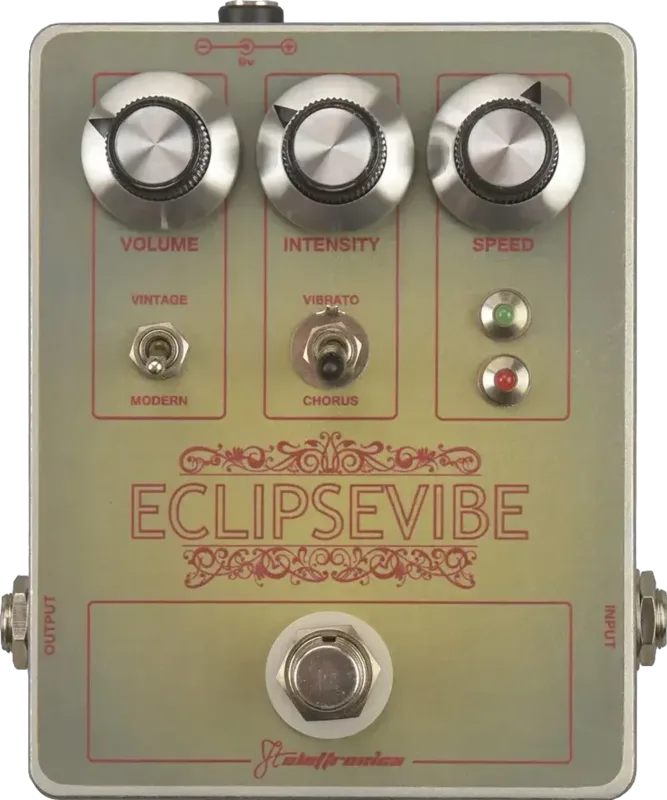
The FTelettronica Eclipse Vibe is a boutique vibrato/chorus pedal, an analog design that pays homage to the original Shin-Ei Uni-Vibe1. It covers three effect types in one box: VIBE, CHORUS and VIBRATO, so it sits alongside dedicated chorus pedals and vibrato pedals while aiming at the swirling, phase-shifting character players associate with a vibe.
Where it comes from
The Uni-Vibe it honors was originally conceived by engineer Fumio Mieda for the Shin-ei company in Japan2. The original pedal had a Chorus/Vibrato selector switch, and its sound came from rotating bulb technology: analog bulb circuitry in which a light bulb spinning over photocells shaped the modulation3. That approach is what later designs, including the Eclipse Vibe, look back to when they chase the heady psychedelic sounds of a vintage Uni-Vibe4.
Controls and the modern/vintage mode
The Eclipse Vibe keeps the layout simple, with controls for volume, intensity, and speed1. Volume sets the overall level, intensity sets the depth of the modulation, and speed sets how fast the effect sweeps, much as the speed and intensity controls work on the Uni-Vibe designs that came before it1.
Alongside those three knobs, the pedal has what RockBoard's PedalPedia calls "a unique modern/vintage mode that shifts the modulation into the realms of square wave"1. That gives the player two characters of modulation from the same circuit: a vintage-leaning side and a more squared-off modern side.
Power and bypass
The pedal runs on 9V DC, center negative, and draws 90mA1. It uses true bypass switching, so the effect is removed from the signal path when the pedal is off1.
At 90mA, the Eclipse Vibe draws more current than many compact analog pedals. A standard low-current daisy-chain output may not be enough for it, so plan your power supply accordingly1.
Questions
Is the FTelettronica Eclipse Vibe analog?
Yes. The Eclipse Vibe is an analog circuit, listed with a circuit type of analog on its product page. That follows the design of the original Shin-Ei Uni-Vibe, which used analog bulb circuitry and rotating bulb technology rather than digital processing, so the Eclipse Vibe works in the same analog tradition.
What power supply does the Eclipse Vibe need?
The Eclipse Vibe runs on a 9V DC, center negative supply and draws 90mA. Use a supply that can deliver that current, and check that any daisy chain or isolated outputs on your power brick can handle a 90mA draw on the pedal's position.
Is the Eclipse Vibe true bypass?
Yes. The pedal uses true bypass switching, so when it is off, your guitar's signal passes through the pedal without the effect circuit in the path.
What does the modern/vintage mode do on the Eclipse Vibe?
The pedal has a modern/vintage mode that, as the maker describes it, shifts the modulation into the realms of square wave. In practice it gives you two flavors of the modulation: a vintage character drawn from the original Uni-Vibe approach and a more squared-off modern take.
Is the Eclipse Vibe based on the Shin-Ei Uni-Vibe?
Yes. FTelettronica describes the Eclipse Vibe as paying homage to the original Shin-Ei Uni-Vibe, the Japanese-designed effect conceived by engineer Fumio Mieda, which used rotating bulb technology and analog bulb circuitry to create its chorus and vibrato sounds.
Sources (4)
- Eclipse Vibe by FTelettronica, RockBoard PedalPedia, 2026
- The FX files: Uni-Vibe, MusicRadar, 2019-04-10
- Cornerstone Aquarium Uni-Vibe, Delicious Audio, 2022-08-18
- “It can totally do the hyper-authentic '60s thing, but it can do a bunch of otherstuff that makes it much more versatile”: Strymon puts “gooey wobble” on the menu with the UltraViolet Vintage Vibe, MusicRadar, 2023-09-26