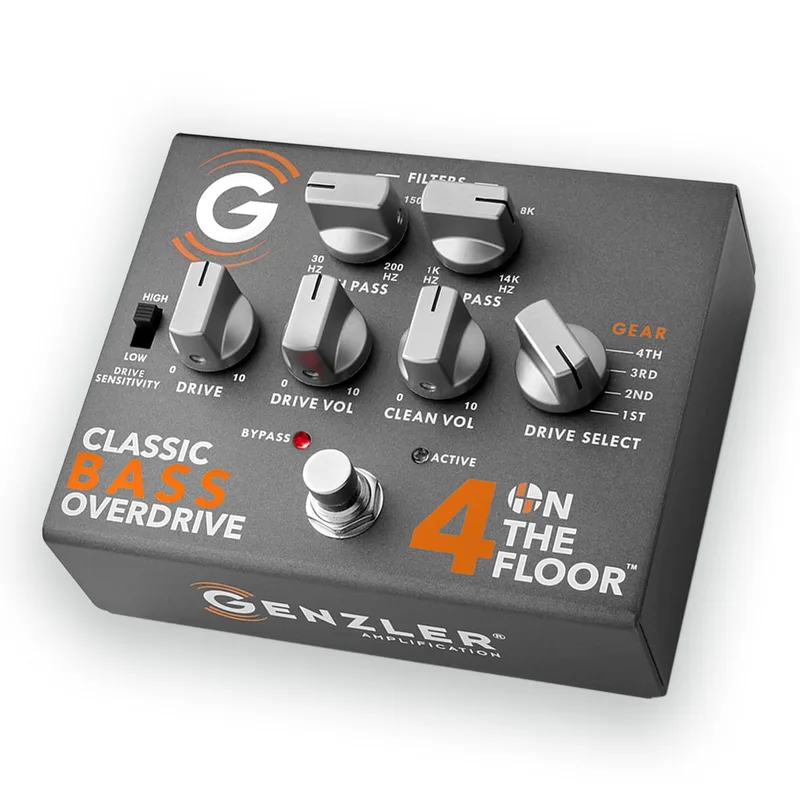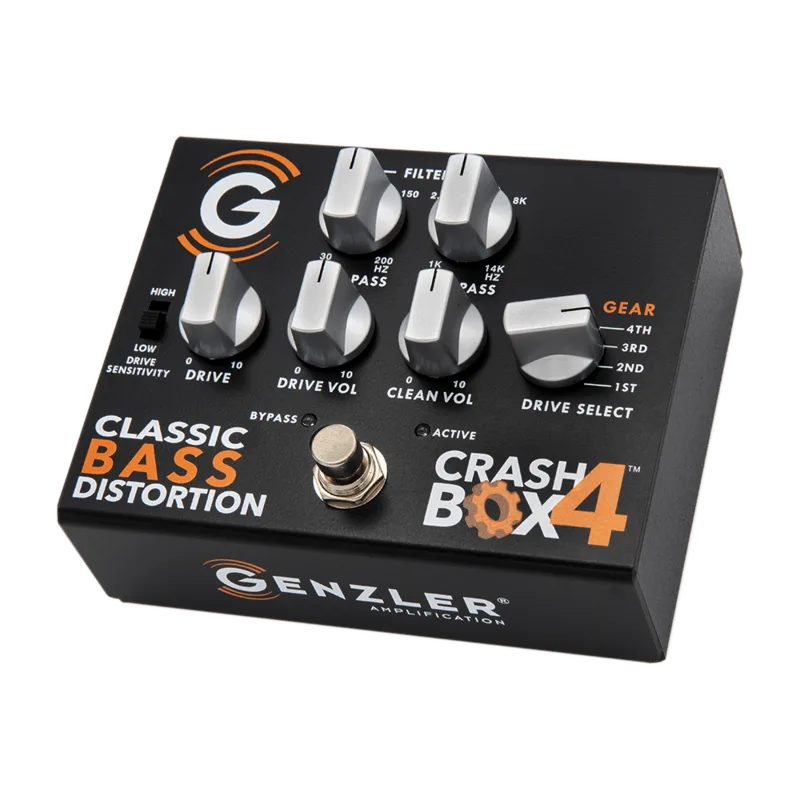


The Genzler Amplification Crash Box 4 is an all-analog distortion pedal for bass, the third effects pedal in the Genzler product line1. Where the company's 4 On The Floor covers classic overdrive, the Crash Box 4, in the words of Genzler, "takes up where their original 4 ON THE FLOOR Classic Overdrive Pedal leaves off," serving up four levels of grittier and more aggressive distortion for bassists1. A 4-position "Gear" selector switch moves between four distortion characters that Genzler says dynamically emulate tube and solid-state distortion circuit topologies, and a parallel clean signal path with a clean blend keeps your low end intact underneath the drive1.
Bass Musician Magazine's reviewer Jake Wolf described the pedal's place plainly: "the Genzler Crash Box 4, Classic Distortion picks up where the 4 on the Floor leaves off, serving up four levels of gritty and aggressive distortion for bassists"2.
The four gears
The core of the pedal is the 4-position distortion "Gear" selector switch. Each gear is a different clipping character, described by Genzler as follows1:
| Gear | Character |
|---|---|
| 1st Gear | Reminiscent of a tube amp's moderately driven channel, with natural harmonics, a bit of compression when driven hard, and even-ordered harmonic richness |
| 2nd Gear | Emulates a tube amp's more heavily overdriven tone, with more odd order harmonics, compression, depth and top-end |
| 3rd Gear | An aggressive up-shift from 2nd Gear: heavier and edgier, higher in odd order harmonics, with greater compression for a tighter feel and greater sustain |
| 4th Gear | The most aggressive gear of all: a heavy, symmetrical, mostly odd order harmonics style distortion with additional crush and increased sustain |
In practical terms, the gears run from a tube amp's moderately driven channel at 1st Gear to the most aggressive, heavy distortion at 4th, with the harmonic balance shifting from even-order richness toward odd-order edge as you shift up. Because the descriptions come from Genzler's own product page, treat them as the maker's account of the sound rather than an independent one1.
Clean blend and filter controls
Two features do most of the work of keeping a distorted bass sound usable12:
- Parallel clean signal path with clean blend. Your dry signal runs alongside the distortion engine, so you can dial in as much or as little of the untouched low end as the mix needs.
- HPF/LPF section. An input high-pass filter on the overdrive engine is adjustable from 30Hz to 200Hz, and an output low-pass filter is adjustable from 1kHz to 14kHz. As Bass Musician Magazine's Jake Wolf put it, "an HPF/LPF section allows you to reign in the top and bottom end of the overdrive character"21.
The high-pass filter thins the lows feeding the distortion engine, which keeps the driven signal from getting flubby, while the low-pass filter rolls off the harsh top end after the clipping stage. Wolf's overall verdict on this control set: "it really offers a myriad of control over precise distortion characteristics, allowing players to get it just right for their preferences, gain staging needs and touch sensitivity control depth"2.
The pedal also carries a High/Low Sensitivity switch to accommodate higher or lower output basses, a feature it shares with the 4 On The Floor2. Genzler's specifications list input sensitivity at -20dBu nominal on high sensitivity and -10dBu nominal on low sensitivity1.
Power and headroom
The Crash Box 4 accepts power supplies from 9VDC to 18VDC of the low noise type, and it auto-detects either polarity, so you do not have to worry about center-positive versus center-negative supplies1. Current draw is 40mA max1.
The power supply is not included with the Crash Box 4, so plan on supplying your own 9V to 18V DC supply1.
Higher supply voltages buy headroom. Genzler's specifications show how the maximum input and output levels scale with the supply voltage, measured with DRIVE at 9:001:
| Supply | Max input (low sensitivity) | Max input (high sensitivity) | Max output |
|---|---|---|---|
| 9V | +5dBu | 0dBu | +9dBu |
| 12V | +12dBu | +5dBu | +14dBu |
| 18V | +18dBu | +10dBu | +20dBu |
For players with hot active basses or who want the clean blend to stay cleaner at high drive settings, the 18V figures mean more room before the front of the pedal itself clips1.
Designer and place in the Genzler line
The Crash Box 4 continues the collaboration between the Genzler Amplification design team and Andy Field, a former Genz Benz engineer1. In the Genzler pedal line it takes up where the original 4 On The Floor Classic Overdrive Pedal leaves off1. Genzler positions it as "an excellent compliment with our other pedals and either of our MAGELLAN 350 or MAGELLAN 800 bass amps"1.
The pedal is built in a black lightweight aluminum chassis with rugged stomp switches, at 1.1 lb (0.5kg) and 5" wide by 4.1" deep by 2.3" high, small enough for a crowded bass pedalboard1.
What reviewers said
The Crash Box 4 has been reviewed by the German magazine Gitarre & Bass, whose test of the pedal is published at gitarrebass.de1. Beyond that press coverage, the maker's own description of the pedal's two gears gives a picture of its intended character: 1st Gear is reminiscent of a tube amp's moderately driven channel, with natural harmonics and a bit of compression when driven hard, while 2nd Gear emulates a tube amp's more heavily overdriven tone, with more odd order harmonics and compression, depth and top-end1.
Videos
Genzler Amplification
BassTheWorld.com
Gregor Fris
Questions
What is the difference between the four gears on the Crash Box 4?
The four gears move from lighter to heavier distortion. 1st Gear is like a tube amp's moderately driven channel with even-order harmonics, 2nd Gear emulates a more heavily overdriven tube tone, 3rd Gear is edgier with more odd-order harmonics and compression, and 4th Gear is the most aggressive, a heavy symmetrical distortion with extra crush and sustain.
Can the Crash Box 4 run at 18V?
Yes. The pedal accepts power supplies from 9VDC to 18VDC of the low noise type, and it auto-detects either polarity, so center-positive and center-negative supplies both work. Running at higher voltages raises the maximum input and output levels the pedal can handle.
Does the Crash Box 4 come with a power supply?
No. Genzler lists the Crash Box 4 with the power supply not included, so you need to supply your own 9V to 18V DC supply. Current draw is 40mA maximum.
Is the Crash Box 4 analog?
Yes. Genzler describes the Crash Box 4 as an all-analog distortion pedal. The four distortion gears are said to dynamically emulate tube and solid-state distortion circuit topologies, but the signal path itself is analog.
How much does the Crash Box 4 weigh?
The pedal weighs 1.1 lb (0.5 kg) in its black lightweight aluminum chassis. Its dimensions are 5 inches wide, 4.1 inches deep and 2.3 inches high, and it ships at 2 lbs.
Sources (2)
- CRASH BOX 4, Genzler Amplification, 2023-12-01
- Review: Genzler Amplification Crash Box 4, Bass Musician Magazine, 2022-06-20