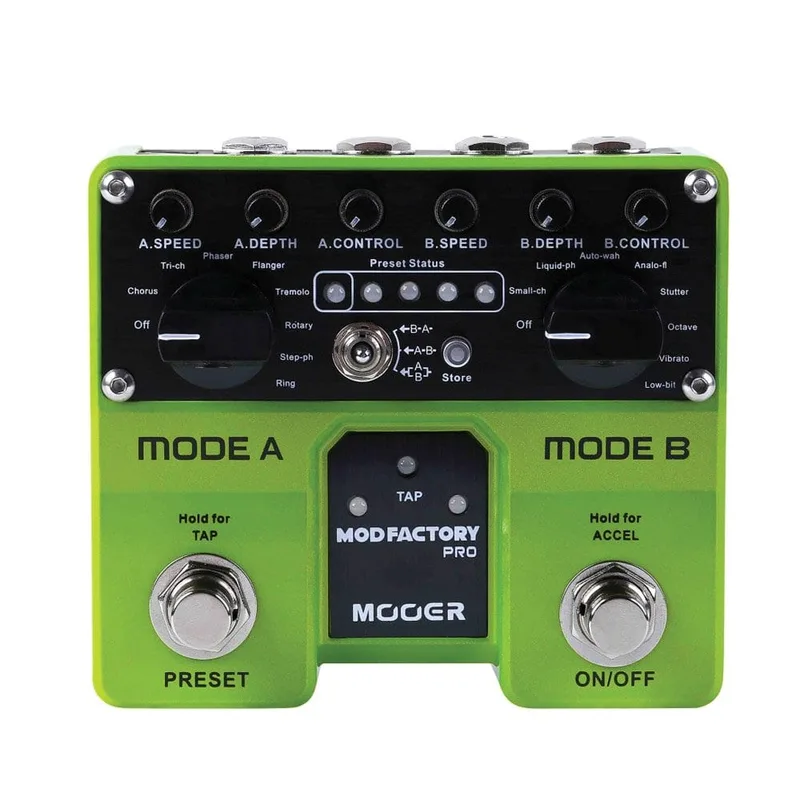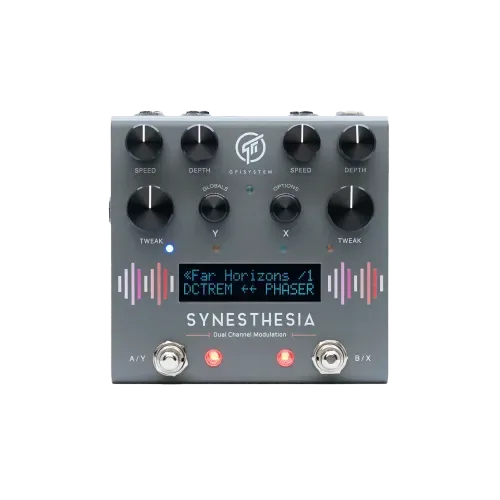


The GFI System Synesthesia is a digital multi-effects stompbox built around two modulation engines that can run at the same time. GFI System describes it as a way to give players an immersive and "colorful" modulation experience, hence the name1. Delicious Audio, profiling it at release in November 2023, called it "an advanced, yet user friendly dual-channel multi-modulation engines" and noted it was one of the first dual-engine modulation pedals, with the Mooer Mod Factory Pro the only other one the publication was aware of2.
Where a single-engine chorus or flanger pedal gives you one effect at a time, the Synesthesia stacks two. It carries up to 38 built-in algorithms covering amplitude, filter, swirl, phase, sequencer and miscellaneous effect types1, and you can combine them, for example running a tremolo into a phaser, or blend them in parallel. Guitar Pedal X's Stefan Karlsson called it "incredibly potent with 38 different algorithms as far I recall"3.
The controls: eight knobs, two footswitches and a screen
The front panel keeps things deliberately simple: Delicious Audio described "an easy to understand user interface featuring just eight knobs (two with push function), two footswitches and a small screen"2. The two footswitches do double duty, and holding both while plugging in power is how you reach firmware update mode4.
For players who want more underfoot, the pedal accepts up to three external switches through its side jack for functions like tap tempo and bank up or down1. American Loopers makes compatible aux switch units, and its listings show the functions those switches can be programmed to:
- Tap Tempo, Page Up, Bank Up, Bank Down5
- Load-A, Load-B, Favorite Preset Call, Auto-Swell, Momentary-A, Momentary-B6
There is also an expression pedal input with adjustable heel and toe values1, and a control voltage input that takes 0 to 2.5 V for synth-style control1. Disaster Area Designs lists the Synesthesia among its supported devices, with CC42 as the expression control column7.
Routing: Cascade, Mixture and Split
The two engines, DSP X and DSP Y, can be arranged in three routing schemes2, and the choice changes what the pedal does to your signal:
| Routing | How the signal flows | What it gives you |
|---|---|---|
| Cascade | Series, left to right, DSP Y into DSP X | Two effects stacked, one feeding the next1 |
| Mixture | Parallel, both engines at once, signals blended | Two effects mixed together rather than chained1 |
| Split | Input divided, DSP Y to left output, DSP X to right output | Stereo separation or dual amp routing1 |
Split routing is what makes the pedal genuinely stereo: each engine drives its own output, so you can run two different modulation effects into two amps, or create wide stereo separation from a mono source1. The effects order can also be flipped per preset through a switchable Pre/Post configuration1.
Power and connections
The Synesthesia runs on 9V DC with a negative-center plug and draws about 240 mA1.
The power supply is not included1, and at roughly 240 mA the pedal needs a proper isolated or high-current output; it is not a candidate for a battery or a small daisy-chain supply.
Connections on the pedal include MIDI In and MIDI Thru, an expression pedal jack, the CV input, and a USB Type B connector for the SymmLab editor1. Audio-wise it presents a 1 MOhm input impedance and 500 Ohm output impedance, with 24-bit DAC/ADC conversion1.
MIDI, tap tempo and the SymmLab editor
Nearly all of the pedal's features and functions are open to MIDI access, including MIDI clock, so a MIDI controller can switch presets, sync time-based effects and automate parameters1. More parameters can be reached through GFI's SymmLab editor software over USB1.
Tap tempo works three ways: on the pedal itself, through an external tap pedal on the aux jack, or via MIDI1.
Firmware updates
Updating the firmware is a short process4:
- Hold both footswitches and plug in power; the screen should show firmware update mode.
- Use the latest version of the SymmLab editor to perform the update, uninstalling any older version first.
The current firmware is 2.5.1, dated September 2026, which fixed intermittent lock-up issues4. The downloads page also carries the Synesthesia User Manual (EN) for firmware v2.3.x4.
Where it came from
GFI System launched the Synesthesia as a new release in late 2023, and Delicious Audio added it to its roundup of multi-modulation pedals at the time2. At launch Delicious Audio reported 22 classic and modern algorithms, expandable to 30 with future updates2; the maker's current page lists up to 38 built-in algorithms1, reflecting how the pedal has grown through firmware. Delicious Audio also noted the pedal sits "ahead of the game in the digital effects' engineering field" for GFI System's digital design work2.
Videos
GFI System
GFI System
AndyDemos
Questions
How many algorithms does the GFI Synesthesia have?
The maker lists up to 38 built-in algorithms covering amplitude, filter, swirl, phase, sequencer and miscellaneous effect types. When the pedal launched in 2023, Delicious Audio reported 22 algorithms with expansion to 30 planned through future updates.
Does the GFI Synesthesia have tap tempo?
Yes. You can tap in your tempo on the pedal itself, with an external tap pedal connected to the aux switch jack, or via MIDI. An external switch unit such as the American Loopers aux switch can also be programmed to a Tap Tempo function.
How do I update the Synesthesia firmware?
Hold both footswitches and plug in power; the screen should show firmware update mode. Then use the latest version of the SymmLab editor to perform the update, uninstalling any older version first. Firmware 2.5.1, dated September 2026, fixed intermittent lock-up issues.
Is the Synesthesia stereo?
Yes. In Split routing the input is divided between the two engines, with DSP Y feeding the left output and DSP X the right output, which allows stereo separation or dual amp routing.
Does the Synesthesia come with a power supply?
No. It requires a 9V DC, negative-center supply drawing about 240 mA, and the power supply is not included, so you need a suitable pedalboard power source.
Can the Synesthesia be controlled by MIDI?
Yes. It has MIDI In and MIDI Thru, and nearly all features and functions are open to MIDI access, including MIDI clock. Further parameters can be reached through the SymmLab editor.
Sources (7)
- Synesthesia, GFI System
- GFI System Synesthesia Dual-Engine Modulator, Delicious Audio, 2023-11-14
- Guitar Pedal X, Guitar Pedal X, 2024-12-06
- GFI System, GFI System, 2026-09-18
- External Aux Switch for GFI Systems Synesthesia, side jack, three clickless buttons, American Loopers (americanloopers.com)
- External Aux Switch for GFI Systems Synesthesia, two clickless switches, American Loopers
- Supported Devices, Disaster Area Designs, 2021-10-11