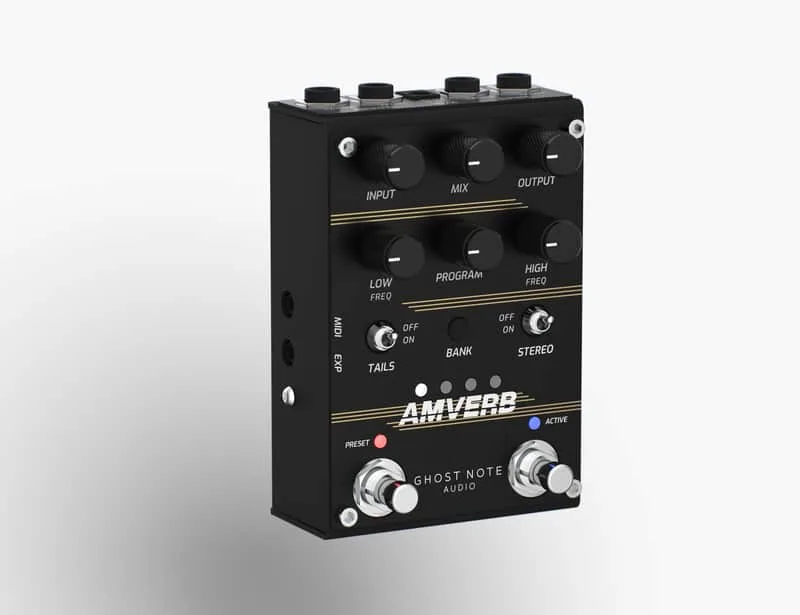


The Ghost Note Audio Amverb is a stereo reverb pedal and an emulation of a classic 1980s reverb unit, part of the maker's Daedalus Digital Effects series. The original unit it models was marketed as a cheaper alternative to the much more expensive digital reverb offerings from companies like Lexicon and EMS, and it ran on a custom, 12-bit, 24KHz signal processor built entirely from discrete logic components. The pedal recreates the full functionality of that hardware using a microcontroller and a software program1.
The controls
The Amverb's front panel carries the input, mix and output levels, two shelf EQ sections, and the program selection controls. The Program knob selects which program you want, and the pedal holds 64 different programs, which you scroll through in banks of 8 before picking the one you want1.
| Control | What it does |
|---|---|
| Input | Sets the input level |
| Mix | Blends dry and reverb signal |
| Output | Sets the output level |
| Low Shelf EQ | Low shelf corner frequency |
| High Shelf EQ | High shelf corner frequency |
| Program knob | Selects the program within the bank |
| Program 1-8 | Eight programs per bank |
| Tails | Reverb tail behavior |
| Bank | Moves between banks of programs |
| Stereo | Off / On switch |
| Footswitches | Bank and program operation |
Controls and ports per Guitar Pedal X's launch coverage2; program selection per the maker's product page1.
The programs
The 64 programs range from very short, small room echoes at just 200 milliseconds long, and gradually extend in length and size up to 20 seconds, with variations offering different room sizes and reflection brightness1. That span covers everything from tight room ambience to long, cavernous decays on one pedal.
Stereo operation and connections
The Amverb is a stereo pedal. It has a Left / 1 Input and both a Left / 1 Output and a Right / 2 Output, plus a USB-C port, and a Stereo Off / On switch lets you run it mono or in full stereo2. A Tails control governs how the reverb tail behaves when you switch the effect off.
The maker's technical data lists the circuit type as analog1, while the pedal is described as a digital emulation of a 1980s reverb unit built on a microcontroller and software program1. The two listings differ on this point.
Power
The Amverb runs on 9V DC, center negative, and draws 100mA1. That is more than some simple pedals need, so on a daisy-chained supply it is worth confirming the current is available on the output you use.
What reviewers said
Guitar.com's Richard Purvis, reviewing the Daedalus series, found the reverb "equally nice but, a little weirdly, not suitable for use with guitar amps"3. That verdict is worth weighing if your intended use is in front of a guitar amp rather than in a recording or studio-style chain.
The Amverb is made by Ghost Note Audio, and the maker's other Daedalus-series pedals were listed at £150 each in the same announcement, with the Amverb priced the same2. If you are comparing it with other options, see the Reverb Pedals page for the wider field.
Videos
Ghost Note Audio
Ghost Note Audio
Ghost Note Audio
Questions
What power supply does the Ghost Note Audio Amverb need?
The Amverb runs on 9V DC, center negative, and draws 100mA. A standard 9V center-negative supply will power it, but at 100mA it is worth making sure your supply or daisy chain has enough current headroom rather than sharing a low-output output with several other pedals.
Is the Amverb a stereo pedal?
Yes. Ghost Note Audio describes the Amverb as a stereo reverb pedal. It has a Left / 1 Input and both a Left / 1 Output and a Right / 2 Output, and a Stereo Off / On switch, so you can run it mono into a single amp or in full stereo across two channels.
How do you select programs on the Amverb?
The pedal holds 64 programs, arranged in banks of 8. You scroll through the banks and then pick the program you want with the Program knob. Each bank carries Programs 1 through 8, and a Bank footswitch moves between banks.
What classic reverb unit is the Amverb based on?
The Amverb emulates a classic 1980s reverb unit that was originally marketed as a cheaper alternative to the more expensive digital reverbs from companies like Lexicon and EMS. The original ran on a custom 12-bit, 24KHz signal processor built entirely from discrete logic components, which the pedal recreates with a microcontroller and software.
Sources (3)
- Amverb by Ghost Note Audio, RockBoard PedalPedia, 2026
- Guitar Pedal X, Guitar Pedal X, 2025-10-20
- Ghost Note Audio Swirls review, Guitar.com, 2026-01-07