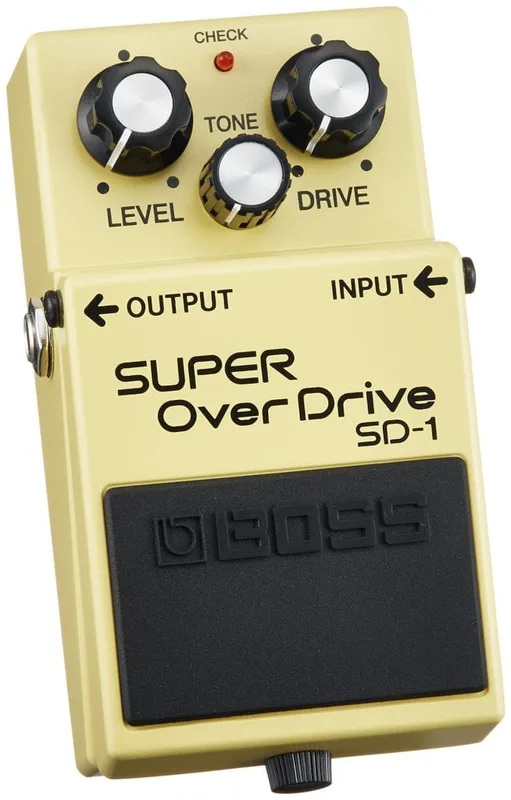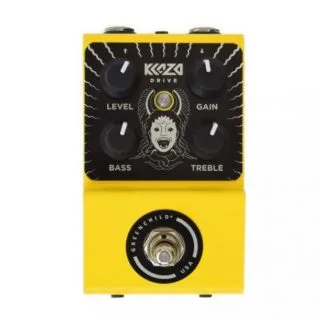


The Greenchild Amplification Klazo Drive is an overdrive pedal designed to transform a guitar's tone dynamically, without the harsh fizz that some drives add. Greenchild describes it as a smooth sounding overdrive that "dynamically responds to pick attack and feels similar to a real amp," which places it in the amp-in-a-box family of pedals: drives that aim to reproduce the feel of a pushed amplifier rather than simply add distortion. It sits alongside other overdrive pedals such as the Tube Screamer and Boss SD-1 designs, though its circuit is built differently from either1.
"dynamically responds to pick attack and feels similar to a real amp"
How the circuit works
The Klazo Drive uses a current driven transconductance amplifier topology with floating diodes, and it relies on finely tuned MOSFET arrays to deliver what Greenchild calls musical signal clipping across the audible frequency spectrum. MOSFET clipping is a soft form of distortion that many players associate with a smoother, more amp-like breakup than hard diode clipping. The signal path is 100% analog1.
The circuit's main building blocks, as Greenchild describes them:
- Current driven transconductance amplifier topology with floating diodes1
- Finely tuned MOSFET arrays for musical signal clipping across the audible frequency spectrum1
- 100% analog signal path1
- Active dual band tone stack1
Controls and tone shaping
The pedal's tone control is more involved than a single knob. It has an active dual band tone stack covering bass and treble, a 2nd order design with a powerful 15 dB of signal cut or boost on each band. Because the bands are active, they can cut as well as boost, giving wide latitude to shape the low end and top end around the drive itself1.
| Tone band | Design | Range |
|---|---|---|
| Bass | Active, 2nd order | 15 dB cut or boost1 |
| Treble | Active, 2nd order | 15 dB cut or boost1 |
Power, bypass and practical details
The Klazo Drive runs on 9V power, and Greenchild describes it as being as close to an amp-in-a-box as one can get at 9V1. It uses Class-A Buffered Bypass rather than true bypass, so a buffer stage stays in the signal path when the pedal is off1. The pedal comes in a unique, space efficient enclosure and carries a lifetime warranty1.
Because the Klazo Drive uses buffered bypass rather than true bypass, players who prefer every pedal out of the chain when off should keep that in mind when placing it on a board.
Background
The Klazo Drive was described in 2020 as Greenchild Amplification's most recent design, and it is designed and assembled in the USA1.
Videos
intheblues
Dennis Kayzer
Blake Hall
Questions
Is the Greenchild Klazo Drive analog?
Yes. Greenchild describes the Klazo Drive as having a 100% analog signal path. The clipping is handled by finely tuned MOSFET arrays, and the circuit uses a current driven transconductance amplifier topology with floating diodes, so there is no digital processing anywhere in the signal chain.
What kind of bypass does the Klazo Drive use?
The Klazo Drive uses Class-A Buffered Bypass rather than true bypass. A buffered bypass keeps the signal passing through a small amplifier stage even when the pedal is off, which can help preserve tone over long cable runs and larger pedalboards.
What power does the Klazo Drive need?
The Klazo Drive runs on 9V power. Greenchild describes it as being as close to an amp-in-a-box as one can get at 9V, meaning the whole amp-like response is achieved from a standard pedal supply voltage.
How much bass and treble boost or cut does the Klazo Drive give?
The Klazo Drive has an active dual band tone stack covering bass and treble. It is a 2nd order design with a powerful 15 dB of signal cut or boost available on each band, which is a wide range for shaping the pedal's low end and top end.
Where is the Klazo Drive made?
The Klazo Drive is designed and assembled in the USA by Greenchild Amplification. It was described in 2020 as the company's most recent design.
Sources (1)
- Greenchild Amplification Klazo Drive, Delicious Audio, 2020-12-02