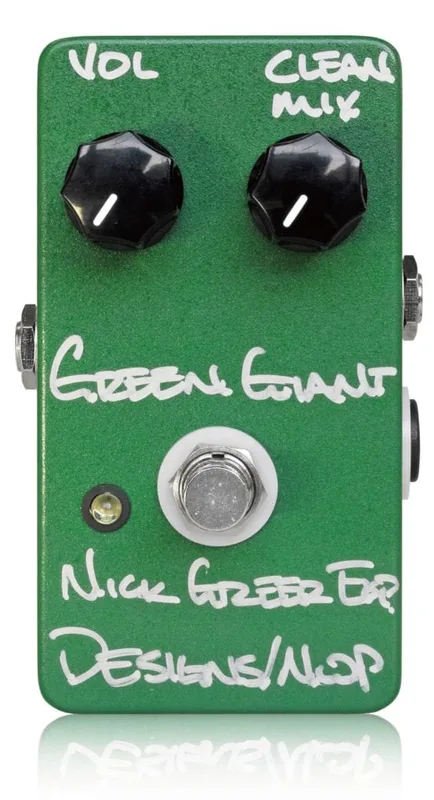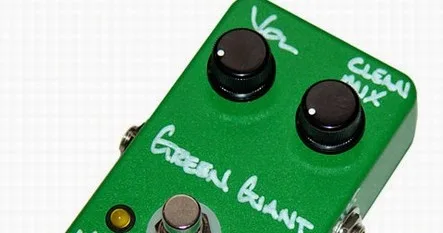
The Nick Greer Green Giant is a distortion pedal from Greer Amplification with an unusual twist: a Clean Mix control that lets you limit how much of your signal gets distorted, so the clean signal sits mixed on top of the distorted one. Guitar FX Layouts describes it as "a basic distortion unit with a limiter between the output of the signal and the clipping section of the diodes," and calls it great for country players and rock and blues players who want good sounding distortion with the ability to dial the amount of hair1.
Endorsers only, then a DIY favorite
The Green Giant was never a normal catalog pedal. Guitar FX Layouts describes it as "formerly built by Greer Amplification for endorsers only" and "one of Nick Greer's personal favorites"1. Because it was not sold widely, the circuit circulated mainly through the DIY community: the Guitar FX Layouts etched-board layout was published on 6 September 2014, built as a request for a forum member named Zach (rocket88)1.
Since the pedal was made for endorsers rather than sold retail, most players who want the circuit today encounter it as a DIY build rather than a production pedal.
How the circuit works
At its core the Green Giant is, in the layout author's words, "an Electra Drive with a saturation control for the diode clipping"1. The same write-up notes it is "very close to the Ghetto Stomp and probably could be thought of as a cut down version with saturation control on" the diodes1. The saturation control idea modifies the effect of the clipping diodes in the same way as Jack Orman's saturation control, and the author quipped, "Oh another pedal that used it before Fuller's ridiculous patent!"1. The broader principle is a familiar one: as Rockman's own technical page puts it, saturation effects "all... are based on the same structure. All. They just differ by the filters placed before the clipping stage" and after it2.
The Clean Mix knob is the pedal's defining control, and it works in two ways at once1:
- What you hear: it limits the amount of signal being distorted, "resulting in a sound much like" the clean signal mixed on top of the distorted signal1.
- What it does in the circuit: the pot sets the amount of signal being clipped by the diode pair by altering the resistance between the signal path and the clipping section, using only two lugs, with lug 3 unconnected1.
- Volume wiring: the volume pot is wired with lug 3 to Clean Mix lug 2, lug 2 to output, and lug 1 to ground1.
Building one, and what builders found
The layout drew a steady stream of builds and mods in the comments1:
- Substituting 150 resistors where the layout calls for 100s was reported to sound "pretty bad! Strangely useable but pretty noisy for something so low gain"1.
- The specified 2N3904 transistor could be swapped for a 2N5088 or MPSA181.
- Zach (rocket88) posted amended layouts on 9 September 2014: one with switchable diodes, and two PNP versions with an onboard inverter, one with an SWTC tone control1.
- For bass use, builders changed the input and output caps to 470nF; one commenter, Beaker, used 470nF input and 100nF output1.
Sources (2)
- Guitar FX Layouts: Nick Greer Green Giant, tagboardeffects.blogspot.com (Guitar FX Layouts), 2014-09-06
- Rockman.fr, Rockman.fr, 2007