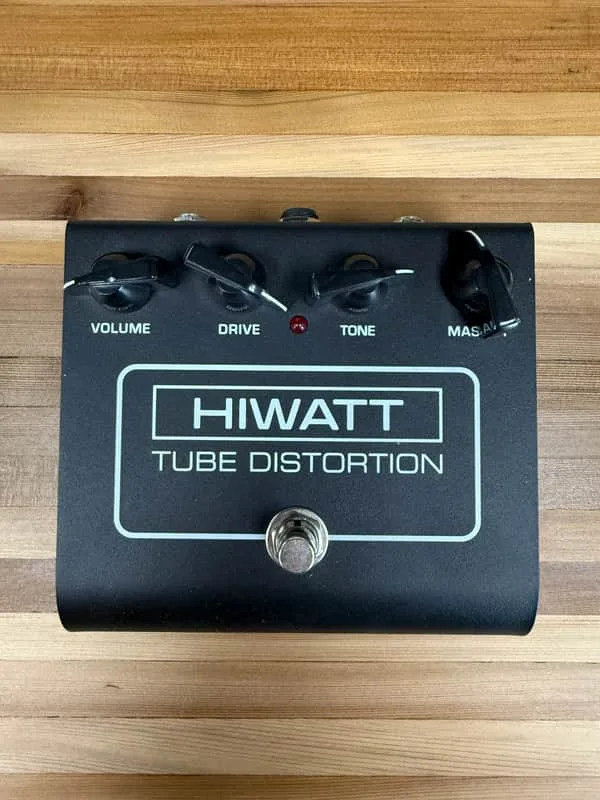


The Hiwatt Tube Distortion is a distortion pedal from Hiwatt that puts a real vacuum tube in a stompbox. It is built around a dual-triode ECC83 (12AX7) tube running at high plate voltage, and RockBoard's PedalPedia describes it as delivering "genuine tube saturation ranging from subtle warm overdrive to high-gain crunch"1. In other words, it is aimed at the player who wants the breakup character of a pushed tube amp on a pedalboard, from light drive on one end to a full crunch on the other.
The circuit is analog, and the pedal uses true bypass mechanical switching, which RockBoard's PedalPedia says "preserves pure instrument signal path integrity when the unit is deactivated"1. It sits in a heavy-duty steel chassis, which RockBoard's PedalPedia says provides roadworthy shielding against external interference in live and studio settings1.
From overdrive to high-gain crunch
The gain range is the pedal's core selling point. Hiwatt positions it as one box that covers the whole drive spectrum: back the gain off for a subtle, warm overdrive, or push it for high-gain crunch1. That range comes from the tube itself. Because the ECC83 runs at high plate voltage rather than the starved-plate arrangement some tube pedals use, the saturation behaves more like an amplifier stage being driven hard1.
The master volume and gain controls work together to regulate the internal signal drive levels, letting you balance overall headroom against the distortion texture1. So you can set how hard the tube is being pushed independently of how loud the pedal is in the chain.
The controls and footswitches
The control panel breaks down into three groups:
| Control | What it does |
|---|---|
| Gain | Sets how hard the tube is driven, from subtle warm overdrive to high-gain crunch1 |
| Master volume | Balances output level against the gain setting, managing headroom1 |
| Bass, Middle, Treble | A passive three-band tone stack for frequency shaping1 |
The tone stack is tailored after traditional British tube amplifiers, which fits the Hiwatt lineage of British amp building, and RockBoard's PedalPedia says it offers precise frequency control1.
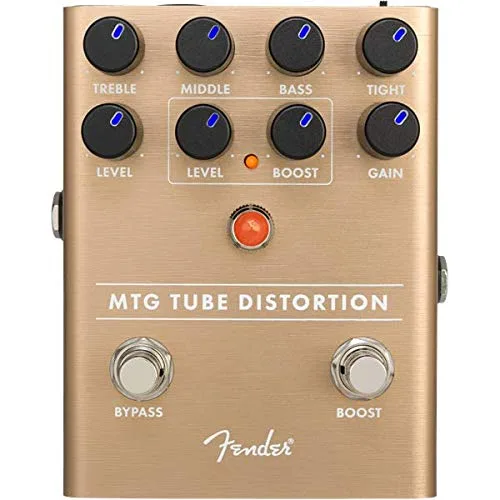
There are two footswitches, and they are independent of each other. One is the standard effect bypass. The other engages a switchable gain boost stage, which pushes the pedal into additional saturation on top of whatever you have dialed in1. That second switch is a familiar idea in tube distortion pedals: the Fender MTG Tube Distortion also carries a second footswitch with a boost, which Delicious Audio described at its launch as a way "to bump up your volume during solos or louder sections"2. On the Hiwatt, the boost stage is about gain rather than simply level, so it changes the character of the drive, not just the loudness.
Power: 18V DC, 1000mA
The Hiwatt Tube Distortion needs an 18V DC center negative supply delivering 1000mA1. That rules out a standard 9V pedal supply and a daisy chain, and it rules out a battery. You need a dedicated high-current 18V output.
The power requirement is worth pausing on, because it is unusual even among tube pedals. The Fender MTG Tube Distortion runs on a 9-volt supply with at least 290mA3, and in Sweetwater's demo of that pedal Mitch Gallagher noted it "draws about 300 milliamps of current though so you want to use a high current output"4. The Hiwatt asks for roughly three times that voltage and more than three times that current, which reflects the high plate voltage the ECC83 runs at. Other makers have taken a different route to the same end: Crazy Tube Circuits' Hi Power runs its tube circuit at 18V DC via an internal voltage booster, so it draws that from an ordinary 9V adaptor5, and Guitar World's review lists its power requirement as a 9V DC adaptor, not supplied6. Hiwatt instead asks you to feed the pedal 18V directly.
How it compares with other tube distortion pedals
The Hiwatt Tube Distortion sits in a small category of pedals that use a real tube as the distortion engine rather than diodes or op-amps. The Fender MTG Tube Distortion is a close comparison: it is also a true bypass tube distortion pedal3, but it uses a US-made new old stock military 6205 tube rather than an ECC8341, and it runs on 9V rather than 18V34. The Fender also carries a boost on its second footswitch2, so the two pedals share the two-switch layout while differing in tube type and power.
The choice between them largely comes down to how the tube is powered. Fender's approach keeps the pedal on a standard 9V supply at around 290 to 300mA34, while Hiwatt's high plate voltage design demands the 18V, 1000mA supply1. Players who already run a high-current power brick with 18V outputs can use the Hiwatt as-is; players on a basic 9V board will find the Fender easier to accommodate.
Videos
MODERN ROYAL JAMS !
Promusic TV
Questions
Is the Hiwatt Tube Distortion true bypass?
Yes. It uses true bypass mechanical switching, which the maker says preserves the pure instrument signal path when the pedal is switched off. Your dry signal passes through untouched rather than through a buffered circuit.
What tube does the Hiwatt Tube Distortion use?
It uses a dual-triode ECC83, also known as a 12AX7, running at high plate voltage. That high plate voltage is what lets the tube saturate the way it does in an amplifier rather than just acting as a low-voltage clipping stage.
What power supply does the Hiwatt Tube Distortion need?
It runs on 18V DC with a center negative plug and draws 1000mA. That is far more current than a standard 9V pedal supply delivers, so you need a dedicated high-current 18V output, and a battery is not an option.
What does the second footswitch do on the Hiwatt Tube Distortion?
The pedal has two independent footswitches. One is the standard effect bypass, and the other engages a switchable gain boost stage that pushes the tube harder for more saturation without changing your base settings.
Is the Hiwatt Tube Distortion analog?
Yes. The maker lists it as an analog circuit, so the distortion comes from the ECC83 tube and analog circuitry rather than digital modeling.
Sources (6)
- Tube Distortion by Hiwatt, RockBoard (rockboard.de PedalPedia), 2026
- Fender MTG Tube Distortion, Delicious Audio, 2019-07-15
- Review: Fender Tre-Verb, Lost Highway Phaser & MTG Tube Distortion, guitar.com, 2019-05-20
- Fender Guitar Effects Pedals at Winter NAMM 2019, Sweetwater (youtube.com), 2019-01-25
- Crazy Tube Circuits HI POWER, gearnews.com, 2023-12-07
- Crazy Tube Circuits Hi Power review, Guitar World, 2024-04-20