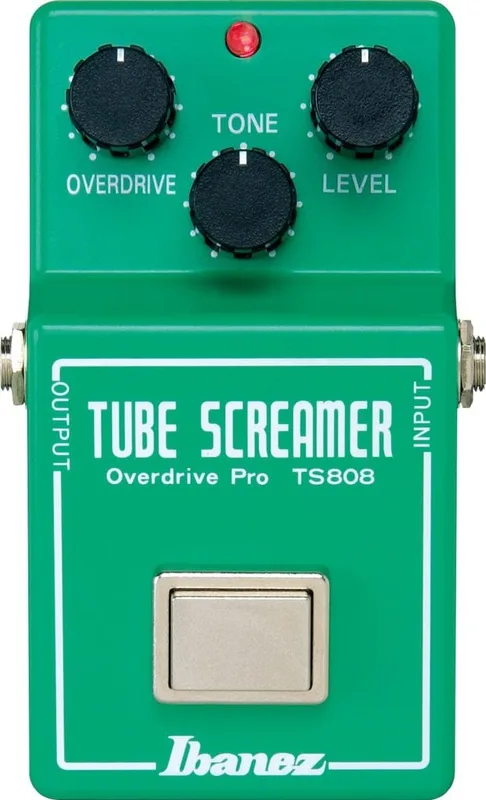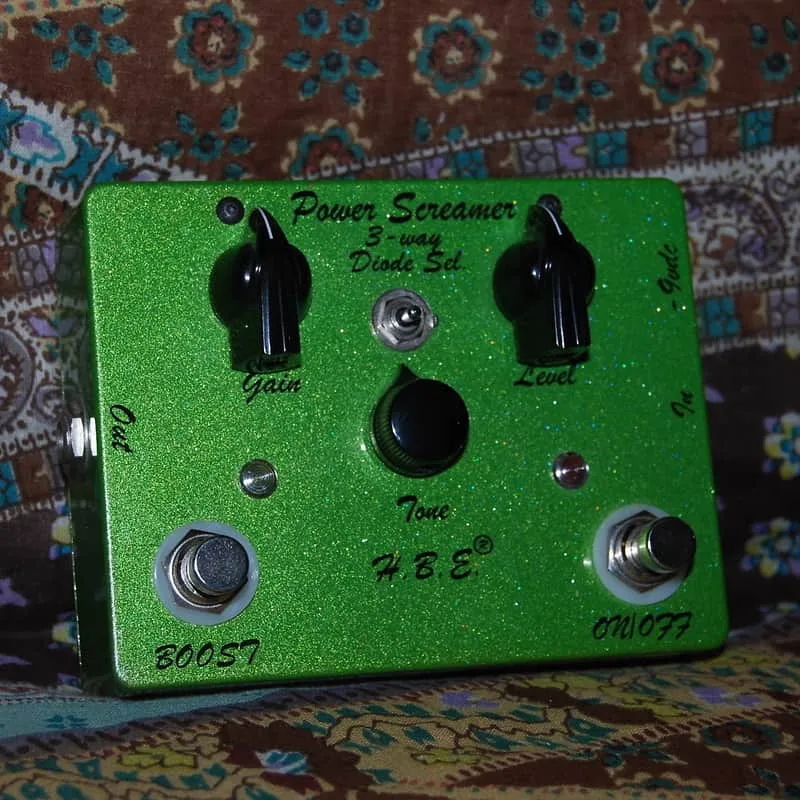


The HomeBrew Electronics Power Screamer is an overdrive pedal built on the JRC4558 op amp, the same chip made famous by the Ibanez Tube Screamer and used in many classic and boutique pedals1. On top of the usual overdrive controls it adds a three-position diode select switch and a footswitchable boost, which sets it apart from a stock Tube Screamer-style circuit. MusicRadar placed its overall sound somewhere between a classic Tube Screamer-style overdrive and a more grainy-sounding fuzz1.
Homebrew Electronics built the Power Screamer as an overdrive pedal based on the JRC4558 op amp, a chip used in many classic and boutique pedals1. Its sound sits somewhere between a classic Tube Screamer-style overdrive and a more grainy-sounding fuzzbox1.
The controls
The front panel carries the customary overdrive controls: adjustable gain, level and tone123. Vintage Guitar described these as the standard set for the type, so a player moving from any Tube Screamer-style pedal will find the layout familiar2. The tone control is a single knob rather than a separate bass and treble pair.
Alongside the knobs sit the two features that define the pedal: the three-way diode switch and the boost footswitch13.
| Control | What it does |
|---|---|
| Gain | Sets the amount of overdrive13 |
| Level | Sets the output volume13 |
| Tone | Adjusts the tonal balance13 |
| Diode toggle (3-way) | Selects which diode is used in the clipping circuit13 |
| Boost footswitch | Adds extra gain and volume on demand12 |
The three-way diode switch
A three-position toggle switch lets you change the diode used in the circuit, which changes the clipping character1. The two reviews describe the three positions differently in detail but consistently in spirit:
- Left: the "classic overdrive" setting, producing a tight, mid-rangey sound not unlike a Tube Screamer1. Vintage Guitar heard a vintage 808-style sound with midrange bark in this position, with tone at 12 o'clock2.
- Middle: MusicRadar found the compression less obvious here, with more gain, bass and treble, calling it the most full-throated sound of the three1. Vintage Guitar's reviewer called this position much more flat and true, and it was that reviewer's favorite setting2.
- Right: a little brighter but heavily compressed, designed to emulate the "sag" produced by running a small valve amp flat out1.
Because the diodes sit in the clipping stage, swapping between them changes how hard the signal is clipped and how compressed the result feels, which is why the three positions range from a familiar midrange overdrive to something closer to a sagging amp1.
The boost footswitch and the fat boost option
A second footswitch adds around 10dB of extra boost1. Vintage Guitar measured the effect differently, finding the boost switch added 6 dB of gain, increasing both volume and gain without really changing the tone, though with a slight loss of low-end that the reviewer did not consider a big concern for a solo boost2.
One of the HBE custom shop options adds an extra toggle switch affecting how the boost works: normal or "fat boost"1. The DIY circuit analysis explains what is happening electrically: the boost switch changes between two sets of components from the op amp's inverting input to ground, so it functions like a fat switch, altering the low-frequency content of the boosted signal rather than simply adding volume3.
How the circuit works
The Power Screamer is based on the JRC4558D3, and its lineage is explicit: Vintage Guitar noted the chip was "made famous by a certain bright green stompbox that also had the word 'screamer' in its name"2. The Tube Screamer family it descends from is itself built on a well-worn gain-stage arrangement, a pot in the op amp loop adjusting gain, a schematic Coda Effects points out appears across many overdrives4.
The broader Tube Screamer topology, as traced by runoffgroove's analysis of a TS-808 workalike, runs: an input buffer, the audio split into a distortion path and a clean path, two series gain amps in the distortion path, a tone section, and an output buffer and mixer that recombines the paths with extra gain so the circuit has plenty of output signal5. The same analysis notes the family's frequency response traces back to the old germanium boosters6.
A DIY vero (stripboard) layout of the Power Screamer was published by Guitar FX Layouts in September 2014, tweaked with a couple of mods to low frequency response and gain, with switchable diodes. The boost switch there is a stomp switch, and with a 2PDT footswitch the second pole can drive an LED3.
What reviewers said
MusicRadar's verdict on the sound was short: "Smooth, transparent overdrive sound."1 The same review framed the pedal's appeal for players who want old-style stompbox character with true bypass and top quality components1.
Vintage Guitar, reviewing the pedal in its January 2005 issue through Crate and Fender amps with G&L, Fender and Zemaitis guitars, found that even with the gain dimed it stayed tight and punchy, with great note clarity2. That reviewer also praised the build: chassis-mounted pots, switches and jack, and the heavy duty battery clip riveted to the cover2. The test unit wore one of HBE's custom finishes, a lacquered tweed covering the magazine described as meticulously executed2.
Videos
ProGuitarShopDemos
TheToneShack
Music Gear Fast
Questions
What op amp does the HomeBrew Power Screamer use?
It uses the JRC4558 op amp, the same chip made famous by the Ibanez Tube Screamer and used in many classic and boutique overdrive pedals. The DIY vero layout of the circuit is also drawn around the JRC4558D, so builders can reproduce the original chip choice.
Is the HomeBrew Power Screamer true bypass?
Yes. Both published reviews describe true-bypass switching, with Vintage Guitar noting a true bypass footswitch with an LED. MusicRadar frames the pedal as old-style stompbox sound combined with true bypass and top quality components.
Does the Power Screamer take a 9V battery?
Yes. The Vintage Guitar reviewer found a heavy duty 9-volt battery clip and connector riveted to the inside of the cover, with the clip snapping securely into a connector. The pedal also has a negative-center power jack for an adapter.
Is there a DIY layout for the Power Screamer?
Yes. Guitar FX Layouts published a stripboard (vero) layout of the Power Screamer in September 2014, with build notes and a couple of modifications to low frequency response and gain. The layout is based on the JRC4558D and includes the 3-way diode select and footswitchable boost.
Sources (6)
- Homebrew Electronics Power Screamer review, MusicRadar, 2007-12-06
- HomeBrew Electronics Power Screamer/Compressor Retro, Vintage Guitar magazine, 2010-05-01
- Guitar FX Layouts: HBE Power Screamer, Guitar FX Layouts (tagboardeffects.blogspot.com), 2014-09-22
- Coda Effects, Coda Effects, 2015-12
- UBE Screamer, runoffgroove.com, 2006-08
- dm-t.pdf, treblebooster.net, 2025