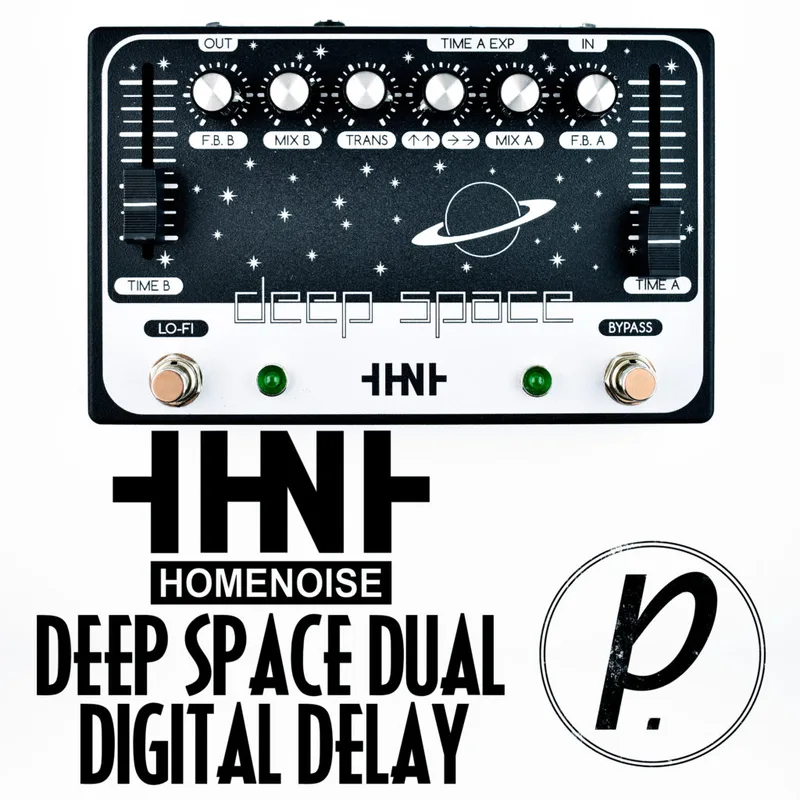


The Homenoise Effects Deep Space is a dual digital delay pedal: two separate echo circuits in one box, each with its own controls, that you can run in parallel or in series and blend together. Where most delay pedals give you one delay line and maybe a tap tempo, the Deep Space's whole design is built around the interaction between its two delays, from the routing between them to how much of Delay A feeds into Delay B1.
According to Pedal of the Day, who reviewed the pedal in August 2018, the two delays can produce anything from "cavernous but quick slap back types of echoes" at lower settings to more intense repeats as you push the sliders up, and the ability to blend the two delays together is "fairly unique" and produces original delay sounds1.
The controls
The Deep Space gives each of its two delays its own set of controls, plus shared knobs that govern how the two sides interact1.
| Control | What it does |
|---|---|
| Delay A / Delay B sliders | Set the delay time for each side, from 40ms up to about 320ms1 |
| Delay A / Delay B Feedback knobs | Control the number of repeats for each side; past about 3:00 they push into self-oscillation1 |
| Delay A / Delay B Mix knobs | Individually set the volume of each delay side1 |
| Arrows knob | Sets the routing: to the left the delays run in parallel, to the right in series1 |
| Trans knob | Sets how much signal is sent from Delay A to Delay B, working with the arrows parameter1 |
| Lo-Fi footswitch | When activated, increases the range of Delay B from 650ms to 1 full second1 |
The arrows and Trans knobs are where the Deep Space departs from a standard dual delay. With the arrows knob to the left, the two delays run in parallel, so each echoes your guitar independently. Turn it to the right and they run in series, with Delay B echoing the output of Delay A. The Trans knob then sets how much of Delay A's signal is handed off to Delay B, which means you can dial in anything from two completely independent echoes to one long, cascading repeat chain1.
Each side's Mix knob sets its volume individually, so you can balance the two delays against each other, and each Feedback knob sets its own repeat count. Pedal of the Day noted that pushing the Feedback knobs past about 3:00 gets "into some crazy self-oscillation territory," where the repeats keep building on their own1.
"The ability to blend these two together is fairly unique, and again produces some original delay sounds."
Delay time and the Lo-Fi footswitch
The sliders on each delay cover 40ms to about 320ms, which on its own is slapback and short-echo territory. Delay B reaches further, with a normal range that extends to 650ms, and the Lo-Fi footswitch stretches that to a full second when activated1. That gives Delay B a much longer maximum repeat than Delay A, which suits the series routing: a short echo from Delay A feeding a long, lo-fi wash from Delay B.
Expression pedal use
The Deep Space has an expression input, and an expression pedal plugged into it controls the delay time of Delay A, letting you sweep the echo length while you play. Pedal of the Day's reviewer went further than just noting the feature1:
"we think it's a must-have to fully utilize all the Deep Space can do"
For a player weighing accessories, that review puts an expression pedal high on the list for this particular delay1.
What it sounds like
In the review's description, lower settings give "cavernous but quick slap back types of echoes," and the repeats grow gradually more intense as the sliders move up. Between the parallel/series routing, the Trans knob's cross-feed, the self-oscillating Feedback knobs and the Lo-Fi switch's extended, degraded repeats on Delay B, the Deep Space leans toward experimental and ambient delay territory rather than clean, studio-style echo1.
Videos
aBunchOfPedals
Pedal of the Day
Questions
Does the Homenoise Deep Space have two separate delays?
Yes. The Deep Space is a dual digital delay with two separate echo circuits, Delay A and Delay B. Each has its own delay time slider, Feedback knob and Mix knob, and an arrows knob lets you run the two delays in parallel to the left or in series to the right, with a Trans knob setting how much signal passes from Delay A to Delay B.
How long can the delay time go on the Deep Space?
Each delay has a slider that sets delay time from 40ms up to about 320ms. Delay B goes further: its normal range reaches 650ms, and engaging the Lo-Fi footswitch extends that range to a full second. An expression pedal plugged into the pedal can also control the delay time of Delay A in real time.
Can you use an expression pedal with the Deep Space?
Yes. Plugging in an expression pedal lets you control the length of time for Delay A, so you can sweep the delay time while you play. The reviewer at Pedal of the Day considered an expression pedal a must-have to fully utilize everything the Deep Space can do.
What does the Lo-Fi footswitch do on the Deep Space?
The Lo-Fi footswitch extends the range of Delay B. When activated, it increases Delay B's maximum delay time from 650ms to one full second. As its name suggests, it does this in a lo-fi fashion, giving you longer, degraded repeats rather than clean ones.
Does the Deep Space self-oscillate?
Yes. Each delay's Feedback knob controls the number of repeats, and according to Pedal of the Day, cranking the Feedback knobs up past about 3:00 on the dial gets you into self-oscillation territory, where the repeats build on themselves without you playing anything.
Sources (1)
- Homenoise Effects Deep Space Dual Digital Delay, Pedal of the Day, 2018-08-08