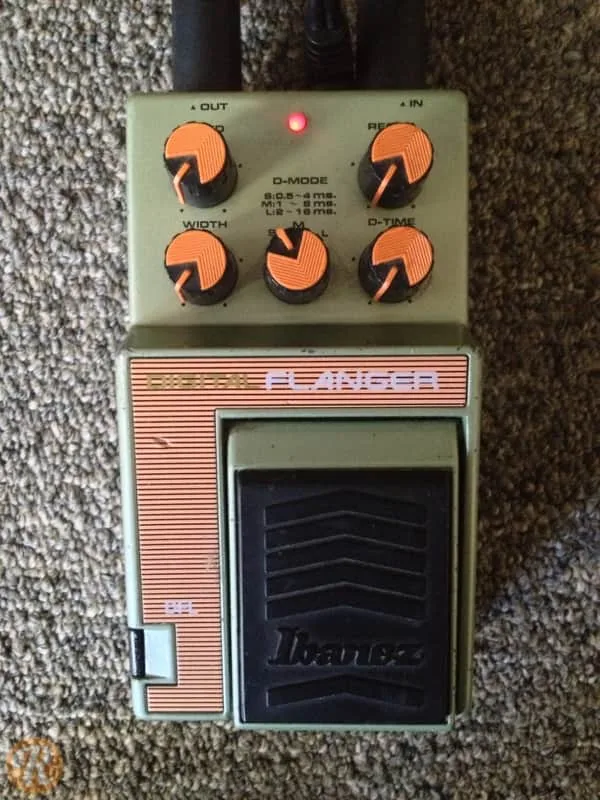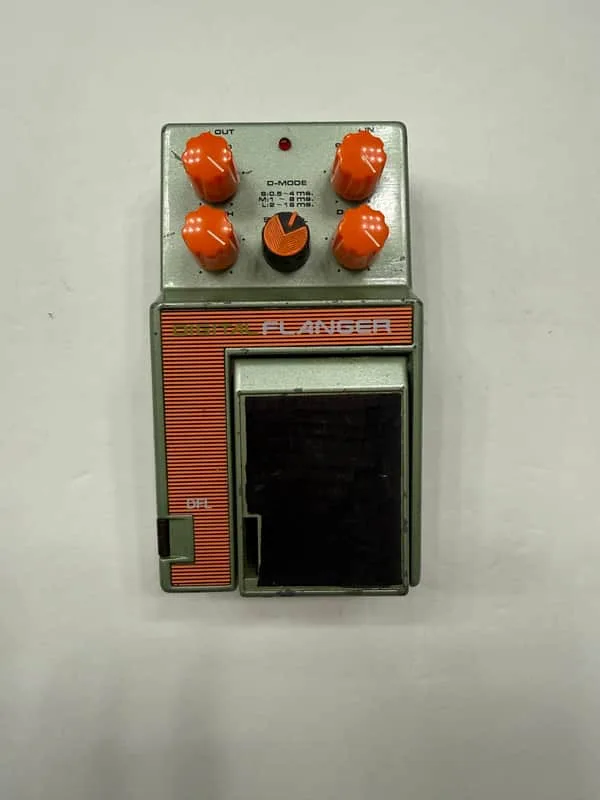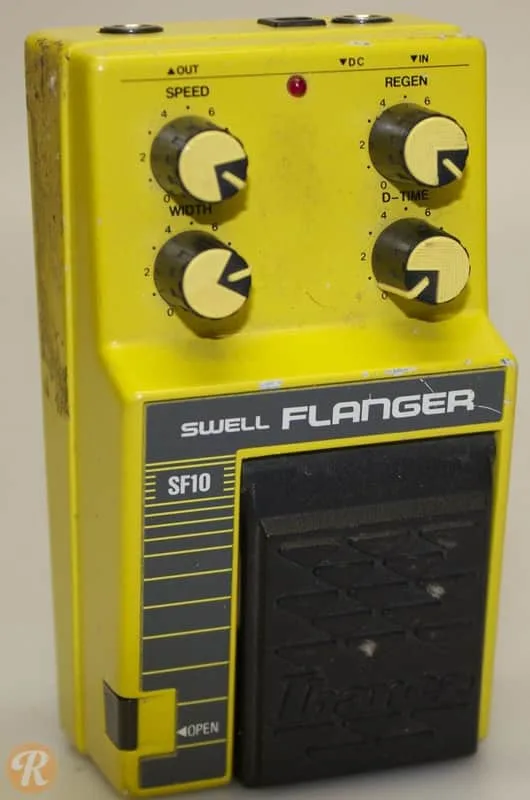


The Ibanez SF10 Swell Flanger is an analog flanger pedal made in Japan, part of Ibanez's Power Series 10 range. It was produced from 1986 to 1993 and has never been reissued1. ToneHome describes its BBD (bucket brigade device) circuitry, the analog delay chip design common in pedals of that era, as delivering "rich, smooth flanging effects"1.
How the SF10 makes its sound
Like any flanger, the SF10 works by mixing the dry signal with a short delayed copy of itself, forming a moving comb-filter, the series of peaks and notches that gives flanging its character1. ToneHome describes the analog circuitry as creating "a uniquely rich and warm sound," and notes it is especially suited for flanging distorted guitar sounds1.
The controls: D-Time, Speed, Width and feedback
The SF10 has four control knobs that give complete control of the delay time, speed, width and feedback of the effect1.
| Control | What it does |
|---|---|
| D-Time | Sets the delay time. Turning it counterclockwise shortens the delay, and the overall effect becomes more metallic in sound1 |
| Speed | Controls the rate at which the comb-filter moves1 |
| Width | Controls the range in which the comb-filter moves1 |
| Feedback | Controls feedback of the delayed signal1 |
SF10 versus the DCF10
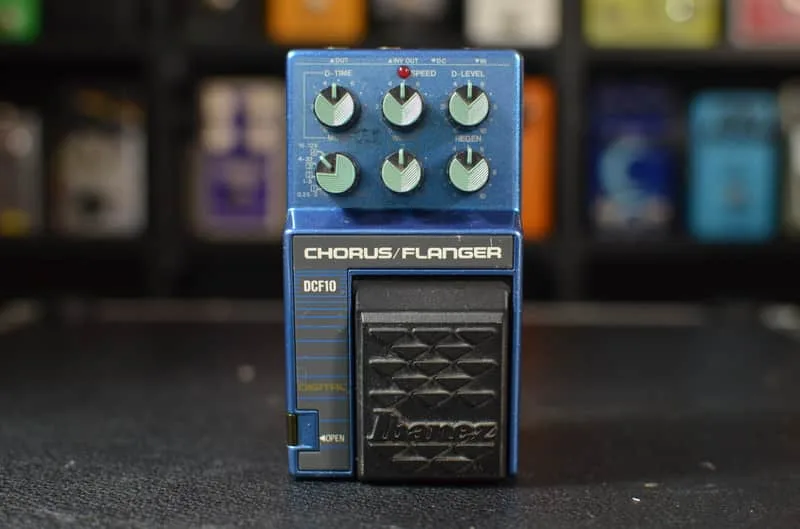
ToneHome describes the SF10 as "virtually identical in theory and operation to a digital flanger such as the DCF10," Ibanez's DCF10 Digital Chorus/Flanger1. The difference is in the circuit: the SF10 is analog with BBD circuitry, while the DCF10 is digital, and its digital design gives it a 7kHz bandwidth21. The DCF10 was produced later, from 1987 to 19932.
The two pedals also differ in how the controls are laid out. The DCF10 uses a four-position Mode selector alongside its D-Time knob to set delay times, plus Speed, Regen and Width controls2. On the DCF10, the Regen knob controls delay time repeats and adds "Swell" to the flanging effect, and the Width control allows narrow or broad sweeps of the comb, with non-sweeping settings at zero width2. The SF10 instead gives the player direct knobs for delay time, speed, width and feedback1.
Availability and collecting
ToneHome rates the SF10's availability on the used market as average and its collectibility as high1. Since it was never reissued, the pedal only exists in its original 1986 to 1993 production run1.
The SF10 has never been reissued, so any example on the market today is a vintage original from the 1986 to 1993 production run1.
Manual
The SF10 manual is available as a PDF from ToneHome1.
Videos
basscajon
Gear Confessions
TooNyTooN