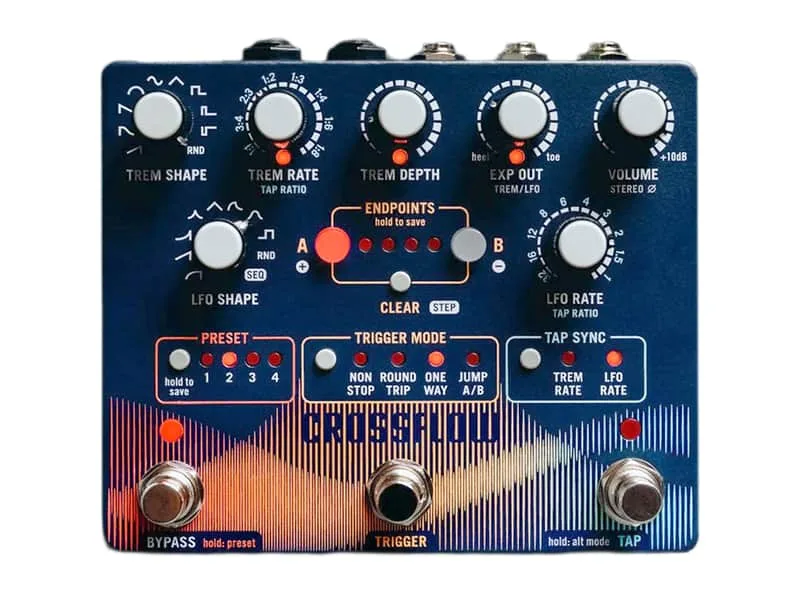


The Intrepid Audio Crossflow is a stereo tremolo pedal that combines an analog signal path with deep digital control. It offers nine waveforms, covering everything from classic amp-like pulses to complex, sequenced movement, and it carries pro features including tap tempo and four onboard presets1. For a player, it sits in the tremolo category but aims well beyond a simple pulse pedal: the digital side of the design drives LFOs and sequences that can also be sent to other pedals.
What it does to your sound
As a tremolo, the Crossflow varies the volume of your signal rhythmically, in stereo. Intrepid Audio's design, as described by Delicious Audio's Paolo De Gregorio, spans classic amp-like pulses at one end and complex, sequenced movement at the other, so the same pedal can cover a traditional Fender-style pulse and more experimental motion1. Alongside its standard waveforms it includes random/sample & hold modes, which De Gregorio describes as delivering "unpredictable, organic movement"1.
Waveforms, tap tempo, presets and CV output
The feature set is where the Crossflow departs from a conventional tremolo:
- Nine waveforms, from basic pulses to sequenced shapes1
- Random/sample & hold modes for organic, unpredictable movement1
- Tap tempo for setting speed in time with a song1
- 4 onboard presets for storing and recalling settings1
- Expression/CV output that can send the pedal's LFOs and sequences to other pedals to modulate their parameters1
- Master clock function for the entire pedalboard1
The Expression/CV output is the notable one. Because the Crossflow can output its LFOs and sequences, it can modulate parameters on other pedals, for example sweeping a filter or wobbling a delay's time in sync with its own tremolo, all while acting as a master clock for your entire pedalboard1. That makes it a candidate for players who think of modulation as a system-wide thing rather than a single effect, in the same territory as some MIDI and switching setups, though the Crossflow does it over CV.
What reviewers said
Delicious Audio's writeup, published on 10 January 2026, frames the Crossflow as redefining what a tremolo pedal can be, calling it a studio-grade modulation hub overall1.
"You can output its sophisticated LFOs and sequences via the Expression/CV output to modulate parameters on other pedals"
Videos
SpiralCasterPlaysPedals
collector//emitter
Megan L
Questions
Is the Intrepid Audio Crossflow analog or digital?
It combines an analog signal path with deep digital control, as Delicious Audio's Paolo De Gregorio describes it. In practice that means the audio passing through the pedal stays analog, while the digital side handles the LFOs, sequences and preset system that shape the tremolo. Players who want the feel of an analog tremolo with modern programmability get both in one box.
Does the Crossflow have tap tempo?
Yes. Delicious Audio lists tap tempo among the Crossflow's pro features, so you can set the tremolo's speed by tapping in time with the music rather than turning a knob and guessing. Combined with its sequenced and random modes, tap tempo makes it easier to lock the movement to a song's tempo.
Can the Crossflow control other pedals?
It can. The Crossflow has an Expression/CV output that lets you send its LFOs and sequences to other pedals to modulate their parameters, and it can act as a master clock for an entire pedalboard. That turns it from a tremolo into a modulation hub for the rest of a rig.
How many presets does the Intrepid Audio Crossflow store?
The Crossflow stores four onboard presets, according to Delicious Audio's writeup. That gives you room to keep a few different tremolo settings, such as a classic pulse, a sequenced pattern and a random movement, and switch between them without re-dialing knobs mid-set.
Sources (1)
- Intrepid Audio Crossflow Stereo Tremolo, Delicious Audio, 2026-01-10