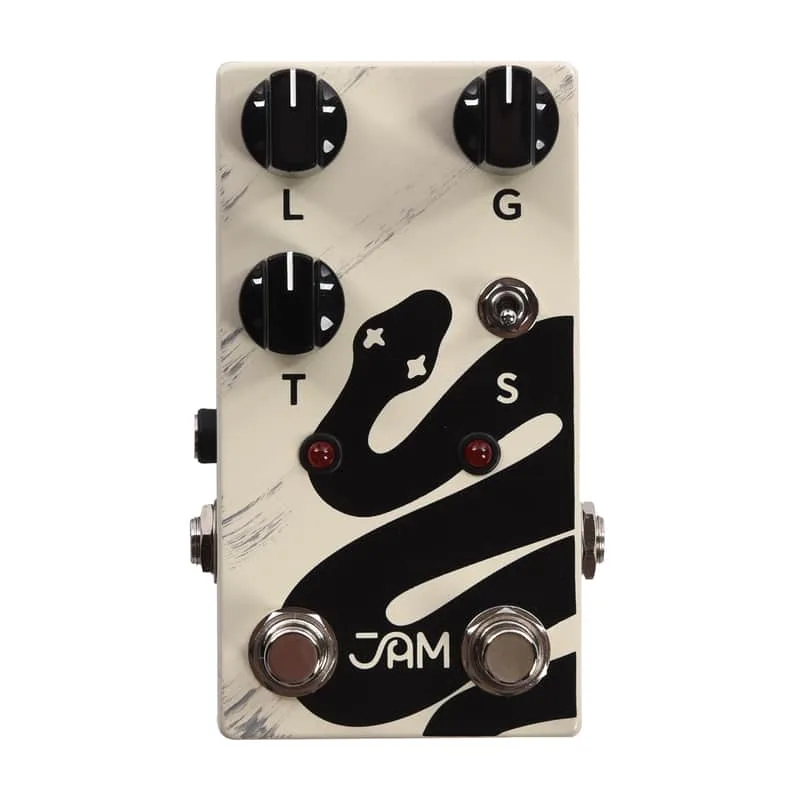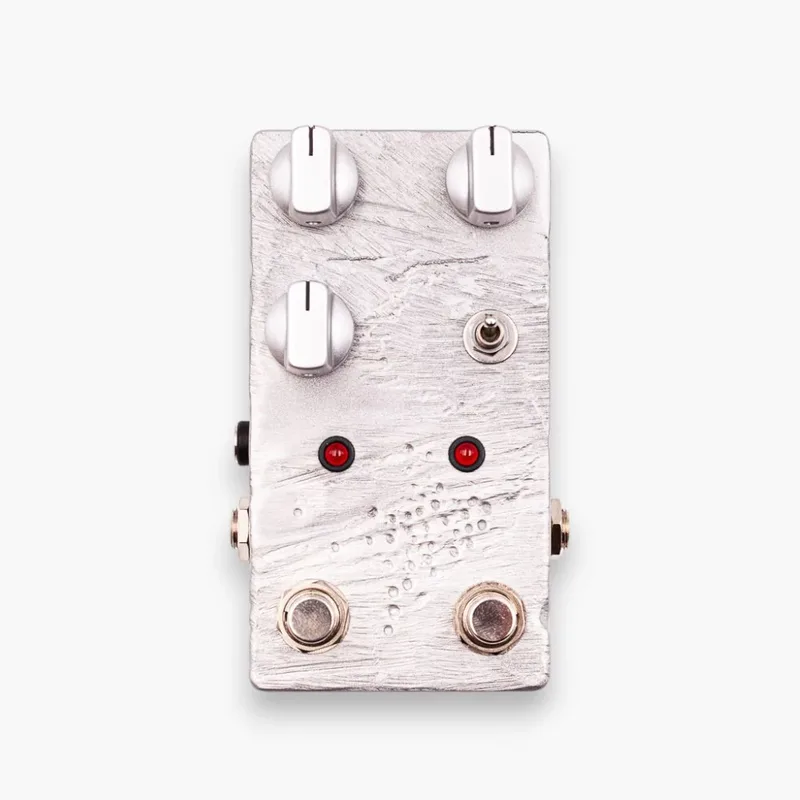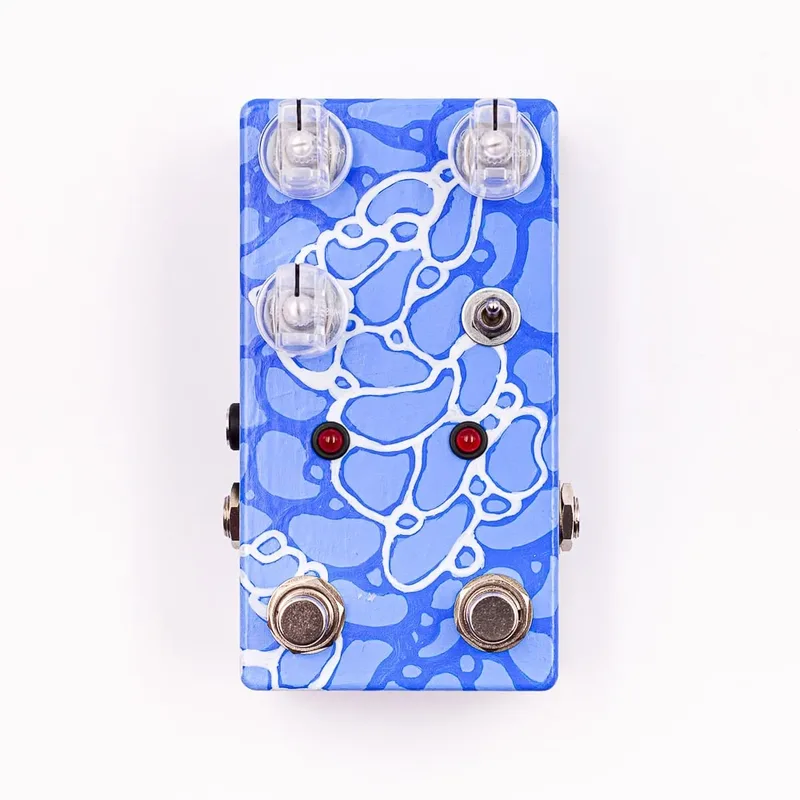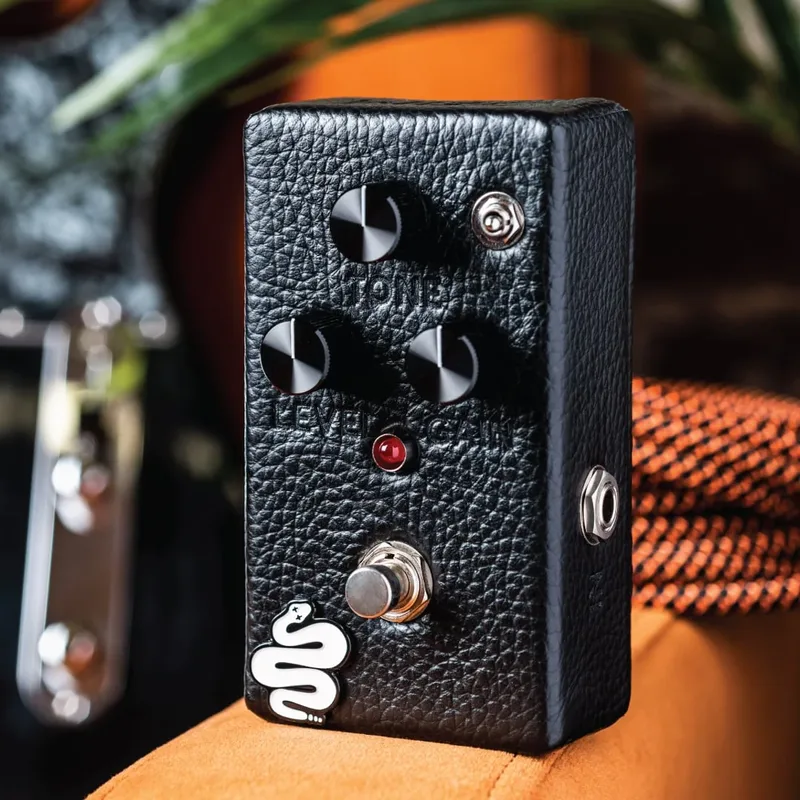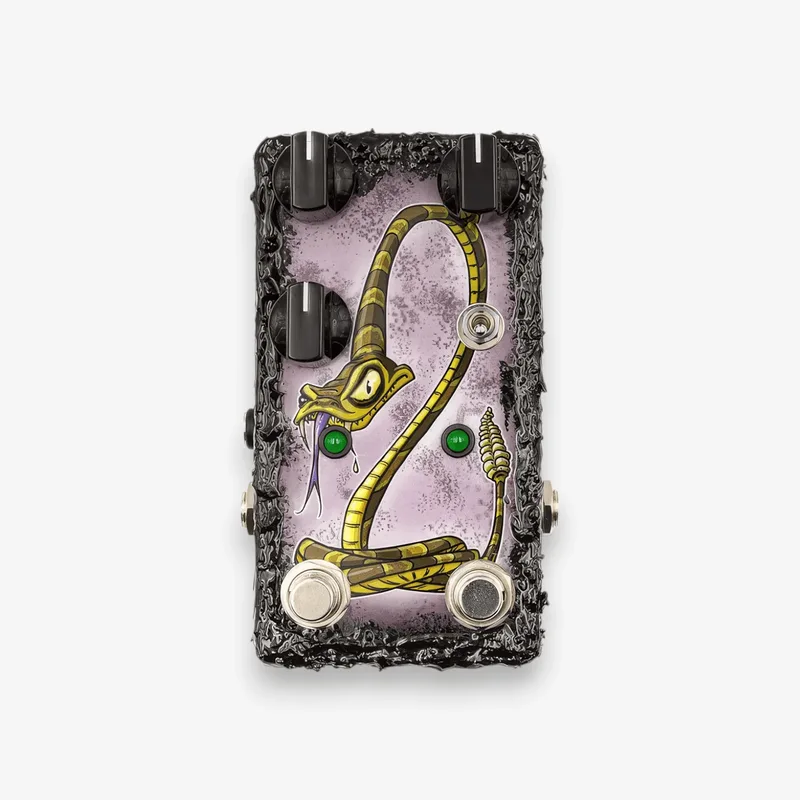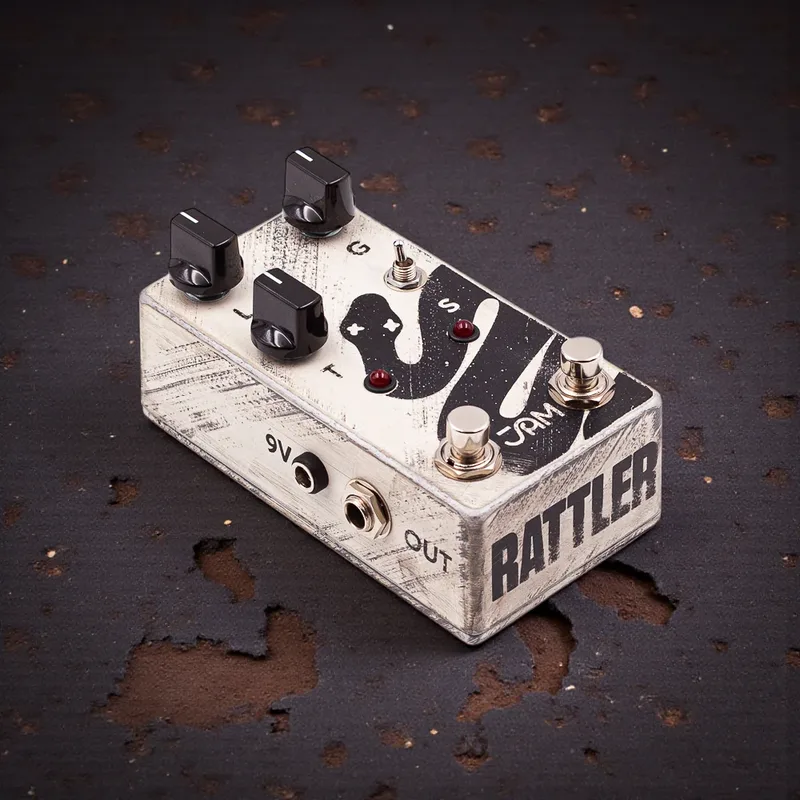
The JAM "Relic" Rattler is a limited-edition, hand-painted version of the JAM Pedals Rattler mk.2 distortion pedal. JAM Pedals describes the Rattler as "a bold, open and dynamic distortion pedal that channels the fat, creamy voice of classic early-'80s circuits through a custom discrete-component op-amp"1. Every custom artwork pedal is a one-of-a-kind hand-painted piece, and the pedal you receive will differ in detail from the photos shown1.
The "Relic" Rattler shares its circuit and sound with the standard Rattler 2: the only difference is the artwork on the enclosure. It carries the same controls, the same clipping selector, the same footswitchable mid boost and the same saved startup states as the other custom artwork versions of the mk.2, such as the "Moonrock" Rattler mk.2 and the "Neurones" Rattler mk.21.
The circuit: a custom op-amp standing in for the LM308
The Rattler's voice comes from a chip substitution. JAM Pedals developed a proprietary discrete-component op-amp "to preserve the open, dynamic and tube-amp-like feel" associated with the discontinued LM308, the op-amp at the heart of the classic early-'80s circuits the Rattler channels1. Guitar Pedal X's roundup of 2024's notable distortions describes the mk.2 as a "Brand new Rattler iteration - with additional clipping options, Mid Boost, and its own proprietary OpAmp chip"2.
The controls: clipping switch, mid boost and saved startup states
The mk.2 control set, as listed by Guitar Pedal X, is:
| Control | What it does |
|---|---|
| Level | Sets output volume |
| Gain | Sets the amount of distortion |
| Tone | Shapes the frequency response |
| Clipping switch | Selects between two clipping voices |
| Mid Boost footswitch | Engages a mid boost before the distortion |
| Bypass footswitch | Switches the effect on and off |
The clipping selector has two positions. The top position selects the original asymmetrical clipping, and the bottom position selects symmetrical clipping, which JAM Pedals describes as giving "a different feel and compression profile"1. In practical terms, the two positions change how the waveform's peaks are cut, which alters both the feel under the fingers and how compressed the distortion sounds.
The left footswitch engages a mid boost before the distortion, and an internal trimmer sets the boost level1. That means the boost amount is set once inside the pedal, then brought in and out with the footswitch while playing, useful for pushing solos or heavier sections forward without bending down.
The pedal also remembers how you left it. The Rattler and Mid Boost startup states can each be saved independently by reconnecting power while holding the corresponding footswitch1. So you can have the pedal come up with the effect already on, the boost already on, both, or neither, and change the saved state whenever you like.
Power and connections
The "Relic" Rattler runs on 9V DC, center-negative, and draws 95 mA1. Its input impedance is 500 kΩ and its output impedance is listed as under 5 kΩ1.
At 95 mA this pedal draws more current than many analog distortions, so plan a power supply output that can deliver it. The center-negative 9V DC requirement matches the common boss-style standard.
The Relic Rattler Bass version
There is also a "Relic" Rattler Bass, a hand-painted version of the Rattler Bass aimed at bass players. JAM Pedals says the Rattler Bass "delivers fat, creamy bass distortion with the headroom, articulation and low-end authority modern players demand"3. Like the guitar version, it is a one-of-a-kind hand-painted piece that will differ in detail from the photos shown3.
Its control set is built around a clean blend, which is the main practical difference from the guitar version3:
| Control | What it does |
|---|---|
| Level | Sets output |
| Gain | Controls saturation |
| Tone | Shapes the response |
| Mix | Blends clean and distorted signals |
The Mix control sets the ratio of clean and distorted signals, which JAM Pedals says retains low-end impact and note definition at heavier gain settings3. Instead of the guitar version's mid boost, the left footswitch on the Bass activates a higher-gain stage for instant bursts of added saturation, and the effect and high-gain startup states can be saved independently by reconnecting power while holding the corresponding footswitch145. It is true bypass, runs on 9V DC center-negative, draws 40 mA, has 500 kΩ input impedance and under 10 kΩ output impedance3.
Availability and the other artwork versions
The "Relic" Rattler is one of a family of custom artwork versions of the Rattler mk.2, all with the same sound and different artwork1. Versions listed include the "Batkin" Rattler mk.2 at £294.00, the "Monterey" Rattler mk.2, the "Moonrock" Rattler mk.2, the "Ophis" Rattler mk.2, the "Neurones" Rattler mk.2, and the "Achenbach" Rattler mk2, which is listed as sold out1.
Because each custom artwork pedal is a one-of-a-kind hand-painted piece, availability changes as individual pedals sell. The Achenbach variant is listed as sold out; check the current listings for the others.
JAM Pedals offers a 30-day money-back guarantee with a no-questions-asked refund on return3. For UK orders, the pedals ship free, DDP, with 20% UK VAT and all duties included and no extra charges on delivery1.
Questions
Is the JAM Relic Rattler true bypass?
Yes. JAM Pedals lists the bypass type of the Relic Rattler as true bypass, so with the effect off the signal passes through without active buffering. The Relic Rattler Bass version is also listed as true bypass.
How do you set the mid boost level on the Rattler?
The mid boost level is not set on the outside of the pedal. An internal trimmer sets the boost level, so you adjust it once with a small screwdriver and then bring the boost in and out with the left footswitch while playing.
What is the difference between asymmetrical and symmetrical clipping on the Rattler?
The clipping selector switch has two positions. The top position selects the original asymmetrical clipping, and the bottom position selects symmetrical clipping, which JAM Pedals describes as giving a different feel and compression profile.
Is the Relic Rattler still available?
Availability varies by artwork. The Achenbach Rattler mk.2 variant is listed as sold out, while other custom artwork versions of the Rattler mk.2 have been listed in stock. Each is a one-of-a-kind hand-painted piece, so listings change as individual pedals sell.
Sources (5)
- “Relic” Rattler, JAM Pedals (www.jampedals.com)
- Guitar Pedal X, Guitar Pedal X, 2024-12-17
- “Relic” Rattler Bass, JAM Pedals (www.jampedals.com)
- "Moonrock" Rattler mk.2, JAM pedals
- “Neurones” Rattler mk.2, JAM pedals (www.jampedals.com)