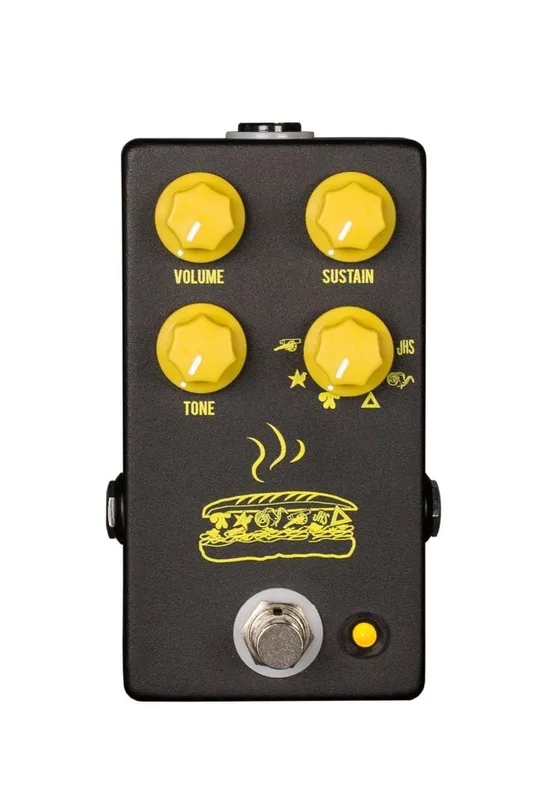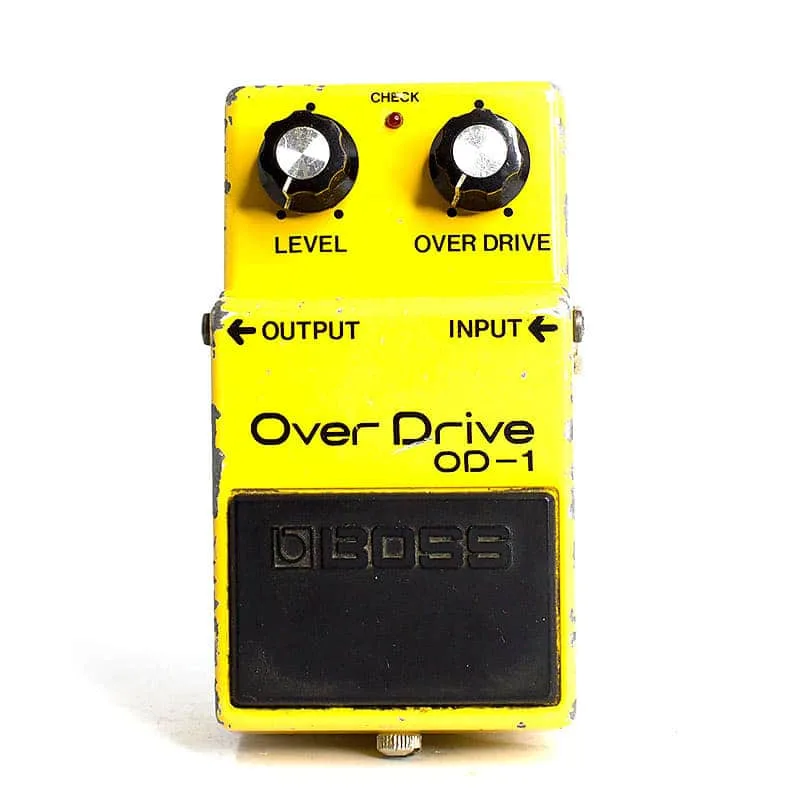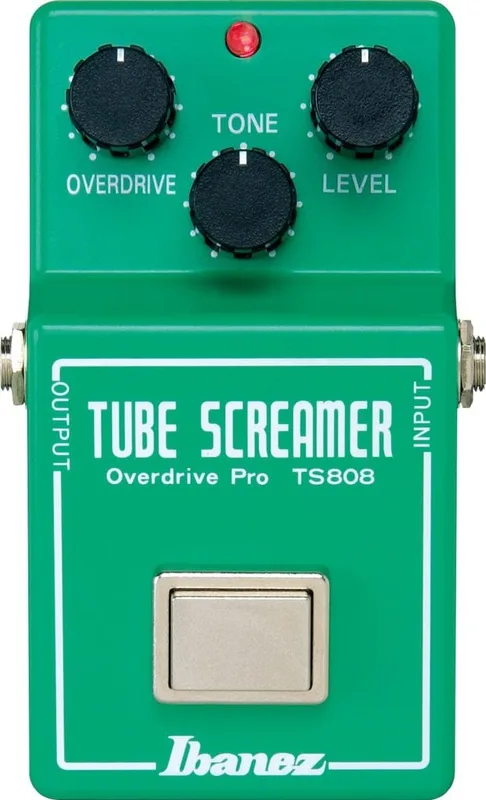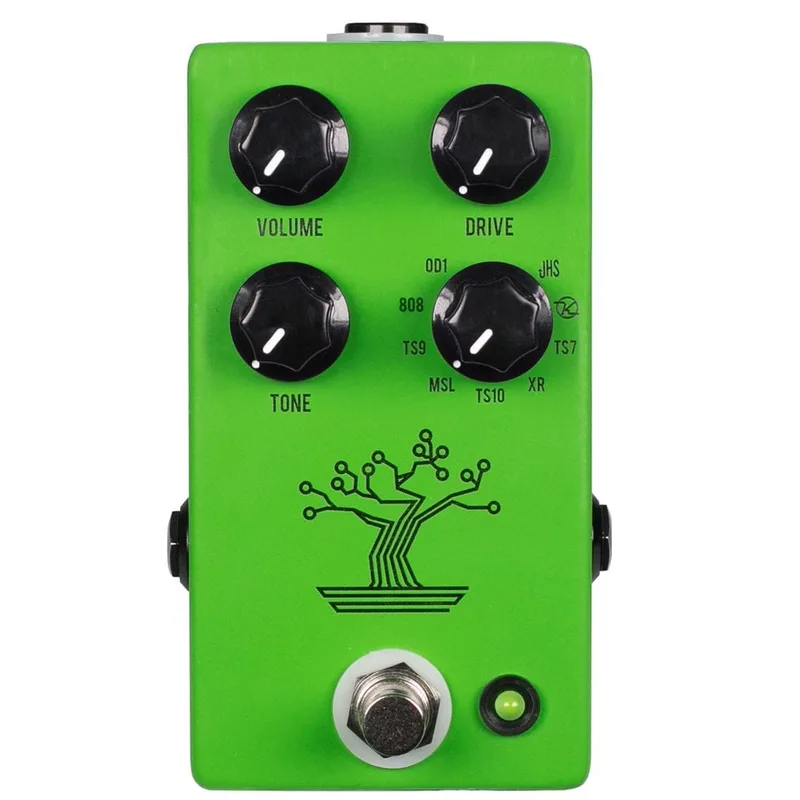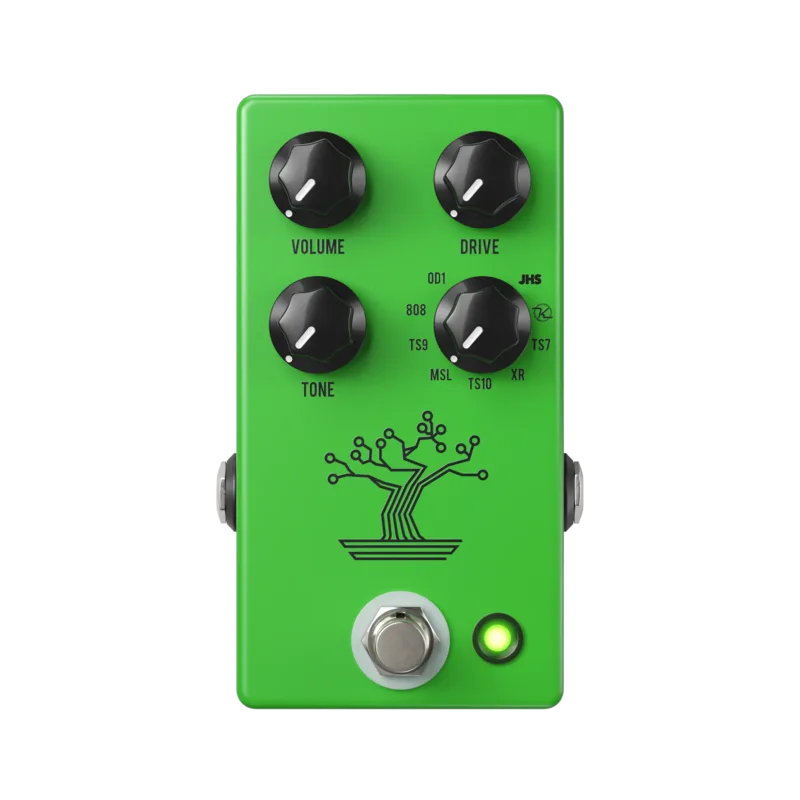


The Bonsai is a compact overdrive pedal from JHS Pedals that packs nine Tube Screamer and Boss OD-1 circuits into one box, selected with a rotary knob. JHS calls it "our tribute to one of the greatest pedals ever created," and the company says it is an exact replication of the nine original units rather than an emulation12. Where a normal Screamer clone gives you one take on the circuit, the Bonsai lets you move between the Boss OD-1, the TS808, the TS9 and six rarer or modified versions without touching your patch cables.
The pedal follows the pattern JHS set with its Muffuletta distortion, released in 2015, which also used a rotary knob to move between circuit variations1. MusicRadar summed up the appeal at the pedal's announcement: "The last thing the pedal world needs is another Tube Screamer, but we won't say no to nine-in-one"2. JHS founder Josh Scott and the JHS team spent three years developing the extra circuitry needed to make the nine modes work in a single enclosure3.
Nine Tube Screamer and OD-1 voices in one pedal
The Bonsai's nine positions cover more than four decades of Screamer history, from the 1977 Boss OD-1 through to a 2008 JHS mod. Pedal of the Day lists the modes with their years72:
| Mode | Based on | Year |
|---|---|---|
| OD1 | Boss OD-1 | 1977 |
| TS808 | Ibanez TS808 | 1979 |
| TS9 | Ibanez TS9 | 1982 |
| MSL | Metal Screamer | 1985 |
| TS10 | Ibanez TS10 | 1986 |
| XR | Exar OD-1 | 1989 |
| TS7 | Ibanez TS-7 (+ mode) | 1999 |
| Keeley | Keeley Mod Plus | 2002 |
| JHS | JHS Strong Mod | 2008 |
The guitar.com review describes the pedal as "eight Tube Screamer variations and an OD-1... with a nine-position switch to select the overdrive type"3. The JHS position recreates the sound of the original JHS Strong Mod from 2009, according to JHS's own write-up of its Screamer lineage8. The OD-1 mode is based on the Boss circuit with asymmetrical clipping, which distinguishes it from the symmetrical clipping of the Tube Screamer designs9.
The controls and the 9-way switch
Day to day, the Bonsai works like any Screamer: three knobs and a switch. The controls are3:
- Volume: sets the output level
- Drive: sets the gain, altering the gain section of the circuit
- Tone: alters the treble and bass section
- 9-way rotary switch: selects the mode
Pedal of the Day notes that Tone and Drive "allow you to dial in the perfect sound, altering the Treble/Bass and Gain sections, respectively"7. Because every mode shares the same three knobs, a setting that works in one mode will usually need a small tweak when you rotate to another, which is the trade-off for having nine circuits in one enclosure.
Power: 9V, external supply only
The Bonsai requires standard 9V DC negative power and consumes 20 mA1. There is no battery compartment; the guitar.com review lists its power as "9V external PSU only" and notes there is no room for a battery inside the compact enclosure3.
The Bonsai cannot run on a battery. Plan on a 9V DC center negative spot on your power supply, which is the same requirement as most modern pedals.
The circuits behind the nine modes
Inside, the Bonsai is not nine complete pedals stacked up. On the Sweetwater demo video, Josh Scott described the topology as shared components routed by analog switches, comparing it to a railway that changes tracks depending on the mode10. That approach is what let JHS fit the nine variations into a compact format enclosure11. JHS has also said its multimode pedals, including the Bonsai, were directly inspired by early DSP pedals like the DigiTech DF-7, which offered several classic circuits in one unit12.
Delicious Audio confirmed the pedal is analog, answering the question directly: "Is it analog? we hear you ask. Yes, it is!"13. The guitar.com review likewise describes the Bonsai as all-analog3.
What reviewers said
Reception was largely positive, with one notable caveat about how different the modes really are37.
- guitar.com (Huw Price, 2018): found the Bonsai "isn't nine distinct overdrives in a single box. It's more like three overdrives plus six variations on a theme," while otherwise praising the compact true bypass design3
- Pedal of the Day (2019): called it "one place that definitely lives up to all the hype"7
- Toneisland (Adam Connell, 2026): wrote that "I especially like the Keeley Mod Plus and JHS Strong Mod. They sound excellent," and found the build quality exceptional9
- That Pedal Show (2018): compared the TS808, TS9 and TS10 against the Bonsai, calling it "what seems to be the best Tube Screamer clone yet"147
- Delicious Audio (2018): included the Bonsai in its Best Stompboxes of 2018 according to Dennis Kayzer15
On the Sweetwater demo, Mitch Gallagher and Josh Scott walked through the modes and the railway-style switching, showing how the shared circuitry changes character as the rotary knob moves between positions10.
The Bonsai has gone on to become one of JHS's strongest sellers: the company says it has consistently outsold every other pedal in the JHS lineup8. Players who want a single Screamer circuit rather than nine can also look at JHS's own 3 Series Screamer, which covers the classic TS ground in a simpler format8.
Videos
Andertons Music Co
Pete Thorn
JHS Pedals
Questions
Does the JHS Bonsai take a battery?
No. The Bonsai runs on a 9V DC external power supply only, and there is no room for a battery compartment inside the compact enclosure. You will need a standard 9V DC center negative supply on your pedalboard to power it.
Is the JHS Bonsai true bypass?
Yes. Both the guitar.com review and Guitar World's Tube Screamer clone buying guide list the Bonsai as true bypass. The guitar.com reviewer noted it comes with the slight popping sound that accompanies switch-on on true bypass pedals.
Is the JHS Bonsai analog?
Yes. JHS describes the pedal as an exact replication, not emulation, of the nine original units, and reviewers including guitar.com and Delicious Audio describe it as all-analog. The mode switching is done with analog switches routing shared components, not digital modeling.
Where is the JHS Bonsai made?
The guitar.com review lists the Bonsai as made in the USA. It is built by JHS Pedals, the Kansas City company founded by Josh Scott, and the pedal was developed by Scott and the JHS team over three years.
Sources (15)
- BONSAI - JHS Pedals, JHS Pedals
- NAMM 2018: JHS Pedals' Bonsai is 9 classic Tube Screamers in one, MusicRadar, 2018-02-01
- Review: JHS Pedals The Bonsai, guitar.com, 2018-05-29
- DOD Badder Monkey review: a bananas reissue, Guitar.com, 2026-03-02
- It's Tube Screamer season, guitar.com, 2022-08-22
- Guitar Pedal X, Guitar Pedal X, 2025-01-21
- JHS Pedals Bonsai 9-Way Screamer Overdrive, Pedal of the Day, 2019-12-03
- WHAT IS THE JHS 3 SERIES SCREAMER?, JHS Pedals, 2022
- 11 Best Tube Screamer Style Pedals (2026 Comparison), toneisland.com, 2026
- JHS Bonsai Multi-overdrive Pedal Demo, Sweetwater (YouTube channel), 2018-01-23
- JHS Pedals, The Bonsai, JHS Pedals (YouTube), 2018-01-24
- DIGITECH'S BEST KEPT SECRET!, JHS Pedals
- 7 Of The Best Tube Screamer Clones, Variants And Reissues In 2024, Delicious Audio, 2024-04-17
- Tube Screamers: TS808, TS9 & TS10, JHS Bonsai, Walrus, RYRA & Hudson, That Pedal Show, 2018-08-03
- Best Stompboxes Of 2018 According To Dennis Kayzer, Delicious Audio (delicious-audio.com), 2018-12-31