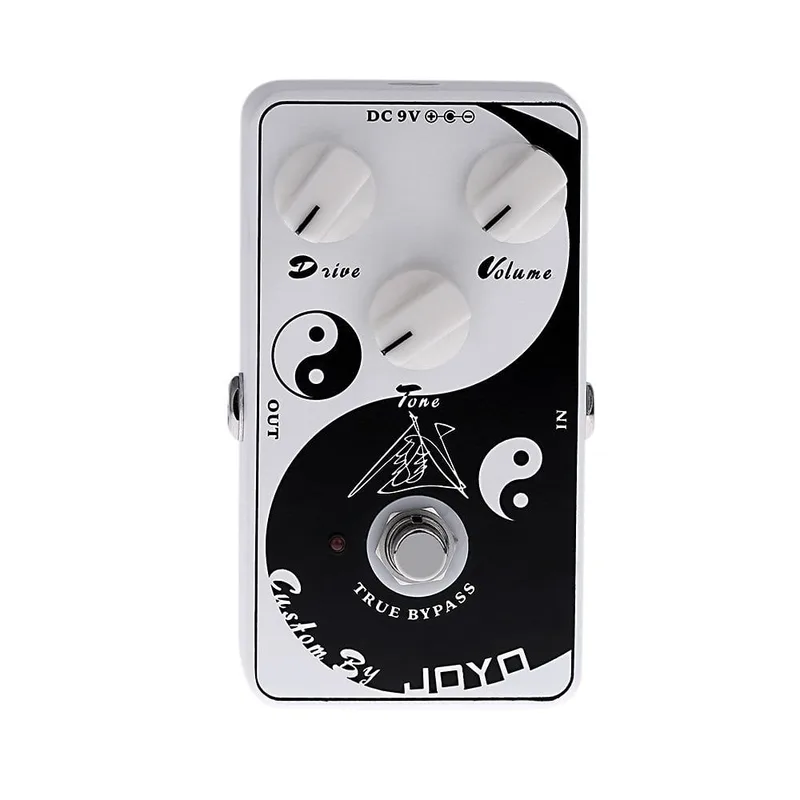


The Joyo TaiChi, released as the R-02 TaiChi, is a low-gain overdrive pedal from Joyo, announced at NAMM 20191. It is the newest addition to Joyo's R series, and the company says it captures the tones of the legendary Dumble Overdrive Special, the rare and elusive amps built by Alexander Dumble21. MusicRadar reported at launch that it "promises to capture the tones of the legendary Dumble Overdrive Special in a pedal"3.
A low-gain Dumble-style overdrive
Delicious Audio describes the TaiChi as "a low gain D-style overdrive with 4 simple controls"2. In practice that means it sits at the gentler end of the drive spectrum: it is built for amp-like breakup and touch response rather than saturated distortion. The Dumble Overdrive Special it is modeled on is the amp played by the likes of Larry Carlton, Carlos Santana and Robben Ford, amps cloaked in mystery and prized for their singing, low-gain overdrive5.
The TaiChi joined a crowded field of D-style pedals, and Delicious Audio added it to its roundup of the best Dumble-style pedals2. What set it apart at launch was the price: Gearnews ran its NAMM 2019 story under the headline "Joyo R-02 TaiChi with Dumble tones for, er, $53!"1.
"But at this price, I would take a punt on this if I was after that sound."
The pedal is housed in a solid metal enclosure that Delicious Audio says can handle "even the toughest touring schedule"2. Like all R series pedals, it carries Joyo's ambient lighting feature, which makes it easy to see on a darkened stage1.
The controls: Volume, Gain, Tone and Voice
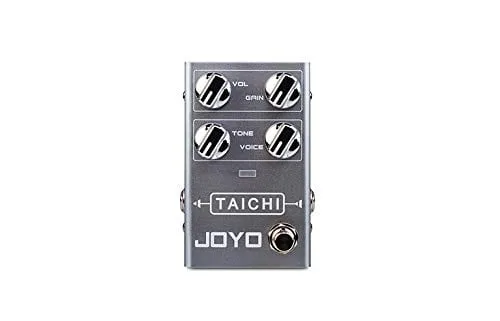
The TaiChi has four knobs. Three of them are the standard controls you would expect from a drive pedal1:
| Control | What it does |
|---|---|
| Volume | Sets the output level2 |
| Gain | Sets the amount of gain2 |
| Tone | Sets the tone2 |
| Voice | Works with Gain and Tone to set the total gain and bass frequency response of the circuit2 |
The fourth control is what makes the pedal more than a standard three-knob overdrive. As Delicious Audio puts it, "Volume, Gain, and Tone are simple enough, but the Voice knob is where the design really gets interesting"2. It works in conjunction with the Gain and Tone knobs to set the total amount of gain and bass frequency response of the circuit2. Gearnews describes the same control as one "used to tweak the gain limit and bass response"1.
For a player, that means the Voice knob is where the D-style character is dialed in. Rather than a simple treble roll-off, it shapes how hard the circuit is pushed and how much low end survives, which matters for the clean-ish, fat low-gain sound this type of pedal is built around.
Power and placement
Guitar World's NAMM 2019 report notes the TaiChi has a rear DC input, so the power jack sits on the back panel rather than the side4. No voltage, polarity or current draw figures have been published for it in the press coverage.
The Zendrive connection
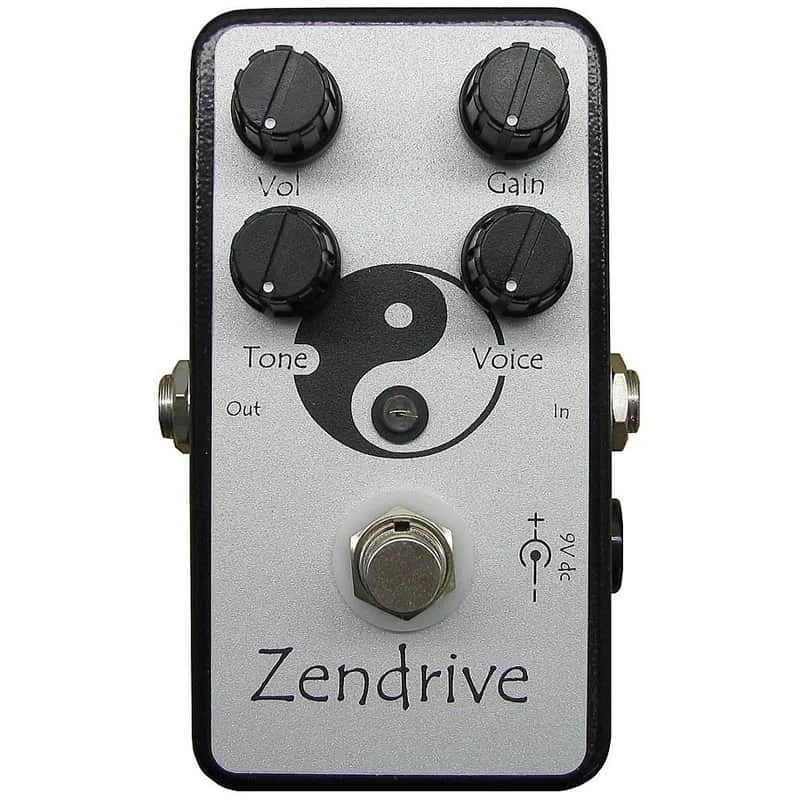
MusicRadar's 2020 buying guide of cheap alternatives to boutique classics lists the TaiChi as an "Alternative to: Hermida Audio Zendrive," with Dumble-style amp overdrive as its strength5. The Zendrive was originally designed to emulate the tones of a Dumble Overdrive Special, the same target the TaiChi aims at5. The guide does not describe the TaiChi as a circuit clone, but the two pedals chase the same sound, and the comparison is the clearest shorthand for what the TaiChi does.
Price and availability
The TaiChi launched at NAMM 2019 with an RRP of $53 in the US1. MusicRadar's July 2020 buying guide still listed it at $535. MusicRadar reported at launch that the Taichi was available now3.
Videos
JOYO AUDIO
Joyo Brasil
Pedal Platform
Questions
Is the Joyo TaiChi a Zendrive clone?
MusicRadar lists the TaiChi as an alternative to the Hermida Audio Zendrive, a pedal originally designed to emulate the tones of a Dumble Overdrive Special. The Zendrive was built for the same D-style sound the TaiChi chases, so the two occupy the same niche, though the press does not describe the TaiChi as a circuit copy.
What does the Voice knob do on the Joyo TaiChi?
The Voice knob works together with the Gain and Tone knobs to set the total amount of gain and the bass frequency response of the circuit. Gearnews describes it as a control used to tweak the gain limit and bass response, which is what makes it more than a standard three-knob overdrive.
How much does the Joyo TaiChi cost?
At launch in January 2019 the TaiChi carried an RRP of $53 in the US and GBP 49.95 in the UK. MusicRadar's 2020 buying guide still listed it at $53, alongside a UK price of £50.
Where is the power input on the Joyo TaiChi?
Guitar World's NAMM 2019 report notes the TaiChi has a rear DC input, so the power jack sits on the back of the pedal rather than the side. No voltage or current draw figures have been published for it.
What amp is the Joyo R-02 TaiChi modeled on?
Joyo says the pedal captures the tones of the Dumble Overdrive Special, the rare amp built by Alexander Dumble and played by players such as Larry Carlton, Carlos Santana and Robben Ford. It is a low-gain, D-style overdrive rather than a high-gain distortion.
Sources (5)
- NAMM 2019: Joyo R-02 TaiChi with Dumble tones for, er, $53!, gearnews.com, 2019-01-21
- Joyo TaiChi Overdrive, Delicious Audio, 2024-11-20
- NAMM 2019: Joyo's Taichi promises Dumble Overdrive Special tones from a $52 pedal, MusicRadar, 2019-01-21
- NAMM 2019: Joyo Announces Taichi Overdrive, Guitar World, 2019-01-25
- 8 cheap but great guitar overdrive pedal alternatives to boutique classics, MusicRadar, 2020-07-21