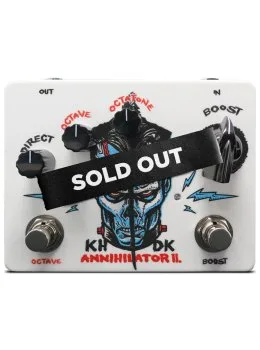
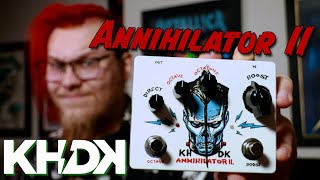

The KHDK Annihilator II is an analog octaver and boost pedal designed with Doyle Wolfgang von Frankenstein, built as a limited edition of 250 pieces, each with a numbered Certificate of Authenticity signed by Doyle1. KHDK describes it as "an octaver and boost in one cutthroat package": it splits your guitar signal into three paths, each with its own volume potentiometer, so you can blend your dry tone, a signal shifted one octave down, and a filtered version of that octave voice1.
It is a glow-in-the-dark pedal, literally: KHDK says each unit is built in the KHDK workshop in Prague, guitar-tested, and sprayed with glow in the dark powder1.
How it works: three signal paths
The core of the Annihilator II is a signal splitter. Your guitar's input is divided into three paths, and a volume potentiometer at the end of each path sets how much of it you hear1:
- DIRECT adjusts the volume of your dry, original, unaffected signal.
- OCTAVE adds a signal shifted one octave down. KHDK describes it as an analog circuit with exceptional tracking, keeping the tone clear and treble-free, and says it works great on low tunings and is excellent with a bass guitar as well.
- OCTATONE is an active sweepable low-pass filter applied to the octave signal only. Clockwise gives an edgier, synth-like sound; anti-clockwise gives a smoother, deeper sub-bass; the center position is described as the ideal mix. It does not affect the direct sound.
On top of the three-way blend sits the boost stage. The BOOST knob boosts the mix of the three signal paths (direct + octave + octatone) and is activated with the Boost switch; KHDK suggests it can be used as a pre-set transparent tone for soloing1. For players exploring this territory more widely, the pedal sits in the broader family of Octave & Pitch Pedals and Boost Pedals.
Controls and jacks
| Control / jack | What it does |
|---|---|
| DIRECT | Volume of the dry, original, unaffected signal1 |
| OCTAVE | Adds a signal shifted one octave down, analog with exceptional tracking1 |
| OCTATONE | Active sweepable low-pass filter on the octave signal only, from deep sub-bass to edgy synth-like tone1 |
| BOOST | Boosts the mix of the three paths, activated with the Boost switch1 |
| INPUT | For your guitar cable1 |
| OUTPUT | For your amp cable or the next effect in your signal chain1 |
Power and battery
The Annihilator II runs on a fresh 9V battery or a clean power supply at 9V DC with a 2.1mm center negative connector1.
If you run the pedal on a battery, KHDK advises always removing the input jack cable when not playing to prevent battery drain1.
A limited run of 250 designed by Doyle
The Annihilator II is a signature collaboration in the same mold as KHDK's other artist pedals. The maker's page names Doyle Wolfgang von Frankenstein as the designer and calls it a "glowing octatone-and-boost multipedal"1. The run is capped at 250 pieces, and each pedal ships with a numbered Certificate of Authenticity signed by Doyle1.
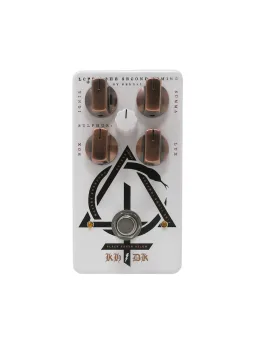
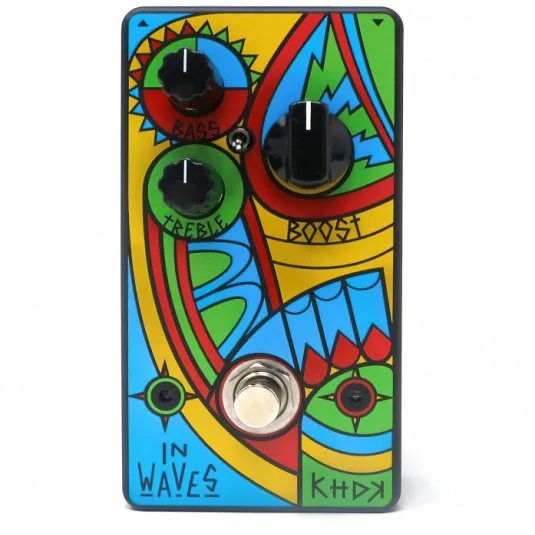
KHDK has built its reputation on this kind of limited artist collaboration: the SGT D with Scott Ian of Anthrax, the LCFR with Behemoth's Nergal, and the In Waves clean boost with Trivium, all released as numbered limited runs1. The Annihilator II follows that pattern, with the added twist of the glow-in-the-dark finish and the octaver circuit, which sets it apart from KHDK's overdrive- and boost-based signatures.
Videos
ToneShack Studio
TVGuitarCenter
Questions
Is the KHDK Annihilator II analog?
Yes. KHDK describes the Annihilator as an analog pedal built with high-end components and true-bypass switching. The octave-down circuit itself is analog as well, with what the maker calls exceptional tracking that keeps the shifted tone clear and free of treble artifacts. It runs on a 9V DC supply or a fresh 9V battery.
Is the Annihilator II true bypass?
Yes. According to KHDK's product page, the Annihilator II uses true-bypass switching, so when the pedal is off your guitar signal passes straight to your amp without going through the circuit. It is an analog pedal with high-end components.
Who designed the KHDK Annihilator II?
The Annihilator II was designed by Doyle Wolfgang von Frankenstein, the guitarist known for his work with the Misfits, together with KHDK Electronics. KHDK describes it as a glowing octatone-and-boost multipedal by Doyle. Each of the 250 pieces comes with a numbered Certificate of Authenticity signed by Doyle.
How many Annihilator II pedals were made?
The Annihilator II is a limited edition of 250 pieces only. Each pedal comes with a numbered Certificate of Authenticity signed by Doyle Wolfgang von Frankenstein.
What does the Octatone knob do?
OCTATONE is an active sweepable low-pass filter applied only to the octave signal. Turned clockwise it gives an edgier, synth-like sound; turned anti-clockwise it gives a smoother, deeper sub-bass. The center position is described as the ideal mix. It does not affect the direct, unaffected signal at all.
Sources (1)
- Annihilator II Guitar Pedal by Doyle von Frankenstein and KHDK, KHDK Electronics