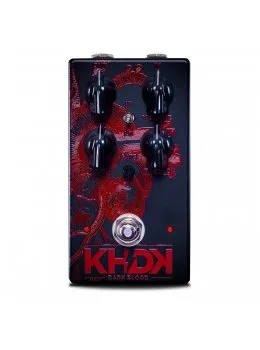
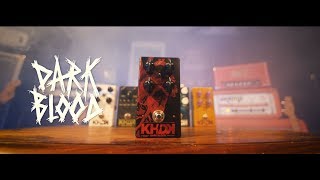

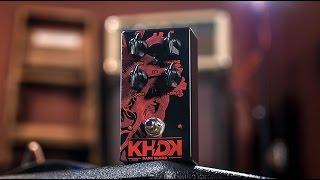
The KHDK Dark Blood is a high-gain analog distortion pedal made by KHDK Electronics and hand-built in Kentucky, USA1. It is Kirk Hammett's signature pedal, and KHDK describes its tone as "tube-like and mid-heavy with added high gain," with what the maker calls "its distinctly amp-like sound"1. At launch it was billed as KHDK's most evil pedal to date2.
What sets the Dark Blood apart from most distortion boxes is what is packed around the main circuit. It is built on KHDK's original circuit combining solid state and MOSFET technology, with a treble booster added to the front end to juice the signal into the distortion stage12. There is also a built-in noise gate, a pre-distortion EQ control called Doom, and a two-position gain switch, which makes it a complete high-gain front end rather than a simple drive box.
What it does to your sound
KHDK positions the Dark Blood as an amp-in-a-box for heavy players. The maker says it "can provide the main tone into your clean amp and is ideal as a fly rig and a backup to an amp or modeling rig"1. In the launch announcement, KHDK described it as "an angry, merciless amp-like distortion, with tube-like, mid-heavy tone boasting extra high gain," designed both for palm-muting riffs and searing high gain solos6.
The treble booster is not a separate effect you switch on and off. It sits on the front end of the circuit and is used to boost the main distortion circuit, pushing the input signal harder in classic metal fashion12. The result, according to the maker, is a mid-heavy, tube-like distortion voice rather than a scooped or fizzy one1.
The controls
The Dark Blood keeps its control set small: Gain, Volume, Doom, Gate, a Treble control and a HI/LO gain switch17. Here is what each one does, as KHDK describes it.
| Control | What it does |
|---|---|
| Gain | Sets the amount of distortion7 |
| Volume | Sets the output volume of the pedal; at higher settings the Dark Blood has a massive output14 |
| Doom | Controls the pre-distortion equalization, determining the amount of low-end grunt; moves from a tight bass to a long sustain, delivering a liquid, solo-ready tone16 |
| Gate | Controls background noise, letting the stronger gain signal pass while weaker humming or hissing is blocked; clockwise for more noise reduction1 |
| Treble | A passive, natural sounding low-pass filter that cuts high end; clockwise it becomes raw, aggressive and cuts through, counterclockwise it cuts highs for a warmer, more mellow tone1 |
| HI/LO switch | Tied directly into the gain. LO offers a massive chunky overdrive great for rhythm playing; HI adds more saturation, sustain, low end and compression, recommended for soloing14 |
| Footswitch | Engages the pedal to on or True Bypass mode1 |
Two details are worth noting for players comparing circuits. The Treble control is passive: it acts as a low-pass filter, cutting out parts of the signal rather than adding more, which is a different approach from an active treble boost2. And the Doom knob works before the distortion stage rather than after it, so it shapes how the distortion circuit reacts to your low end rather than EQing the finished tone12.
Guitar World's reviewer found the gain "tight and thick, with plenty of bass response courtesy of the appropriately named" Doom control8.
Power
The Dark Blood runs on a single 9V battery, accessed by unscrewing the bottom plate of the enclosure, or on an external 9V DC power supply with a center negative plug1. Current draw is 33mA3, which is modest by modern standards and leaves plenty of headroom on a typical isolated power supply.
The battery lives behind the bottom plate, so swapping one mid-gig means unscrewing the enclosure. Players who regularly run the pedal will find the center negative 9V DC supply the practical option.
Where the circuit came from
The Dark Blood's origin story is unusual. Kirk Hammett found an obscure MOSFET-based distortion pedal while on tour in Europe, a pedal he says was made for only about six months, and had it reverse-engineered, keeping the good bits and upgrading the rest25. MusicRadar reported the design work as "a canny design from engineer Antonin Salva"5. The name came quickly: as Hammett told Guitar World, "I plugged it in and the name Dark Blood came to me right away"4.
KHDK announced the pedal in November 20166, with the Premier Guitar announcement marking the one-year anniversary of the company's launch6. Alongside the standard pedal, KHDK offered a limited edition of 100 Anodized Dark Blood pedals, hand-signed by Kirk Hammett, sold through The Guitar Guru Network46.
The enclosure artwork reflects the name. As KHDK explained to Guitar Interactive Magazine: "We used an image of the human heart in deep red lineart on the pedal to reflect this incredible life-giving power"9.
Kirk Hammett and Hardwired... To Self-Destruct
The Dark Blood arrived alongside Metallica's album Hardwired... To Self-Destruct, and Kirk Hammett has stated that he used the pedal on the record2. MusicRadar's 2023 guide to distortion pedals for metal calls it "Kirk Hammett's signature distortion pedal" and "a brutal-sounding thing," listing its controls as gain, volume, doom, gate and the hi/lo switch7.
At launch the European RRP was €272.512; the current US list price is $229.991. Gearnews's reviewer called it "not exactly cheap," but thought that "if you like his guitar tone, then it may actually be a bargain for you," and liked the idea of the pedal as "a flexible way of getting high gain distortion sounds," interesting for gigging rockers who do not want to carry high-gain amp heads2.
A demo video of the Dark Blood, presented by Dennis Kayzer, shows the pedal's high-gain character in context10.
Videos
KHDK
Ola Englund
Chicago Music Exchange
Questions
Does the KHDK Dark Blood take a battery?
Yes. The Dark Blood runs on a single 9V battery, and you reach the battery connection by unscrewing the bottom plate of the enclosure. Alternatively, it accepts an external 9V DC power supply with a center negative plug, which is the more practical option on a pedalboard.
Is the KHDK Dark Blood true bypass?
Yes. KHDK lists the bypass mode as True Bypass, and the footswitch engages the pedal to on or to true bypass mode. With the pedal off, your signal passes through without the circuit coloring it.
What does the Doom knob do on the Dark Blood?
Doom controls the pre-distortion equalization, which determines how much low-end grunt is in your tone before the signal hits the distortion stage. Turned one way it gives a tight bass response; turned the other it moves toward long sustain and a liquid, solo-ready tone. Reviewers credit it with the pedal's thick bass response.
Does the Dark Blood have a noise gate?
Yes. The Gate knob controls the background noise of your tone, letting the stronger gain signal pass while weaker humming or hissing is blocked. Turning it clockwise increases the noise reduction, which is handy on a high-gain pedal like this.
Can the Dark Blood work as a fly rig into a clean amp?
Yes. KHDK says the Dark Blood can provide the main tone into a clean amp and is ideal as a fly rig and as a backup to an amp or modeling rig. Its high gain and aggressive dynamics are designed for palm-muting riffs and high gain solos alike.
Sources (10)
- Dark Blood by KHDK Electronics, KHDK Electronics
- KHDK Electronics' Dark Blood pedal: Damn it, Hammett, it's pure evil!, gearnews.com, 2016-11-23
- Dark Blood by KHDK, RockBoard PedalPedia, 2026
- Kirk Hammett's KHDK Electronics Releases Dark Blood Overdrive, Guitar World, 2016-11-15
- Kirk Hammett's KHDK Electronics unleashes "distinctly amp-like" Dark Blood distortion pedal, MusicRadar, 2016-11-15
- KHDK Electronics Introduces the Dark Blood Overdrive, Premier Guitar, 2016-12-03
- Best distortion pedals for metal: High gain tones, MusicRadar, 2020-12-21
- Solar Chug Lite high-gain distortion pedal review, Guitar World, 2025-05-10
- KHDK Unveil Most Evil Pedal to Date; the Dark Blood Overdrive, Guitar Interactive Magazine, 2016-12-05
- KHDK - Dark Blood Distortion | Delicious Audio, Delicious Audio, 2017-12-30
 Kirk Hammett