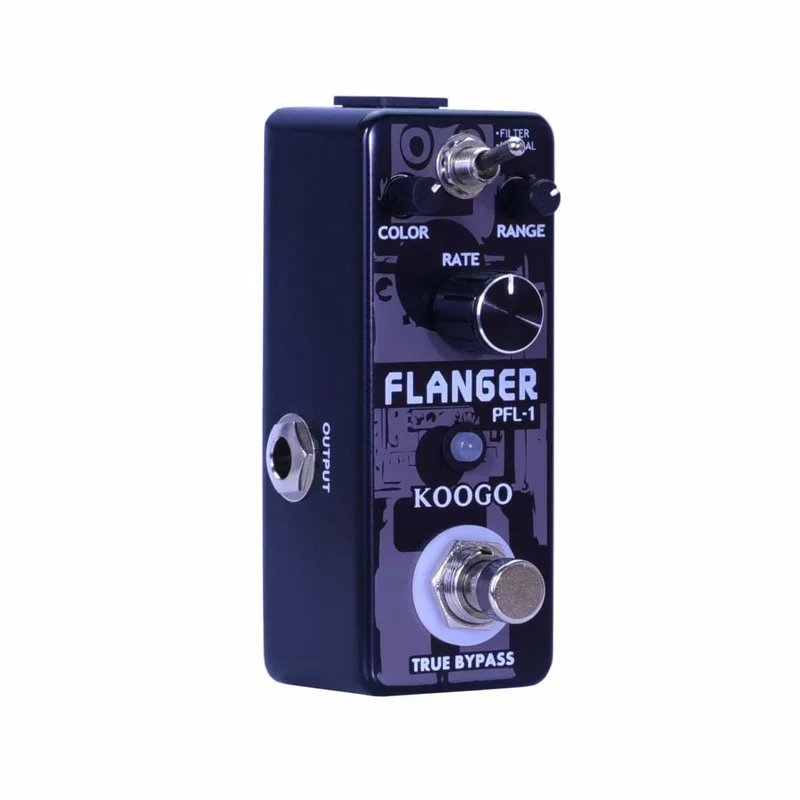
The Koogo Flanger is a flanger pedal from Koogo. Like every flanger, it belongs to the modulation family of effects, the group that also includes chorus, phaser and vibrato pedals. What sets a flanger apart is the sound it produces: the sweeping, whooshing jet-engine effect heard on countless records, from subtle movement under chords to the full "airplane taking off" sweep.
What a flanger does
Flanging is a modulation effect created by mixing two identical audio signals, applying a slight delay to one signal, and slightly and continuously varying that delay over time1. EarthQuaker Devices describes the result plainly: two identical signals are mixed together, with one playing at a slightly slower speed, creating a swooshing effect similar to the sound of a jet engine2. Because the delayed copy keeps sliding in and out of alignment with the original, certain frequencies cancel while others reinforce, and that moving pattern of peaks and notches is what you hear as the sweep.
The character of the sweep depends on how the pedal is set. Drolo's documentation for its own flanger describes the range available across the effect as a whole:
"pretty wide range, from ear-piercing accelerated jet plane sounds to super boing rubber sounds"3
Drolo FX manual3
The same manual notes that on a delay-length control, counterclockwise settings give the shortest delay times and more airplane-like conventional flanger sounds, while increasing the delay brings in very short repeats3. Feedback is the other key ingredient: as Jon Cusack of Cusack Music puts it, a flanger uses a much shorter delay with feedback, giving the jet-engine sweep4.
How a flanger works, step by step
Flangers work on time delay, taking two signals and mixing them, and playing one signal back at a slower speed with an LFO (a low-frequency oscillator) to modulate the timing of the delay, giving a sweeping, whooshing effect5. In order:
- Your guitar signal is split into two identical copies.
- One copy is delayed by a very short, constantly changing amount of time, driven by the LFO.
- The two copies are mixed back together, so their frequencies reinforce and cancel as the delay shifts.
- Feedback routes some of the delayed signal back through, intensifying the sweep into the familiar jet-engine whoosh54.
Where flanging came from
Flangers originated in the studio by manipulating tape machines, producing their jet-like sweep6. The story goes back to early experiments with audio signals on magnetic tape, including two reel-to-reel machines and pressing on the reels; engineers would change the position of the machines to make them run slower or faster7. The effect only later shrank into the pedal format players use today.
One famous example of the effect on record: Rush uses flanging in "The Spirit of Radio", where it helps the opening arpeggio feel like it is building even though it is the same part repeating7.
How a flanger differs from chorus and phaser
The modulation family all work by delaying or shifting a copy of your signal, and how much the signal is delayed or its frequencies altered leads to the different effects: chorus, phase, and echoes7. The practical distinction for a player choosing between them:
| Effect | How it differs from flanger |
|---|---|
| Chorus | A flanger uses shorter delay times than a chorus1 |
| Phaser | A phaser shifts phase rather than using the very short delayed copy and feedback that give flanging its jet sweep4 |
| Echo/delay | Longer delay times produce distinct repeats rather than the flanger's continuous sweep7 |
Companies like Strymon, TC Electronic, Electro-Harmonix, Universal Audio, and many more all make their own versions of modulation pedals with flanging7, so a player comparing a budget unit like the Koogo against established makers has a wide field to choose from.
The description above applies to the flanger effect the pedal is built to produce.
Sources (7)
- What is a Flanger?, Strymon (www.strymon.net), 2018-02-01
- A Beginners Guide To Pedalboards Pt. 1: Choosing Your Pedals, EarthQuaker Devices, 2021-12-06
- Molecular patches reference, drolofx.com
- Tremolo vs Vibrato vs Chorus: The Definitive Explainer, Cusack Music, 2026-09-29
- The Great Modulator: A Guide to EarthQuaker Devices Modulation Pedals, EarthQuaker Devices, 2022-05-16
- KEMPER Phaser and Flanger Effects, Kemper Amps
- Guitar Tricks presents The History of the Flanger, Pedal of the Day, 2023-08-15