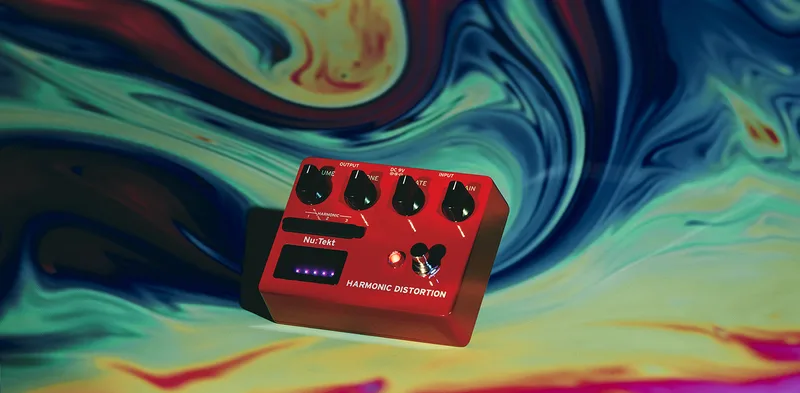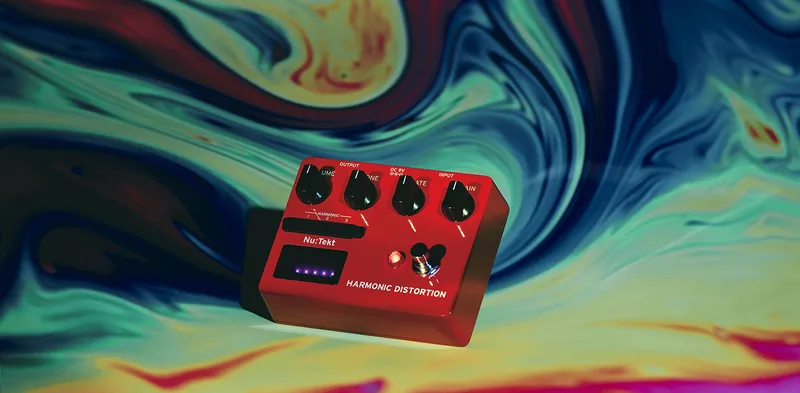


The Korg HD-S is a distortion pedal kit from Korg, part of the company's Nu:Tekt series of self-assembly products. Instead of one clipping stage, it combines three different distortion circuits to create what Korg calls harmonic modulation, and you can use those circuits singly or together to move from traditional fuzz to sounds Korg describes as "out of this world"1.
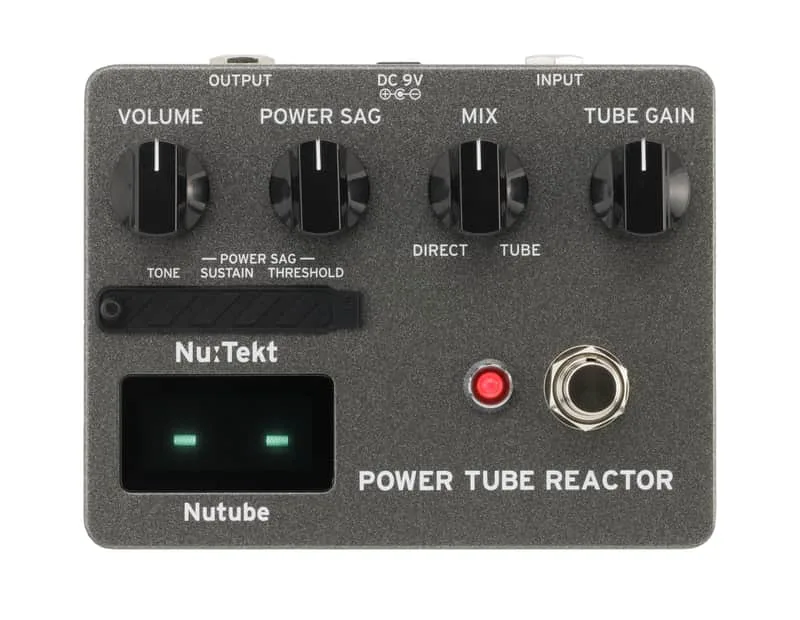
Because the three circuits can be freely combined, Korg positions the HD-S as usable well beyond guitar. The company says it works with bass guitars, synthesizers and other instruments, not just guitar2. It was announced in January 2023 alongside the Nu:Tekt TR-S Power Tube Reactor, another kit pedal3.
Three distortion circuits combined for harmonic modulation
The core idea of the HD-S is that distortion comes from three separate circuits rather than one, and that blending them produces harmonic modulation Korg says goes beyond traditional distortion. The three circuits are dialed in with three Harmonic trimmers, and they can be used singly or combined5.
In Guitar World's review, Trevor Curwen described the range this opens up: the circuits can create "everything from traditional cranked stack-style distortion sounds, through a range of fuzz shadings to highly resonant, raucous distortion at the more extreme end of the scale"5. Gearnews reported that the balance between the circuits can be adjusted from smooth to aggressive via hidden controls under a front panel3.
The HD-S is based around Korg's Nutube, which the company says operates exactly as a triode vacuum valve5. Its three distortion circuits can be used singly or combined, producing everything from traditional cranked stack-style distortion sounds, through a range of fuzz shadings, to highly resonant, raucous distortion at the more extreme end of the scale5.
The controls: four knobs and three trimmers
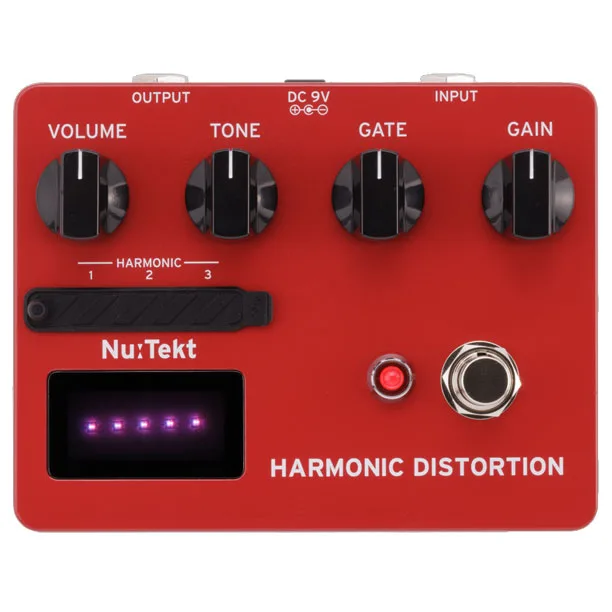
On the top panel the HD-S has four control knobs, plus a bypass footswitch. The published sources disagree on the fourth knob's name: Guitar World's review lists Volume, Tone, Gate and Chain5, while Guitar.com's launch report lists Volume, Tone, Gate and Gain6. The other three names match across both.
| Control | What it does |
|---|---|
| Volume | Sets the output level5 |
| Tone | Shapes the frequency balance5 |
| Gate | Controls the noise gate behavior6 |
| Chain or Gain | Fourth knob; sources disagree on its name and function56 |
| Bypass footswitch | Switches the effect in and out5 |
Inside the top cover of the housing sit three trimmer knobs, labeled Harmonic 1, 2 and 3, one for each distortion circuit15. Korg says using these trimmers to adjust the balance between the three circuits is how you create the pedal's wide range of sounds1. Guitar World described them as screwdriver-adjusted and designed to be set and forget7.
Korg warns that the trimmer knobs must be turned carefully. Forcing them beyond their designed range may damage them, so adjust them gently1.
How the three trimmers behave was a point Josh Scott of JHS Pedals made in 2023: rather than giving three independent voices, they shape one overall character7.
The four main knobs handle the everyday tone shaping. Korg's documentation lists Volume, Tone, Gate and Chain controls on the panel, alongside a Harmonic section with three positions and a bypass footswitch5. Beyond those, three trimmer knobs sit inside the top cover of the housing, and Korg says that by using them to adjust the balance between the three different distortion circuits you can create a wide range of sounds1. The manual warns that they should be turned carefully: forcing them beyond their designed range may damage them1.
Scott still called the HD-S the most cool and unique distortion device he had seen in decades7.
Power and connections
The HD-S runs on a 9V alkaline dry cell battery (6LF22/6LR61) or a DC 9V AC adapter through its DC.9V terminal, and neither is included in the kit4. Current draw is 45mA4, and battery life is approximately 10 hours with alkaline batteries4. Connection is simple: one monaural phone jack input and one monaural phone jack output4.
A Nu:Tekt kit designed by Fumio Mieda
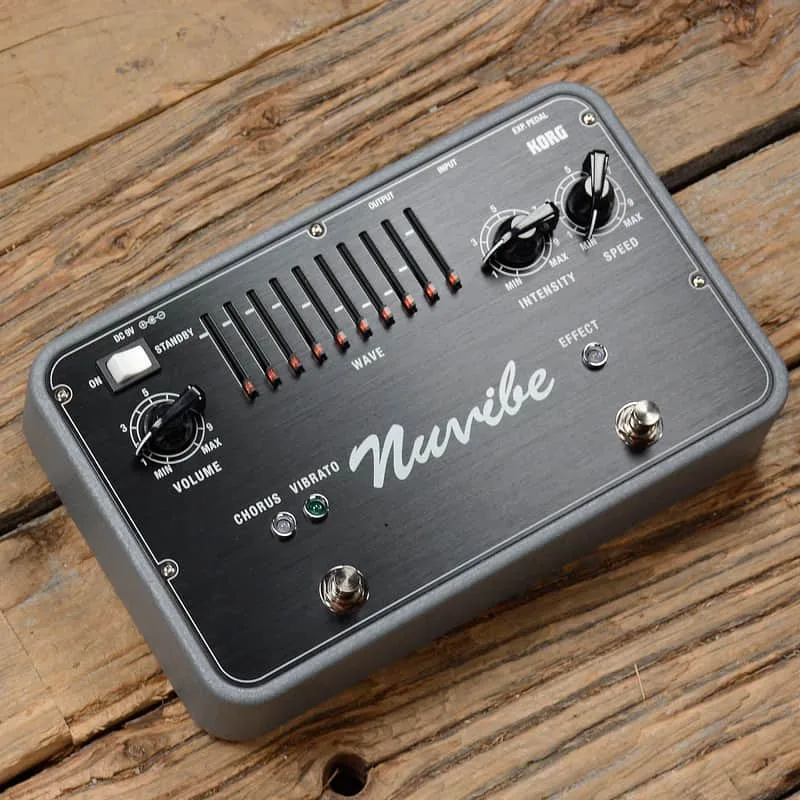
The HD-S was developed by Fumio Mieda, the original designer of many well-known Korg pedals and synths, including the Uni-Vibe1. Guitar World calls him the Japanese pedal designer behind the Shin-ei Uni-Vibe7. Mieda has said the HD-S came about because most distortion effects rehash the sounds of the past, and that Korg developed a new distortion type based on harmonic synthesis covering both classic sounds and new sonic territory2.
As a Nu:Tekt product, the HD-S is a kit you build yourself. Korg presents the build as one of the appealing features of the series, a chance to assemble the product1. No soldering is required, and all the tools needed come in the kit3. The box includes the owner's manual and a combined Tool&Pick4.
The HD-S is an effect pedal kit, measuring 122 x 96 x 55mm (W x D x H) and weighing 340g excluding batteries4. A related kit, the Korg Nu:Tekt HD-S Harmonic Distortion, appears under that fuller name in some coverage.
Videos
KORG
Knobs & Switches
John McNicholas Guitar
Questions
Is the Korg HD-S a kit that needs assembly?
Yes. The HD-S is part of Korg's Nu:Tekt series of self-assembly products, so you build the pedal yourself. No soldering is required, and all the tools needed to assemble it come in the kit, along with the owner's manual.
Does the Korg HD-S come with a battery or power adapter?
No. The HD-S runs on a 9V alkaline battery (6LF22/6LR61) or a DC 9V AC adapter, and both are sold separately. The pedal draws 45mA, and a set of alkaline batteries lasts approximately 10 hours.
How long does a battery last in the Korg HD-S?
Korg's specifications put battery life at approximately 10 hours with alkaline batteries. The pedal draws 45mA, and the 9V alkaline battery is sold separately, as is the DC 9V AC adapter.
Can you use the Korg HD-S with bass or synth?
Yes. Korg says the HD-S can be used not only with guitars but also with bass guitars, synthesizers and other instruments, because its three combined distortion circuits produce a wide range of sounds beyond traditional guitar fuzz and distortion.
Who designed the Korg HD-S?
Fumio Mieda developed the HD-S. He is the original designer of many well-known Korg pedals and synths, including the Uni-Vibe, and Korg describes him as the Japanese pedal designer behind the Shin-ei Uni-Vibe.
What tools come with the Korg HD-S?
The kit includes an owner's manual and a combined Tool&Pick, and Korg says all the tools required to build the pedal come in the kit. No soldering is needed, so no soldering iron is required.
Sources (7)
- HD-S - EFFECT PEDAL KIT | KORG (USA), Korg (www.korg.com)
- HD-S - EFFECT PEDAL KIT | KORG (USA), Korg (www.korg.com)
- Korg Nu:Tekt HD-S and Nu:Tekt TR-S: DIY pedals?, gearnews.com, 2023-01-26
- Specifications, KORG (www.korg.com)
- Korg Nu:Tekt TR-S Power Tube Reactor and HD-S Harmonic Distortion review, Guitar World, 2023-07-20
- Korg launches two new build-it-yourself pedals, the TR-S and HD-S, Guitar.com, 2023-01-27
- Josh Scott says this distortion pedal is the most unique design he's seen "in decades", Guitar World, 2023-05-16