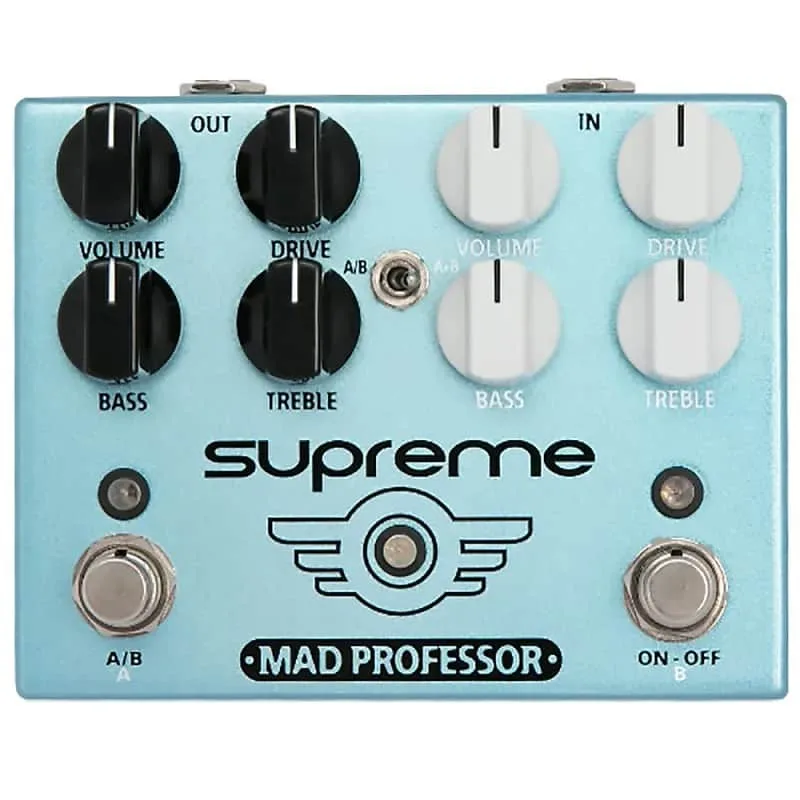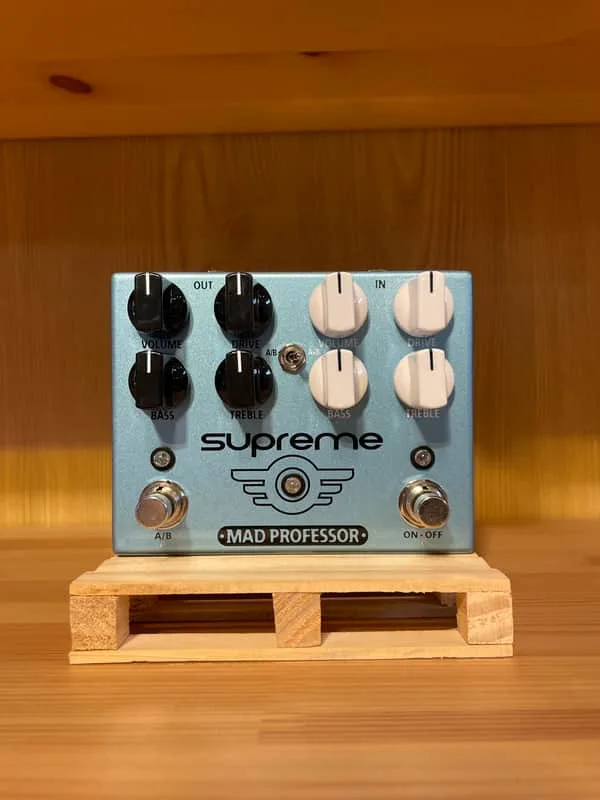


The Mad Professor Supreme Dual Overdrive is a dual overdrive pedal: two independent overdrive circuits in a single enclosure, engineered in collaboration with the famous blues guitarist Matt Schofield1. Instead of placing two pedals on a board, a player gets both in one box, switching from one side to the other with just a single press on the switch1.
Two channels, two voices
Each channel has its own controls featuring Volume, Gain, Bass and Treble, so both sides can be dialed in independently1. The two circuits are not twins:
| Channel A | Channel B | |
|---|---|---|
| Circuit lineage | mostly based on the company's low gain [Royal Blue-style] low gain circuit | completely original circuit |
| Character | boost to low gain drive | "power amp" response with a lot of headroom |
| Typical use | mostly on a neck pickup | mostly on a bridge pickup |
Channel A is mostly based on the company's low gain Royal Blue Overdrive, while Channel B features a completely original circuit that delivers a "power amp" response with a lot of headroom1. As voiced at the factory, the tones were set for a great all around boost to low gain drive on the A side, used mostly on a neck pickup, and for the B side a fat dynamic tone containing some "power amp" response with a lot of headroom, used mostly on a bridge pickup1. In practice that gives a player one lower gain side for rhythm and fuller chords and one higher headroom side for lead work, each matched to a different pickup position.
Parallel and stacked modes
A toggle switch in the middle of the pedal routes the two channels in parallel (A/B) or on top of each other (A+B)1. In parallel mode, the pedal behaves like two separate overdrives that can be swapped with one press. In stacked mode, the output of one drive feeds the other, and the result is a different kind of gain structure altogether. As Paolo De Gregorio of Delicious Audio put it:
"Stacking the drives will lead you into another huge variety of more compressed and driven tones"
That makes the stacking mode the pedal's third voice: a compressed, more driven sound that neither channel produces on its own, reached without changing any knob settings1.
Where it came from
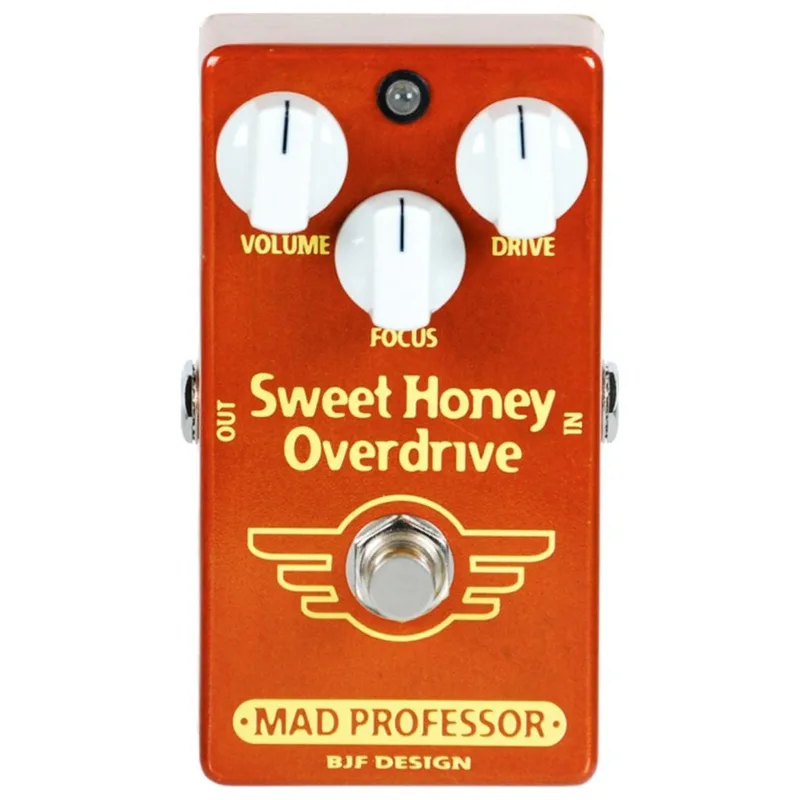
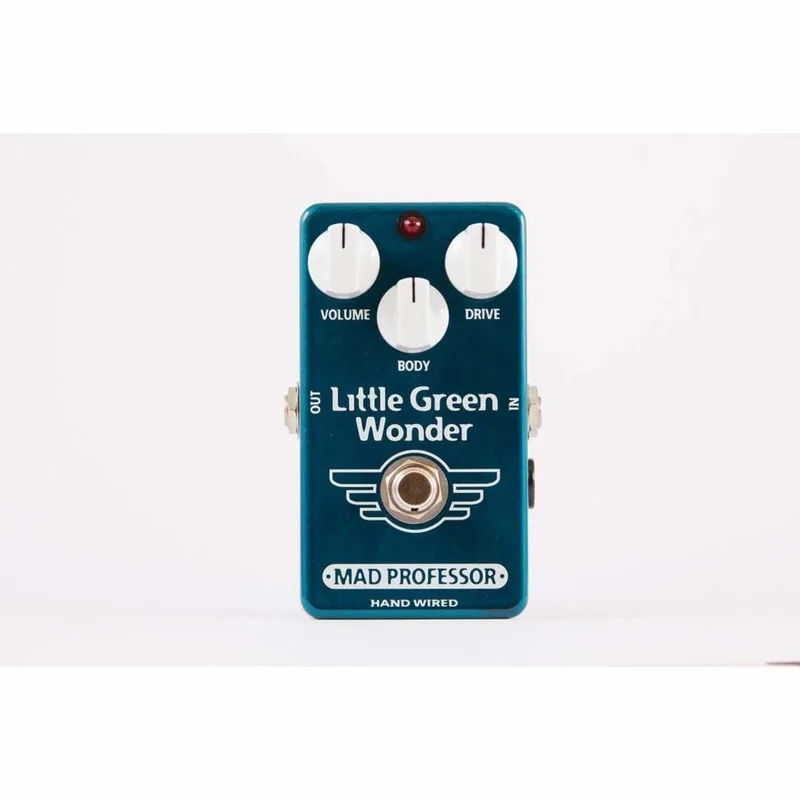
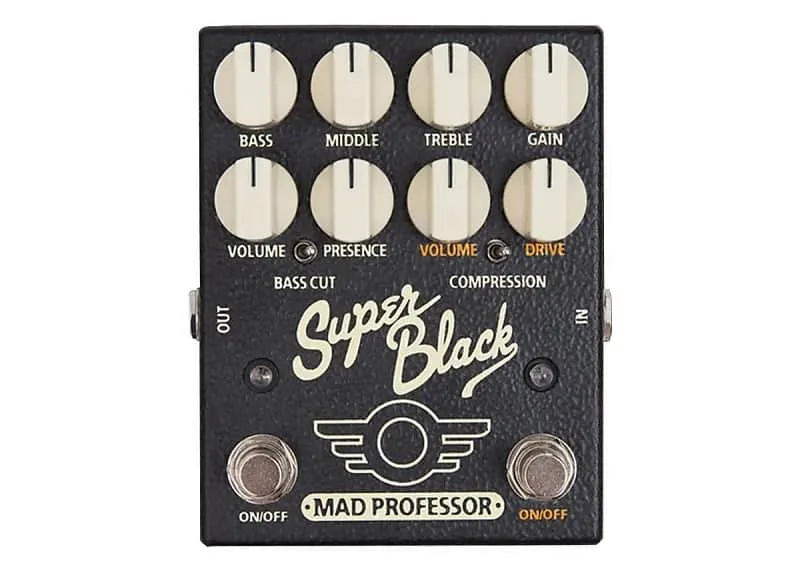
The pedal was announced in June 2020, when Mad Professor came out with a new dual overdrive called Supreme1. The design work was shared with Matt Schofield, and the factory settings reflect a player's approach: the A side for neck pickup work, the B side for the bridge1. It sits in a wider Mad Professor overdrive range that includes the Sweet Honey Overdrive, the Little Green Wonder and the Super Black, and it is covered in more detail on the Mad Professor Supreme page alongside other overdrive pedals1.
Videos
That Pedal Show
Mad Professor Amplification
Mad Professor Amplification
Questions
What is the difference between Channel A and Channel B on the Mad Professor Supreme Dual Overdrive?
Channel A is mostly based on Mad Professor's low gain Royal Blue Overdrive, and in the factory settings it was voiced as an all around boost to low gain drive, used mostly on a neck pickup. Channel B is a completely original circuit that delivers a power amp style response with a lot of headroom, voiced as a fat dynamic tone used mostly on a bridge pickup. Each channel has its own Volume, Gain, Bass and Treble controls.
What does stacking mode do on the Supreme Dual Overdrive?
A toggle switch in the middle of the pedal routes the two channels either in parallel, marked A/B, or on top of each other, marked A+B. In the stacked mode, one channel feeds into the other, and Delicious Audio's Paolo De Gregorio wrote that stacking the drives leads into another huge variety of more compressed and driven tones.
Who is Matt Schofield and what was his part in the Supreme Dual Overdrive?
Matt Schofield is a blues guitarist who worked with Mad Professor on the pedal's design. Delicious Audio described the Supreme Dual Overdrive as engineered in collaboration with the famous blues guitarist Matt Schofield, and the factory settings reflect his playing, with the A side set for neck pickup use and the B side for bridge pickup use.
Is the Supreme Dual Overdrive based on the Royal Blue Overdrive?
Only in part. Channel A is mostly based on the company's low gain Royal Blue Overdrive, while Channel B is a completely original circuit with a power amp style response and a lot of headroom. So the pedal pairs one familiar Mad Professor circuit with one new design in a single two-in-one enclosure.
Can you switch between the two channels with one footswitch press?
Yes. Delicious Audio described the pedal as two pedals in one, switching from one side to the other with just a single press on the switch, so a player can move between Channel A and Channel B without a second tap or a separate controller.
Sources (1)
- Mad Professor Supreme Dual Overdrive, Delicious Audio, 2020-06-03