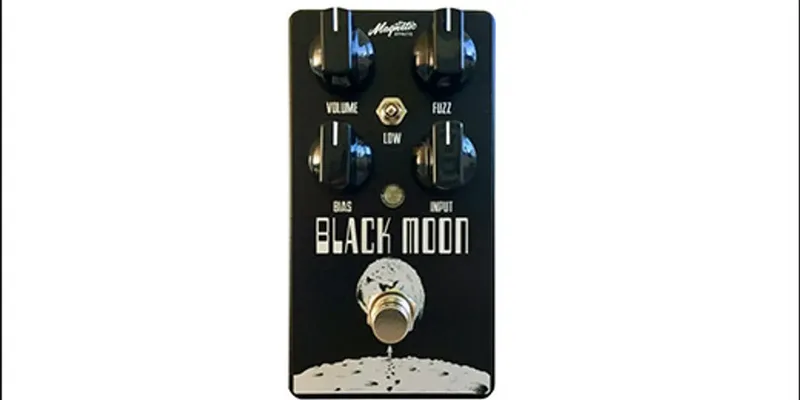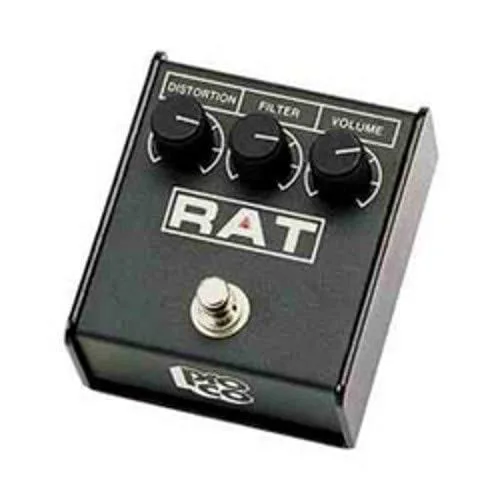

The Magnetic Effects Lonely Robot is a limited-edition, RAT-inspired overdrive/distortion pedal released by the London builder on 21 November 2018, alongside the Fuzz Face-inspired Black Moon1. Where the Pro Co RAT covers a wide gain range on its own, the Lonely Robot takes that circuit and adds controls for shaping it: Magnetic Effects describes it as "running the gamut from overdrive though to distortion and fuzz, the Lonely Robot is a versatile drive pedal that builds upon a legend"1.
Premier Guitar's reviewer later called it "a multi-faceted, one might say hydra-headed, evolution of Pro Co's standard-bearing RAT," with a National Semiconductor LM308N op-amp at the heart of the circuit2. An internal voltage doubler increases the headroom available1.
The Lonely Robot was a limited edition from the start, and a 2024 buying guide lists the later Lonely Robot Distortion OpAmp Fuzz version as discontinued3. Expect to find this pedal on the used market rather than new.
A RAT-based drive from overdrive to fuzz
The RAT circuit has always spanned gain ranges. On Guitar.com's RAT video, Josh Gardner summed up the original: "Overdrive, distortion, fuzz, it does it all!"5. The Lonely Robot keeps that range and adds shaping controls around it. Magnetic Effects' announcement lists the controls as Gain, EQ (Ruetz Mod), Clip (Clipping Threshold), Volume, Bass and Treble on the later Distortion OpAmp Fuzz version, which also carries "that extra low end input courtesy of the Ruetz Mod"3.
The Ruetz mod is a well-known RAT modification that trims gain in the bass frequencies, giving the pedal a tighter, less flubby low end. Magnetic Effects built a tweaked version of it into the Lonely Robot's EQ control rather than leaving it as a solder-in mod1.
The EQ and clip controls
Two controls do most of the shaping that separates the Lonely Robot from a stock RAT21.
| Control | What it does |
|---|---|
| EQ | Alters the amount of gain applied at specific frequencies. Right is brighter and tighter with more gain; left is fuller with less gain. A tweaked version of the Ruetz mod EQ control1 |
| Clip | Sets the clipping threshold. Toward the extremes it dulls picking attack and saturates the signal; at its lowest settings it gives an airier, more open signal2 |
| Gain | Sets the drive level, from overdrive through distortion to fuzz1 |
| Volume | Sets the output level3 |
Magnetic Effects says the EQ control "is designed to control the amount of gain applied at specific frequencies"2. The Premier Guitar reviewer heard it working differently from a plain tone control: at one end it excited upper-mid content like a presence control, at the other it emphasized warm, round bass overtones2.
The clip control earned specific praise in high-gain settings. The reviewer found "it can be very useful for taming treble spikes in high-gain settings"2, which is where a stock RAT can get harsh.
Buffers and placement
Unlike many fuzz pedals, which can lose character when a buffer feeds them, the Lonely Robot was designed for a modern pedalboard. Magnetic Effects states it "has a high input impedance and low output impedance. This makes it compatible with buffered effects" in the signal chain1. gearnews.com confirmed the true bypass switching and the impedance design4. For a player running it alongside other distortion or overdrive pedals, that means it can sit anywhere on the board without a special placement rule.
What the reviewer said
Premier Guitar's 2023 review was positive on the pedal's core strengths, listing "impressive smooth-to-savage and low-to-high-gain versatility" and "thoughtfully executed design and build" among the pros, along with a "fair price" at a $165 street2. On tone, the reviewer found the Lonely Robot's "tones are often richer and more complex than a typical RAT's," and noted they "can be sculpted for specific instruments in precise ways"2.
The trade-off was ease of use:
"It's not as easy to use or as intuitive as an original RAT"2
Premier Guitar reviewer, on the Lonely Robot2
The reviewer's verdict was that the fine-tuning capabilities make it "a potentially valuable studio tool with airiness and articulation a vintage RAT cannot easily match"2.
A later view came from GuitarPedalX's 2024 RAT-style roundup, which covered the Distortion OpAmp Fuzz version and found it "pretty decent sounding, but not as potent as some of the more recent examples" in the category3.
Where it came from
Magnetic Effects built the Lonely Robot as a limited-edition, RAT-inspired overdrive/distortion pedal1. Reviewers found it stands apart from the circuit it draws on: as one review put it, "The Lonely Robot's tones are often richer and more complex than a typical RAT's"2. The pedal's high input impedance and low output impedance also make it compatible with buffered effects elsewhere in the signal chain1.
Videos
Jackson Brooksby
Questions
Is the Magnetic Effects Lonely Robot true bypass?
Yes. Magnetic Effects states the Lonely Robot uses true bypass switching, and gearnews.com confirms it. The pedal also has a high input impedance and a low output impedance, so it plays well with buffered effects elsewhere in the chain.
What circuit is the Lonely Robot based on?
It is based on Pro Co's RAT circuit. Premier Guitar's reviewer described it as an evolution of the RAT, with Magnetic Effects' own announcement calling it a limited-edition, RAT-inspired overdrive/distortion pedal that runs from overdrive through distortion to fuzz.
What op-amp does the Lonely Robot use?
A National Semiconductor LM308N op-amp sits at the heart of the circuit, the same part associated with vintage RAT distortion pedals. An internal voltage doubler raises the available headroom around it.
How much does the Lonely Robot cost in the US?
Premier Guitar's 2023 review listed a street price of $165. At launch in 2018 the pedal retailed at £125 in the UK, and a later buying guide listed the follow-up Distortion OpAmp Fuzz version at $179 before it was discontinued.
Does the Lonely Robot work well with buffered pedals in front of it?
Yes. Magnetic Effects designed it with a high input impedance and a low output impedance specifically so it stays compatible with buffered effects in the signal chain, unlike some fuzz designs that prefer to see a guitar's pickups directly.
Is the Lonely Robot still in production?
The original Lonely Robot was a limited edition at its 2018 release. A later version, the Lonely Robot Distortion OpAmp Fuzz, was listed as discontinued in an August 2024 buying guide, so finding one new is unlikely.
Sources (5)
- Magnetic Effects Unveils Lonely Robot & Black Moon, Premier Guitar, 2018-11-21
- Magnetic Effects Lonely Robot Review, Premier Guitar, 2019-04-19
- Guitar Pedal X, GuitarPedalX, 2024-08-30
- Lonely Robot and Black Moon: Magnetic Effects revisits the Fuzz Face and RAT circuits, gearnews.com, 2018-11-24
- 60 Seconds S1E30: Pro Co RAT, Guitar.com, 2024-06-21