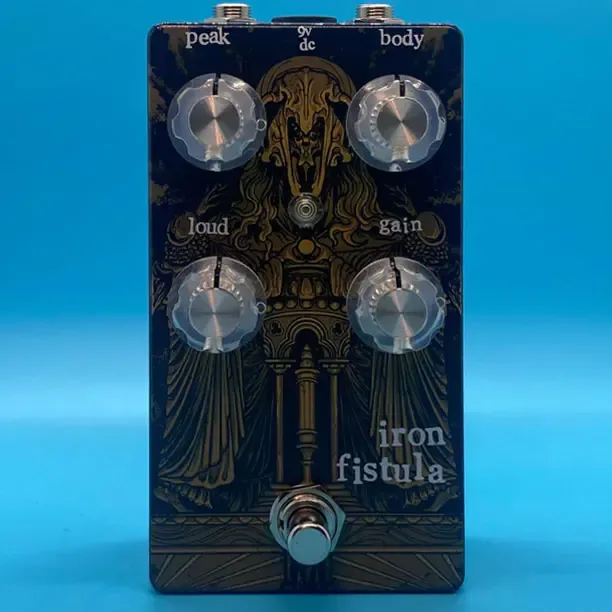


The Malaise Forever Iron Fistula JFET Preamp Drive is a flexible JFET transistor-based overdrive/preamp pedal, released on 22 August 2022 as the brand's third pedal12. It joins the numerous club of Plexi-style overdrives: pedals built to imitate the saturation of a cranked Marshall-style amp head. Instead of digital modeling, it uses JFET transistors to emulate tube amp saturation, an approach Malaise Forever describes as a love letter to the plexi-drives of yore1.
How the circuit works
JFETs are able to emulate tube amp saturation with surprising accuracy, making them perfect for amp-in-a-box style circuits, as Pedal of the Day put it2. The Iron Fistula has two gain stages, with a low-pass filter (the Peak control) placed between them1.
The EQ section is where the pedal differs from most simple drives. An active bass control, labeled Body, is placed in the circuit just before the Gain control, which makes the two controls highly interactive12. Because the low end arrives before the clipping stage, the presence of the low end increases as gain is increased, and the point at which Body is set significantly affects how hard the circuit clips2. Malaise Forever calibrates the Body control so it significantly boosts low-end frequencies without muddying the overall sound2.
The controls
| Control | What it does |
|---|---|
| Loud | Controls output volume1 |
| Gain | Sets the level of breakup1 |
| Body | Active bass control placed just prior to Gain; boosts low end and stimulates extra clipping with fuzzier results12 |
| Peak | Low-pass filter between the two gain stages; neutral when maxed out, progressively cuts high and high-mid frequencies when turned anti-clockwise1 |
Pedal of the Day describes Peak slightly differently, as a passive variable frequency filter that subtly sets the Peak of the treble frequencies2. Both accounts agree it shapes the top end rather than acting as a conventional treble boost.
What it does for a player
Malaise Forever positions the Iron Fistula as a flexible dirt pedal with two particular uses: it makes for a perfect overdrive channel complement to a clean solid-state amp, and it serves as a particularly effective bass overdrive/preamp1. Players running a clean platform amp can use it as a second channel; bass players get a drive voiced to keep low end intact, which the Body control reinforces1.
It also works at the quiet end of its range. Pedal of the Day found that with more than enough volume on tap, the Iron Fistula also has a low noise floor, making it an effective full-frequency clean (or dirty) boost to slam the front end of a tube amp2. For more on that use, see Boost Pedals, and for the bass application see Bass Pedals.
At the other end of the range, with both Body and Gain maxed the circuit can be driven into much fuzzier territory than JFET overdrives typically reside in2. That puts its ceiling closer to what players expect from Distortion Pedals and Fuzz Pedals than a typical transparent drive, though it remains an overdrive at heart. For context on the wider category, see Overdrive Pedals and Preamp Pedals.
What reviewers said
Pedal of the Day reviewed the pedal at its release in August 2022. The reviewer reported that from the first moments of playing it at high settings, it was clear the pedal was a special one, and gave this verdict2:
"a swiss army knife of incredible tones and dialed-in dirt for days"
Videos
collector//emitter
ambienttrash
Pedal of the Day
Questions
Is the Iron Fistula an analog pedal?
Yes. The Iron Fistula is a JFET transistor-based overdrive/preamp pedal, meaning it uses junction field-effect transistors rather than digital processing. JFETs are able to emulate tube amp saturation with surprising accuracy, which is why they are often used in amp-in-a-box style circuits, and the Iron Fistula follows that approach.
How many knobs does the Iron Fistula have?
Four: Loud, Gain, Body and Peak. Loud controls the output volume, Gain sets the level of breakup, Body is an active bass control placed just before the Gain stage, and Peak is a low-pass filter between the two gain stages. Pedal of the Day noted that four controls is all it takes to create some powerfully overdriven sounds.
What does the Body control do on the Iron Fistula?
Body is an active bass control placed just prior to the Gain control in the circuit, so the two are highly interactive. It significantly boosts low-end frequencies without muddying the overall sound, and because it sits before the Gain stage, its setting affects how hard the circuit clips.
Can the Iron Fistula be used as a clean boost?
Yes. Pedal of the Day found that with more than enough volume on tap and a low noise floor, the Iron Fistula works as an effective full-frequency clean or dirty boost to slam the front end of a tube amp.
Does the Iron Fistula go into fuzz territory?
It can. With both the Body and Gain controls maxed, the circuit can be driven into much fuzzier territory than JFET overdrives typically reside in, according to Pedal of the Day. At more moderate settings it stays in conventional overdrive territory.
Sources (2)
- New Pedal: Malaise Forever Iron Fistula Drive, Delicious Audio, 2022-08-22
- Malaise Forever Iron Fistula JFET Preamp Drive, Pedal of the Day, 2022-08-22