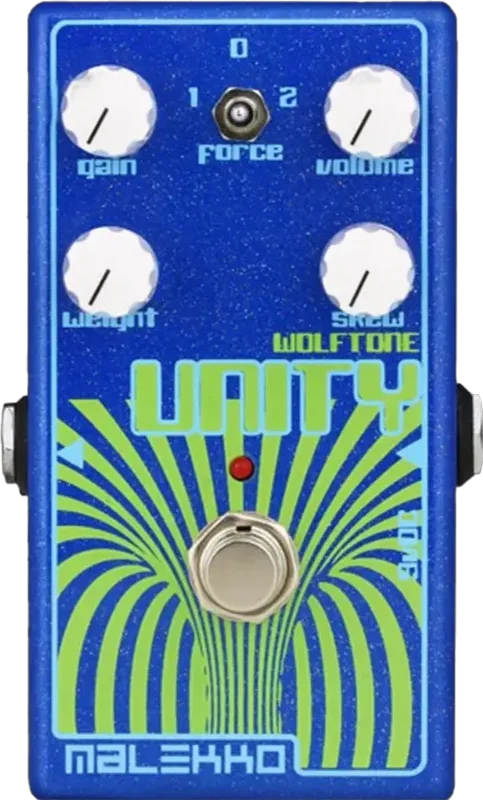

The Malekko Unity MkII is an analog fuzz pedal with a compression section built into the same box. At its core it is a multi-tap, two-transistor fuzz, and RockBoard's PedalPedia describes the Unity MkII as "a multi-tap 2 transistor fuzz pedal fused with a compression section allowing maximum fuzztone flexibility"1. It sits in the fuzz family rather than being a straight compressor: the compression is there to shape and support the fuzz, not to work as a standalone squeeze.
What it does to a fuzz
The compression section is what separates the Unity MkII from a plain two-transistor fuzz. Engaged with the Force switch, it tightens and evens out the fuzz signal, and the maker frames the combination as "an extremely flexible and reactive fuzz pedal: from sweet to discordant!"1. As for the character of the fuzz itself, the maker's description covers a wide range: "From over-the-top fuzz mayhem to super buttery fuzz smoothness, the UNITY, like all WOLFTONE pedals, is extremely musical and very responsive to a player's dynamics"1. That last point matters in practice: the maker positions the pedal as one that follows how hard or soft you play, in the way fuzz players usually expect a two-transistor circuit to.
The controls: Weight, Gain, Skew and the Force switch
The Unity MkII has three knobs and a switch, and the maker describes the three controls as working in a particular way1:
| Control | What it does |
|---|---|
| Weight | Creates a certain kind of gain and distortion, tapping into the circuit at a different place with its own response to the player and effect on timbre and overall signal1 |
| Gain | Creates a certain kind of gain and distortion, tapping into the circuit at a different place with its own response to the player and effect on timbre and overall signal1 |
| Skew | Creates a certain kind of gain and distortion, tapping into the circuit at a different place with its own response to the player and effect on timbre and overall signal1 |
| Force switch | Engages the compression section1 |
The idea behind the three knobs is that each one reaches into the two-transistor circuit at a different point, so each changes the gain and distortion in its own way and responds differently to your playing. Rather than one gain control and one tone control, the Unity MkII gives you three separate ways into the same circuit, which is where the maker's "maximum fuzztone flexibility" comes from1.
Power
The Unity MkII runs on a 9V DC, center negative supply and draws 60mA1. That is a modest draw by modern standards, but it is above what a battery-style low-draw fuzz typically needs, so it is worth checking what your supply has spare on the output you plan to use.
The Unity MkII is listed as a WOLFTONE pedal by the maker1. If you are comparing it with other fuzzes, it is a fuzz with compression built in, not a compressor with a fuzz option, so it belongs on a board where the fuzz is the point.
Where it sits on a board
As a fuzz, the Unity MkII belongs alongside the fuzz family rather than with overdrive or distortion pedals, though the maker's "sweet to discordant" range suggests it can cover ground those pedals occupy1. What sets its gain apart is how the three controls, WEIGHT, GAIN, and SKEW, work: RockBoard's PedalPedia describes each as creating "a certain kind of gain and distortion" that taps into the circuit at a different place, with its own response to the player and effect on timbre and overall signal1.
Videos
Malekko HeavyIndustry
Questions
What does the Force switch do on the Malekko Unity MkII?
The Force switch engages the Unity MkII's compression section. According to the maker, adding the compression's Force switch makes the pedal an extremely flexible and reactive fuzz, with a range the maker describes as running from sweet to discordant. It works alongside the Weight, Gain and Skew controls, which each tap into the circuit at a different place to shape gain, distortion and timbre.
What power supply does the Malekko Unity MkII need?
The Unity MkII runs on a 9V DC, center negative power supply and draws 60mA. A standard pedal supply of that type covers it, but the 60mA draw is worth keeping in mind when sharing a daisy-chain output with other pedals.
Is the Malekko Unity MkII analog?
Yes. The Unity MkII is an analog circuit, built around two transistors with multiple taps, fused with a compression section.
How much current does the Malekko Unity MkII draw?
The Unity MkII draws 60mA at 9V DC, center negative.
Is the Malekko Unity MkII a fuzz or a compressor?
It is both, in one box. At its core the Unity MkII is a multi-tap two-transistor fuzz pedal, and it has a compression section built in, engaged with the Force switch. The maker describes the combination as allowing maximum fuzztone flexibility.
Sources (1)
- Unity MkII by Malekko, RockBoard (rockboard.de), 2026