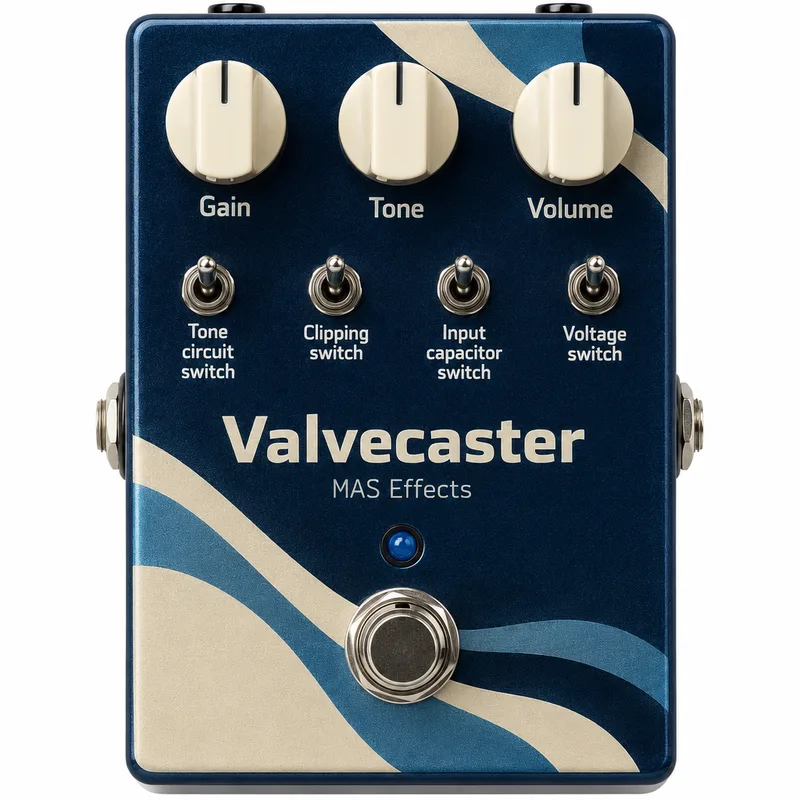


The MAS Effects Valvecaster is a tube preamp and overdrive pedal: a guitar pedal built around a real vacuum tube rather than transistors or chips. MAS Effects describes it as adding "warm, touch sensitive drive" to a chain, with two gain stages that range from clean boost to crunchy overdrive, and says it shines in front of an amp at the edge of breakup1. It is hand-crafted, point to point wired, and built as a one-of-a-kind unit rather than a production run12.
Where the circuit comes from
The Valvecaster design has a history beyond MAS Effects. MI Audio, in the context of its DIY kits, calls the Matsumin Valvecaster "THE DIY valve overdrive circuit that has been made many times over with great success"4. As a circuit type, other builders describe it the same way: Saturnworks says a Valvecaster, powered by a 12AU7 vacuum tube, "produces a huge volume boost, but adds only a bit of tube overdrive"5. The MAS Effects version takes that idea and adds switching and build refinements around it.
The controls and switches
Beyond the standard gain, tone, and volume controls, the Valvecaster adds three switches that shape the core sound1:
| Control | What it does |
|---|---|
| Gain, tone, volume | Standard drive controls1 |
| Tone circuit switch | Switches the tone circuit off entirely1 |
| Clipping switch | Selects between no clipping, silicon (Si) diodes, and LEDs; the diodes are socketed for even more flexibility1 |
| Input capacitor switch | Switchable between 10nF and 47nF input capacitor1 |
| Voltage switch | Switches between regulated 9V and bypassing the regulator to run 9 to 18V13 |
The socketed diodes are worth dwelling on, because they are unusual. A clipping switch on an overdrive normally changes the sound between fixed options; here, because the diodes sit in sockets, a player can swap in different diodes altogether. Combined with the input capacitor switch, which changes how much low end reaches the gain stages, the pedal offers a good deal of tonal range from a three-knob faceplate1.
Power: 9V regulated or up to 18V
The Valvecaster requires a center negative power supply, which is not included1. A voltage switch gives two ways to run it3:
- Regulated 9V: MAS Effects suggests this to reduce hum with some power supplies.
- Bypassed regulator, 9 to 18V: the on-board regulator is bypassed and the pedal runs at higher voltage.
MAS Effects notes that running over 9V is likely to shorten the life of the tube. The 18V setting is a deliberate trade-off, not a free upgrade.
The maker says the pedal sounds best at 9 to 18V with a 12AU7, and specifically not a 12AX7 or 12AT71. That said, the wider Valvecaster circuit family is flexible on tubes: MI Audio notes that any 12A_7 tube can be used, each having a unique gain and tonal character4. For this pedal, the maker's recommendation is the 12AU7.
Price and availability
The Valvecaster is listed by MAS Effects at £184.00 GBP, with tax included12. As of 26 October 2026 the pedal shows as sold out1. Because each unit is hand-crafted and one of a kind, stock is not a matter of restocking a production line; the maker instead invites players to email mark@mas-effects.com to have one made to order, with a choice of colors, graphics, knobs, and other details1.
For readers comparing tube-driven and conventional gain pedals, the Valvecaster sits in the territory covered by overdrive pedals and preamp pedals: it can push an amp from the front like a boost or overdrive, while carrying an actual tube stage on the board15.
Videos
iccaros
Ljubiša Mandić
Ljubiša Mandić
Questions
Can you use a 12AX7 in the MAS Effects Valvecaster?
MAS Effects says the Valvecaster sounds best with a 12AU7, and specifically notes it is not a pedal for a 12AX7 or 12AT7. More broadly, the Valvecaster circuit family accepts any 12A_7 type tube, and each type brings its own gain and tonal character, so swapping tubes is part of how players shape the sound. For this particular pedal, though, the maker's guidance is to stay with a 12AU7.
Does running the Valvecaster at 18V shorten tube life?
Yes. The Valvecaster has a voltage switch that lets you run the on-board regulated 9V supply, or bypass the regulator and run 9 to 18V. MAS Effects notes that running over 9V is likely to shorten the life of the tube, so the higher voltage setting is a trade-off the player makes knowingly.
Are the clipping diodes in the Valvecaster socketed?
Yes. The clipping switch selects between no clipping, silicon diodes, and LEDs, and the diodes are socketed so they can be swapped for even more flexibility. That makes the clipping character of the pedal something you can change rather than something fixed at the factory.
Can you order a custom MAS Effects Valvecaster?
Yes. MAS Effects invites players to email mark@mas-effects.com to have a Valvecaster made for them with their choice of colors, graphics, knobs and other details. Each pedal is already built as a one-of-a-kind, hand-crafted, point to point wired unit, so a custom order extends that approach to the cosmetics and hardware.
Sources (5)
- Valvecaster: Tube Preamp / Overdrive, MAS Effects
- Valvecaster: Tube Preamp / Overdrive, MAS Effects
- Valvecaster Product Embed Data, MAS Effects
- MI DIY Kits, MI Audio
- Dark Matter Tube Boost + Overdrive Pedal, Saturnworks Pedals, 2026-08-08