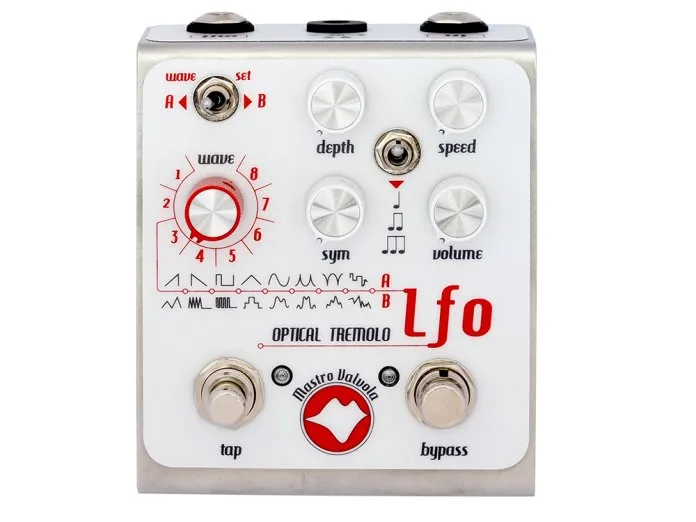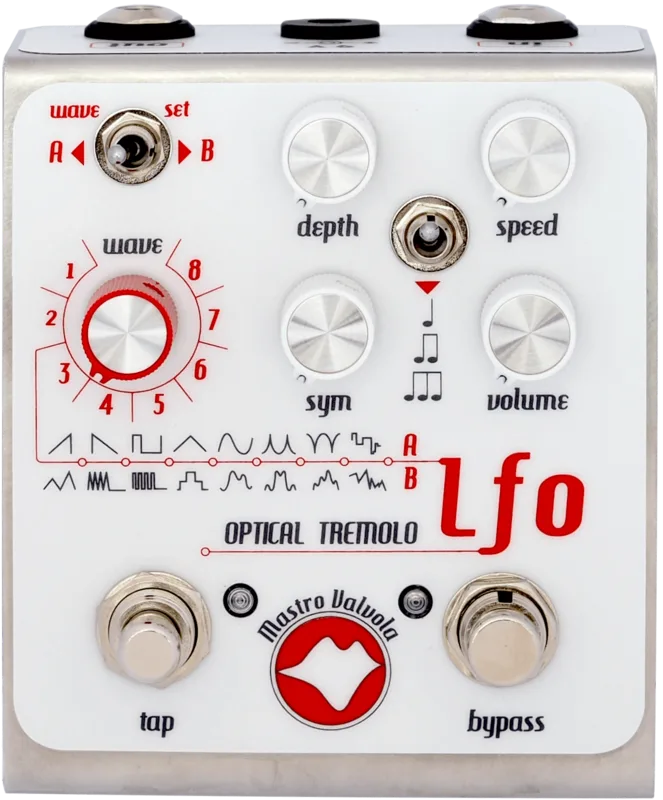


The Mastro Valvola LFO is an optical tremolo pedal from Italian maker Mastro Valvola, unveiled in 20181. Its sound comes from an opto-isolator sitting at the heart of an analog audio circuit, the same variable resistance approach used in many classic amplifier circuits of the 1960s, but a digital brain manages that opto-isolator and adds modern features2. Premier Guitar's reviewer put it this way:
"Although an analog optical tremolo circuit is its ticking heart, a digital brain controls this device."3
Mastro Valvola describes the result as evoking the classic vintage sounds of the past, the warm, enveloping modulation of 1960s valve amplifiers, alongside new waveforms and hypnotic effects2. Premier Guitar found the fundamental tones "classic optical tremolo, organic, warm, and satisfying at subtle and extreme settings"3.
How it works: an analog heart with a digital brain
The LFO's audio path is built around an opto-isolator, a component whose resistance changes with light and which shapes the signal the same way the tremolo circuits of 1960s tube amps did2. Guitar.com described the design as "inspired by the tremolos on '60s-era tube amps," with the opto-isolator at the heart of it all5.
What separates the LFO from a vintage amp tremolo is the control layer. The opto-isolator is managed by a digital brain, which is what makes 16 waveforms, symmetry shaping and tap tempo possible2. Premier Guitar's reviewer found this hybrid approach to be the pedal's real strength:
"But it's the digital component of the LFO recipe that makes it extraordinary and opens up possibilities beyond classic tremolo tones."3
The controls: waveforms, symmetry and tap tempo
The LFO's control set centers on three things: waveform selection, a Symmetry control, and tap tempo23.
| Control | What it does |
|---|---|
| Waveform | Selects among 16 different waveforms2 |
| Symmetry | Alters the shape of the LFO waveforms2 |
| Speed | Sets LFO speed by knob or tap tempo5 |
| Tap tempo | Sets speed by tapping, with 3 selectable divisions2 |
The 16 waveforms run from traditional tremolo shapes to unusual ones. Guitar.com named "Quad Pulse," "Tri Step" and, "for the chaos-inclined," "Random Slopes" among them5. Premier Guitar's reviewer noted that many of the waveforms "can be pushed well beyond typical tremolo territory into bit crushed" sounds3.
The Symmetry control is the deepest of the bunch. Premier Guitar described it as a knob "that lets you tailor the interaction between tremolo waveforms and your signal in very specific and often radical ways"3. Tap tempo, which the reviewer called invaluable, lets you set the speed in time with the music and choose among three divisions23.
Who it works for
Mastro Valvola lists the LFO as intended for guitar, bass, electric pianos and more2, so it is not limited to guitarists. The top-mounted jacks are a practical touch for anyone building a tight pedalboard; Premier Guitar noted they "will be appreciated by space-conscious" players3.
The LFO has been sold directly through the Mastro Valvola online store at a retail price of € 2154.
Where it came from
Mastro Valvola unveiled the LFO in 20181. The Italian manufacturer, which Premier Guitar described as having "a flair for massaging the best of vintage tech into modern tools"3, announced the pedal in April of that year as an optical tremolo handcrafted in Italy4. The design brief was straightforward: take the opto-isolator tremolo circuit that guitarists know from 1960s valve amplifiers and put a modern control layer around it25.
Videos
Eirik Stordrange
R.J. Ronquillo
60 Cycle Hum
Questions
How many waveforms does the Mastro Valvola LFO have?
The LFO offers 16 different waveforms, ranging from traditional tremolo shapes to unusual ones like Quad Pulse, Tri Step and Random Slopes. Premier Guitar's reviewer noted that many of them can be pushed well beyond typical tremolo territory into bit-crushed and more experimental sounds.
What power supply does the Mastro Valvola LFO need?
The maker specifies a 9V power supply drawing 100 mA. That current draw is on the higher side for a compact pedal, so a dedicated 9V supply is the safe choice rather than a small daisy chain.
Does the Mastro Valvola LFO work on bass?
Yes. Mastro Valvola lists the LFO as intended for guitar, bass, electric pianos and more, so bass players are explicitly among its intended users.
Where is the Mastro Valvola LFO made?
The LFO is handcrafted in Italy by Mastro Valvola, an Italian manufacturer that builds vintage-inspired circuits into modern tools. It can be purchased directly from the Mastro Valvola online store.
Is the Mastro Valvola LFO analog or digital?
Both. The audio signal path is an analog optical tremolo circuit built around an opto-isolator, the same variable resistance approach used in classic 1960s amplifiers, but a digital brain manages the opto-isolator and controls the waveforms and tap tempo.
Sources (5)
- Mastro Valvola LFO Optical Tremolo, Delicious Audio, 2019-01-17
- Mastro Valvola pedals, Mastro Valvola, 2021-08-18
- Mastro Valvola LFO Optical Tremolo Review, Premier Guitar, 2018-09-18
- Mastro Valvola introduces LFO optical tremolo., MusicPlayers.com, 2018-04-17
- Go tremolo wild with Mastro Valvola's new pedal, Guitar.com, 2018-04-18